

Yorgos Lanthimos has an eye for the absurd in the everyday. The Greek auteur behind recent spectacles Poor Things (2023) and Kinds of Kindness (2024) takes commonplace aspects of modern life — the nuclear family, dating rituals, workplace relationships — and pushes them to a logical extreme, uncovering the considerable strangeness lurking beneath our norms. By exaggerating social dynamics, often to the point of grotesqueness, Lanthimos defamiliarizes the customs we take for granted while simultaneously provoking us to consider the ways his twisted version of human behavior mirrors our own.
That said, his films offer no grand political statements, which may frustrate viewers looking for a tidy moral takeaway. Instead of answers, Lanthimos leaves us with uneasy questions about what’s right and wrong, real and possible. His chief concern is bizarro world-building, pairing a true-to-life quality with elements of the supernatural and characters who speak and act as if they were from another planet, or at least a parallel universe where emotion is flattened like a limp, gray pancake. By dissolving the boundaries between realism, absurdism, mythology, and science fiction, he draws attention to the blurred lines in our own post-truth world.

Teddy and Don inspect a honeycomb from their apiary. Source: IMDB
His latest effort, Bugonia, itself a reference to the myth that bees spawn from animal carcasses, is paradoxically his most otherworldly and least foreign-feeling. While the premise is quite literally about whether extraterrestrials exist, the characters themselves feel all too human. This is at least partly explained by Lanthimos’ late entry into the project and lack of involvement in the initial screenplay (although he says it was love at first read). The film is a remake of Jang Joon-hwan’s maximalist Korean sci-fi Save the Green Planet! (2003), adapted by the more straight-ahead satirist Will Tracy (The Menu, Succession) at the behest of filmmakers Ari Aster and Lars Knudsen, both of whom signed on as producers in 2020. It was only after Jang pulled out for health reasons that Lanthimos was brought on to direct in 2024 with his blessing.
Lanthimos saw in the project an opportunity to explore the destabilization of truth in the 21st century. As evidenced by wild speculation surrounding the 2020 election, COVID-19, and Jeffrey Epstein, many are rejecting top-down narratives and cooking up their own. In Lanthimos’ words, “People are willing to … question the facts they’re being given and try and find their own truth.” While the quandary of what, if anything, we can really know has plagued philosophers since ancient times, our contemporary landscape of deep fakes and misinformation mills has left us even more epistemically lost at sea. Science itself has taken on a conspiratorial tone, with some mainstream physicists suggesting humanity may be living in a simulation or as part of an alien experiment. Lanthimos is fascinated with these theories, which he describes as “asking you to believe almost in the way you believe in God.” Bugonia inhabits this contradiction laid out by Lanthimos, where “the more science and technology advance, the more blurred it all becomes.”
The film opens with a colorful montage of bees pollinating flowers before dissolving to a lonely, rundown house surrounded by shrubs and trees and not much else Inside lives ungroomed conspiracy theorist Teddy Gatz (Jesse Plemons) and his autistic cousin and reluctant sidekick Don (Aidan Delbis), who are plotting to kidnap Big Pharma CEO Michelle Fuller (Emma Stone) on suspicion she’s an “Andromedan” intent on destroying earth. To prepare for the abduction, Teddy and Don stretch out on beach towels and jog through ferns while Michelle is shown kickboxing with a personal trainer and pounding a high-end treadmill wearing a biometric mask in exercise routines as starkly opposed as those of Rocky Balboa and Ivan Drago in Rocky IV.
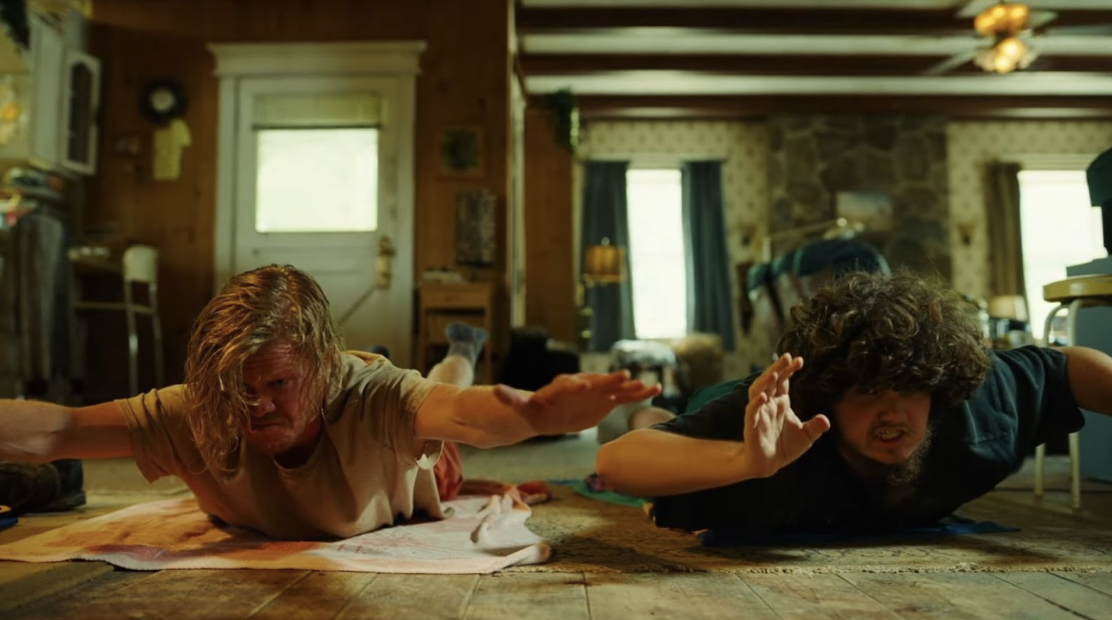
Teddy and Don stretch out on beach towels. Source: IMDB
Michelle embodies what Slovenian philosopher Slavoj Zizek calls the postmodern boss, a pseudo-egalitarian who deprives you of the satisfaction of hating them by pretending to be your friend. She records PR statements on the importance of diversity and invites her employees to leave early — unless, of course, they have work to do. Michelle is featured on the cover of magazines, drives a G-wagon, and lives in a sleek mansion with a glass terrace and an indoor pool. Teddy and Don represent the opposite rung on the social ladder: forgotten, forsaken, abandoned. When Don worries someone may find out about their plan, Teddy reassures him, “No one on earth gives a single fuck about us,” standing in for all those left behind in the march of progress.
Teddy proves himself right when they manage to sedate Michelle in her yard and drive her unconscious body back to their home undetected. Upon waking, shaved and smeared with antihistamine cream, Martian-eyed Stone, shot in the wide clarity of VistaVision, sure looks the part of an alien. But her character coolly denies Teddy’s accusation, instead employing intimidation tactics in a forceful monologue that treats her hostage situation as a business negotiation. In a zeitgeist where workplace jargon has infiltrated our casual conversations and personal interactions are increasingly treated as commercial transactions, this bit of corporate-speak satire unsettles as much as it amuses.
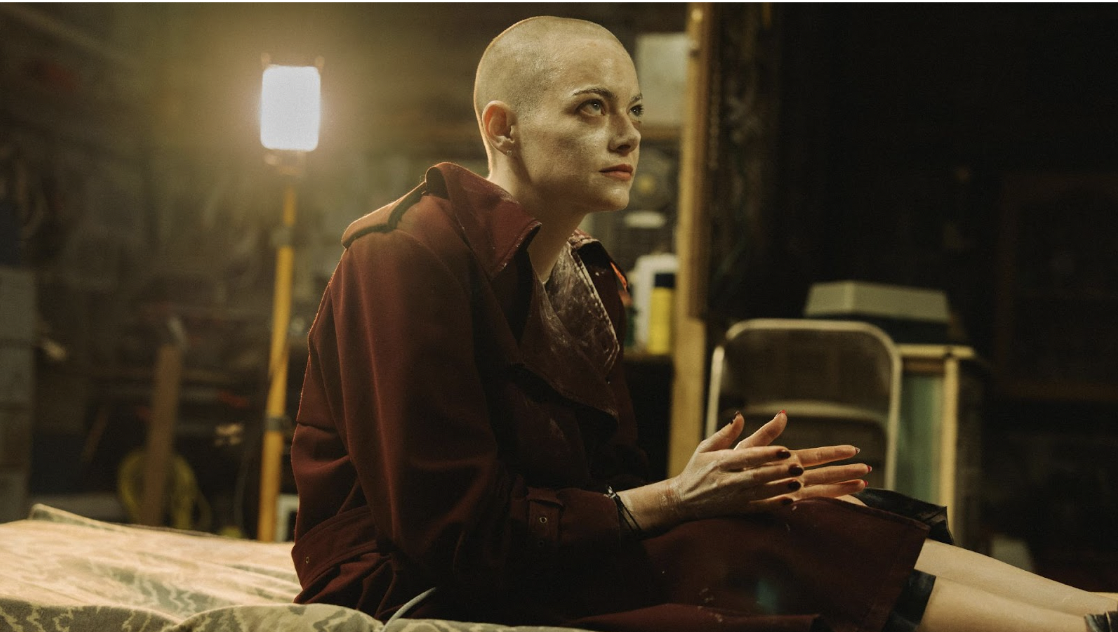
Michelle negotiates with Teddy. Source: IMDB
What follows is an Is-she-or-isn’t-she? guessing game, with most of the evidence pointing to the latter. Teddy has been wronged by Michelle in more ways than one, and a picture of him emerges as a regrettably familiar casualty of late-stage capitalism, retreating into digital fantasy to make meaning out of his wretched reality. Illegitimate ideas are often borne of legitimate grievances. In a moment of implicit doubt about Michelle, Teddy tells Don, “Even if it was human, and it’s not, it’s pure corporate evil.” Later, he seems to unconsciously question his own sanity, blasting Green Day’s “Basket Case” while electrocuting her.
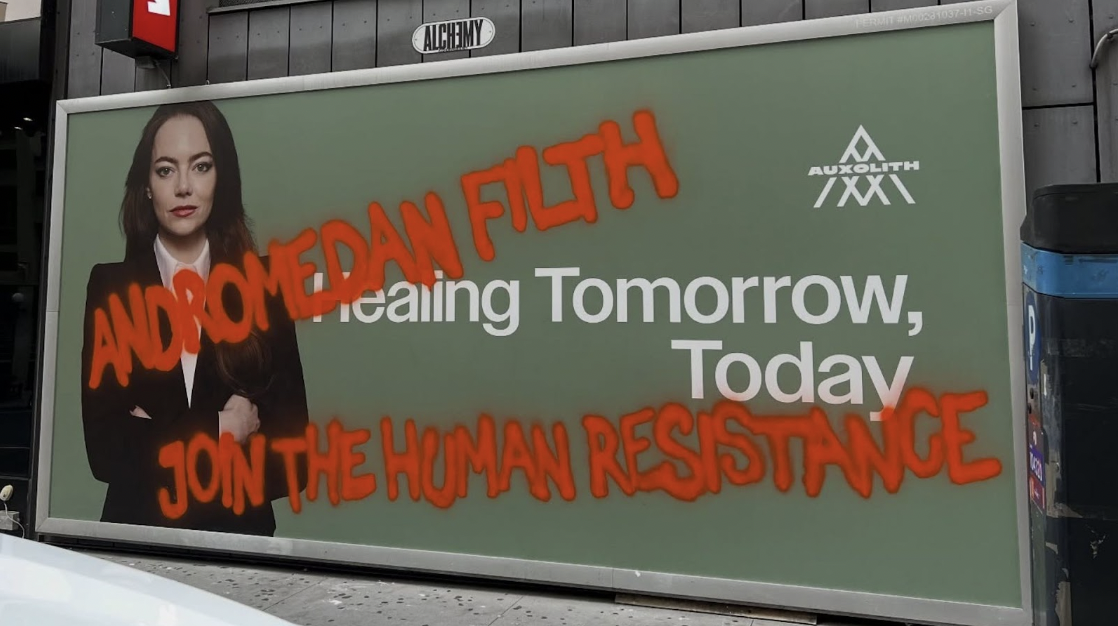
Promotional billboard for Bugonia. Source: IMDB
It would be easy to conclude Bugonia as a cautionary tale about alienated young men. But that wouldn’t be very Lanthimosian. In a final sequence that plays like a fever dream, Michelle beams herself up to the Andromedan mothership, where the set design evokes the inside of a cosmic volcano. There, she declares the human experiment a failure and tearfully pops the gossamer atmosphere of a flat-model earth, instantly terminating all human life.
As the credits roll, Pete Seeger’s anti-war number “Where Have All the Flowers Gone” fades into the field sounds of birds chirping, suggesting a calm is finally returning to the green planet. The abrupt tonal shift and fantastical ending may or may not sit right with audiences, which is presumably the point. Lanthimos has always preferred the uncanny to the didactic. But in a world where truth and lies are blurred and reality is often stranger than fiction, is it so far-fetched?




Leave a Reply