
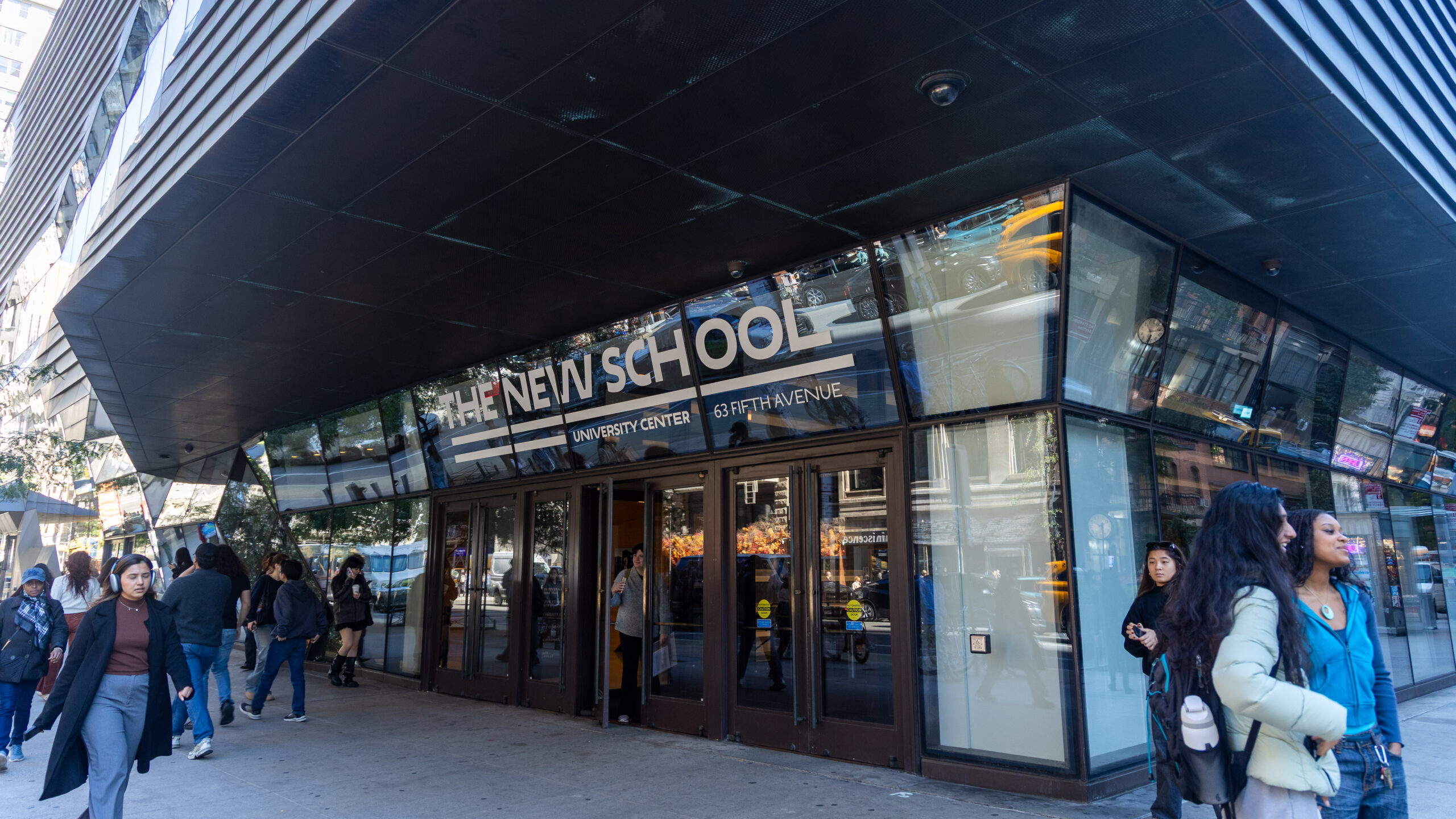
“At this school, it’s not fitting in. It’s standing out,” Draven Nitecki said. Nitecki, a first-year Parsons School of Design student, believes that such a statement encapsulates The New School’s contradiction of character. Individuality is the key to finding your people. If you attend TNS, you’ve probably heard something about our perpetual ‘problem with community.’ It seems to be a shared myth that it’s hard to find a place to fit in. The university’s city-as-campus structure is often blamed for a lack of community, as is the divided nature of the four separate colleges, but maybe we’re looking at things the wrong way. What does a community look like when it’s scattered, self-made, and even a little accidental?
TNS attracts a variety of creatives from across the globe with passions ranging from fashion design to acting. Everyone arrives with their own sense of self, or at least the performance of one. Alum Chrissy Shaffer went to Parsons School of Design in the early aughts and came to the city with friends at New York University, which removed any pressure to fit in while still allowing for a new and thrilling experience. “I was already so cool, I didn’t care, and I already had this crew of people … but it was also really intimidating,” Shaffer said. That intimidation factor was part of the allure of New York City in the late ‘90s, and still is today. At TNS, everyone has their own vision and taste, which can be intimidating for anyone new to the city.
So, where do connections happen if you’re not entering with pre-made friends? First-year Parsons, the college, students Willow Martinez and Lizzie Grattan first saw each other on a campus tour and didn’t speak, each privately deciding the other seemed a little intimidating. “It was through our dads that we became friends … I thought Willow was low-key gonna be mean because she didn’t say anything to me,” Grattan said. The feeling was mutual. “I thought [Grattan] was gonna be mean, ’cause she didn’t talk to me, either,” Martinez said. Call it fate; otherwise, without their dads conversing on the tour, this set of best friends would not have met. Often, belonging isn’t something you seek out; it’s something that finds you.
One downside to a world of hyper-individual identities is that unfamiliarity can feel scary. “I think we have preconceived notions of people in general, especially as artists and actors; people could be a little standoffish,” said Holiday Raimond Jones, a third-year student at the College of Performing Arts.
However, individuality can also lead to serendipitous social connections — if everyone is different, no one has to fit in, and common ground isn’t necessarily a precursor to friendship. Accidental and unexpected friendships happen to be a common experience for students at TNS, acting as one more alluring trait of New York City. Unexpected friendships is another advantage of having a city-campus structure.
Communities aren’t exclusively formed based on shared backgrounds, interests, or hobbies. Friendship can be found in stairwells, in line at the dining hall, or a night at Washington Square Park. TNS’s location and structure may seem limiting for students seeking communal spaces, but in reality, the student culture thrives in an atypical environment.
For first-year Eugene Lang College of Liberal Arts student Emilia De La Rosa, community-building started small — with roommates, then classmates, and eventually mutual friends. Delarosa said she would hang outside on Stuyvesant Park’s stoop with her roommates, and that’s how she got to know her friends, because the spontaneity felt more organic, which would help drive an interaction with someone new. Coming from Portland, Oregon, meeting people here is “different, because I think everyone is kind of their own person, I feel there’s less people who are clinging to others. Everyone has their own personality, for better or for worse,” De La Rosa said.
At The New School, individuality isn’t the opposite of community — it’s the thing that holds it together. Assumptions and quiet guardedness may make it seem hard to find a common connection, but that itself morphs into a shared language. “I think we’re all here to pursue our passions, but we know that we’re taking huge risks,” Jones said. There is a mutual understanding that students are all taking the risk together. Fitting in is an attempt to be seen by one another, and there’s no one single way to fit in, except to stand out.
Here, at TNS, community is often framed as something elusive because students are too dispersed, too individual, too shaped by the city to ever fully connect, but community is all around. We may just be missing the connections happening right in front of our eyes. What if the same intensity of individuality that’s seen as a barrier is actually a point of connection? In a space where no one way to belong exists, fitting in takes on a different meaning of individuality being the cultivator of community.


Leave a Reply