
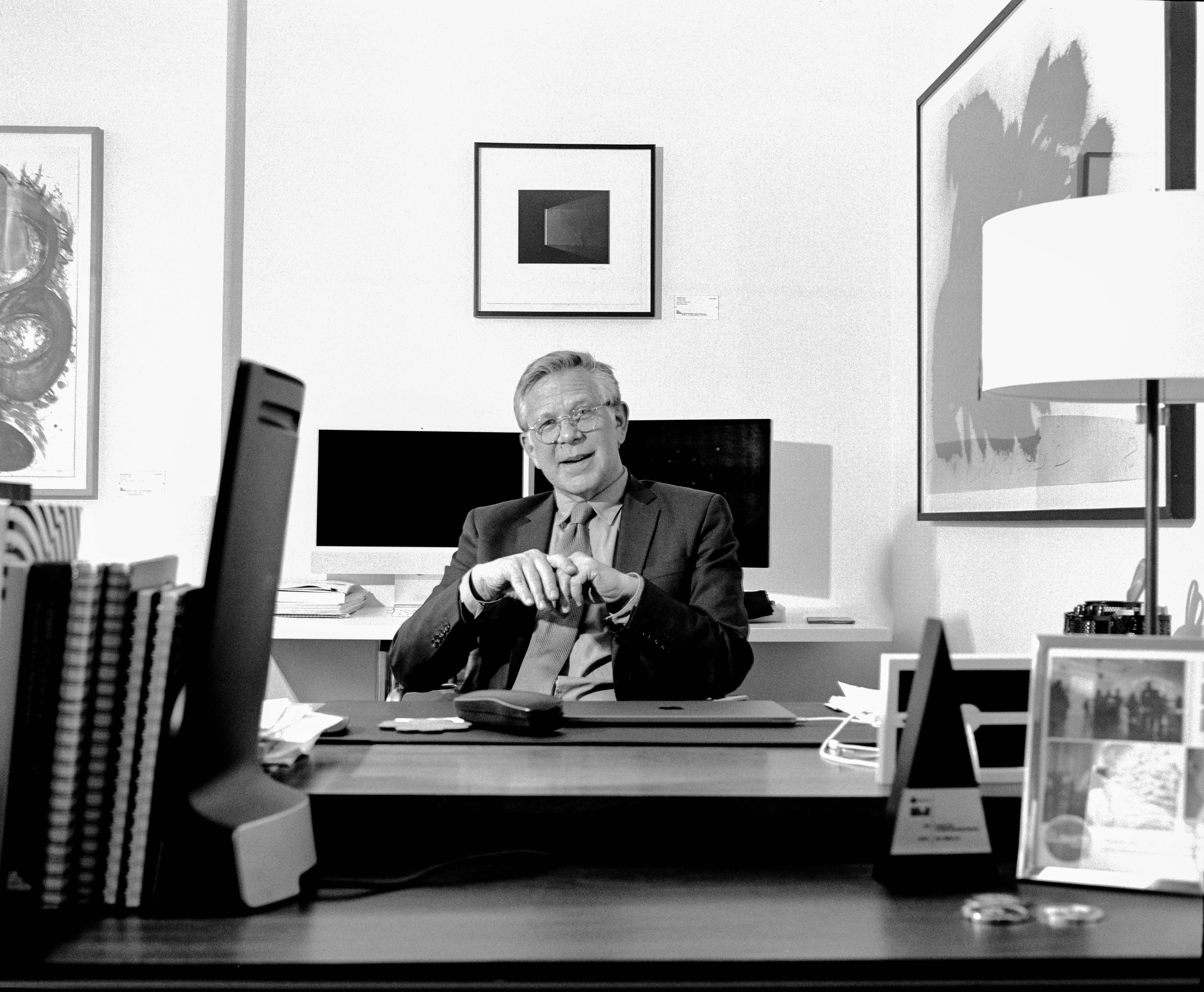
As a historic year for The New School wraps up, the New School Free Press sat down with University President Joel Towers on May 8.
The conversation with Towers and the New School Free Press centered on the university’s restructuring plan. Since last summer, the university has undertaken a controversial and extensive cost-cutting effort aiming to stabilize the university’s longstanding operating deficit.
Towers discussed what the current deficit is, his qualifications for leading the school, the stress of being president, plans for a “global campus,” and other pressing topics related to restructuring.
The interview has been edited for clarity and concision.
NSFP: In a podcast episode that came out last September, you said that taking on the role as president felt “natural.” Can you explain why it felt natural to you?
Joel Towers: Tension is a space that I’ve occupied throughout my academic and professional career. I am somebody who works in a very applied field. I’m an architect. The work that I do doesn’t have the luxury of sitting within the academy. Knowledge for knowledge sake, right. I like to say, “You build buildings, they get wet in the rain.”
So part of my work is very much connected to the material, cultural transformation of the city, of space. And so it relies heavily in that applied tradition. Part of my work is in climate change and sustainability and resilience and policy and planning, which has deep roots in research and in the academy.
Both of these have been tied up in my own work for more than 30 years. So, it feels natural to me. The New School — I’ve been here 22 years — felt like a home that was both embracing the challenges of the time, the outside world, the applied, and the role of scholarship and research and learning. So that’s why I’ve always found myself very comfortable here.

Based on your experience, what makes you qualified to lead The New School?
[Towers smiles. He coughs and pauses for a drink of water]
Well. If you look at what we teach … somewhere between 60-70% of what we teach at The New School is directly connected to Parsons, in terms of student numbers. I’ve been teaching and researching in that space for over thirty years. A good portion of what we do here is research-based.
My experience doing research and writing policy, working for the mayor’s office, those kinds of things, qualify me as a scholar and a researcher. My teaching is probably the most fundamental thing that would qualify you to be a university president.
My proudest moment was not when I was named president or asked to take on the role, but when I received a distinguished university teaching award. That was about four or five years ago.
In the end, I don’t think it’s possible to say one is qualified to be the president of a university based on being a teacher or a scholar or a practitioner in a particular field. Because the truth is, none of those things are preparing you for the complexity of what it takes to actually run an organization of roughly 14,000 people, between students, faculty, and staff, with — in the case of The New School — a $450 million operating budget. That comes from a lifetime of experience working in very complex situations, organizations. I spent five years co-chairing New York City’s panel on climate change with more different voices than you could possibly imagine.
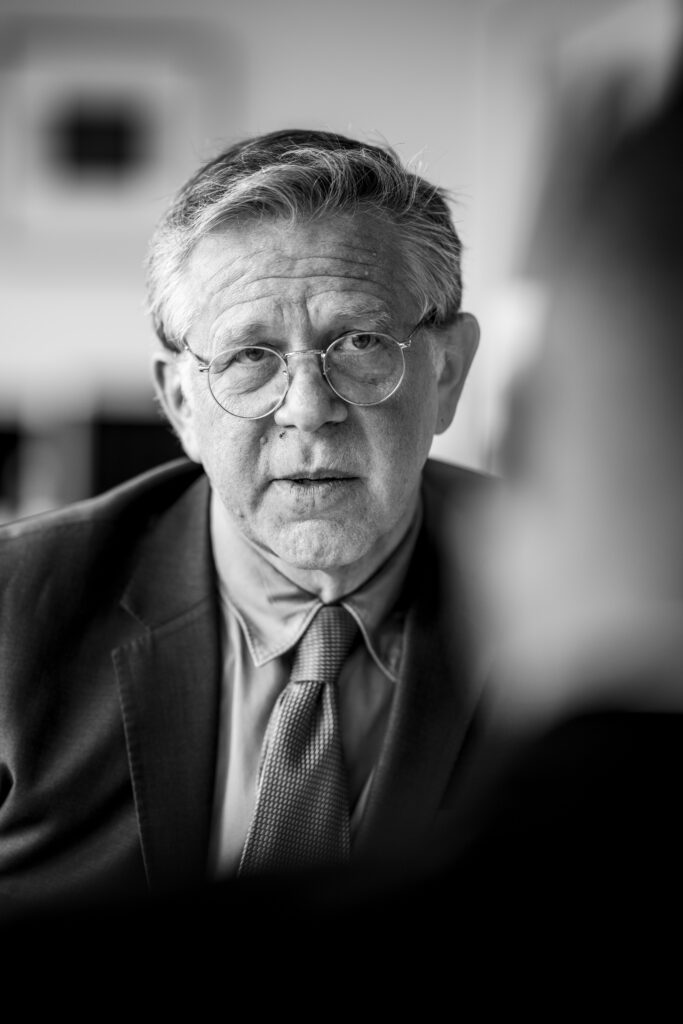
How [do] you feel about administrative capping of salaries?
First of all, the proposal is not quite as clean as you’ve asked the question. It emerges from a faculty meeting. The proposal comes to me to cap all salaries at $200,000, not administrative salaries … I felt it was my responsibility to bring it to the board of trustees.
It was brought to the Workforce and Compensation Committee. That’s the committee that oversees all of our salary frameworks and salaries over a certain amount. They felt that it was not the way to proceed. It would have placed us in a situation where we would have been unable to maintain the level of expertise and talent that we need.
As definitively as you can, what is the deficit right now?
The current year deficit is close to $60 million. The cumulative deficit over the last five years … is about $165 million, not including the one-time sale of real estate.
We’ve sold the former president’s residence and we sold a dorm on [W.] 20th Street. Together, that took about $27 million off of the cumulative deficit. But those were one time.
Is there anything that’s in the near future of The New School that you’re excited about, but haven’t fully announced yet?
We have said we are a global university for as long as I’ve been here. … We’ve said that because people from around the world come here. We are not as fundamentally in the world as I think a real global university would be.
We have our Paris campus, which is fantastic, but it’s relatively small …
We are looking to kind of flip the script to remain fundamentally anchored in New York and global and pursuing all of our values and to look to build out more locations around the world where our students can go from here and where students who, to be perfectly blunt about it, might not be comfortable coming to the United States today because of the just deep animosity that characterizes our foreign policy. …
So one of the things that we’re working on is a series of different possible locations. We’ve had a lot of interest. Usually that comes through either Mannes College of Music or Parsons. Those are the two most international units of The New School and their brands are most well known internationally. Partnerships, new campuses, opportunities tend to come through those two doorways.
We see that as a way of bringing, then, the opportunity to Lang or to other parts of the performing arts and so forth.
Where would the money come from for those campuses?
From the partners outside. We are not putting any of our resources here into expanding the university. This will all be financed by partnerships with governments or other universities or other entities that want to support us.
Would NYU ever buy The New School?
[Towers quickly answers] No. NYU is not interested in buying The New School.
Are there going to be any more majors and minors to be cut in the future?
Yes.
How many do you think will be cut by the end of restructuring?
I have no idea because … this first phase of work is really the most comprehensive in terms of getting our baseline budget back in order. The reason I can answer so confidently yes to your first question is because programs should always be being opened and closed on a regular basis based on the interest level, the quality, the relevance of the program. The university got out of the business of doing a very careful assessment of its programs years ago. So no new programs were opened and none were closed for over a five-year period. That’s actually bad practice. You have to be constantly evaluating the program.
So I don’t know which ones we would close, but I am certain that with 120 or 130 programs, there will be programs that should be sunset and there’ll be new programs that should be launched.
Here’s an anonymous comment from a professor: “Professors want to be celebrated instead of what they stand for and work for being thrown away.” What’s your response?
I celebrate the work of our faculty every day.

It’s been over a year since you’ve been president. How stressful has it been for you?
On a daily basis, [it is] among the most complicated tasks I have ever taken on in my life. … I’m 61 years old. …
The stress is real because I feel the burden for sure — the responsibility for so many individuals and their livelihoods and for students and the cost of our education and all that. It’s not a light burden, but it’s one I joyfully carry.
The part where the stress comes in is that we live in a time of incredibly coarse, aggressive discourse.
The things that people who do not know me feel comfortable saying to me and ascribing to me from every different angle you could possibly imagine in some of the most vile language you could possibly imagine is stunning to me. And it’s not just here, right? It’s not just The New School.
We’re living in a time in which there’s an aggressiveness to our discourse. With all due respect to the Free Press — controversy sells. Subtlety [and] nuance are rarely appreciated … I find that to be deeply saddening. I’m not naive about it, but I find it stressful because I think it runs counter to the core values of higher education.
We are of the world. We’re in the world … But we do not have to fall prey to the worst characteristics of the world. I think we should be better than that. I find even in our own community, we have a coarseness, a quickness to blame and accuse, [and] not a terribly deep interest in actually pursuing the facts. We replace opinion with fact all the time. Those things create stress.

Leave a Reply