
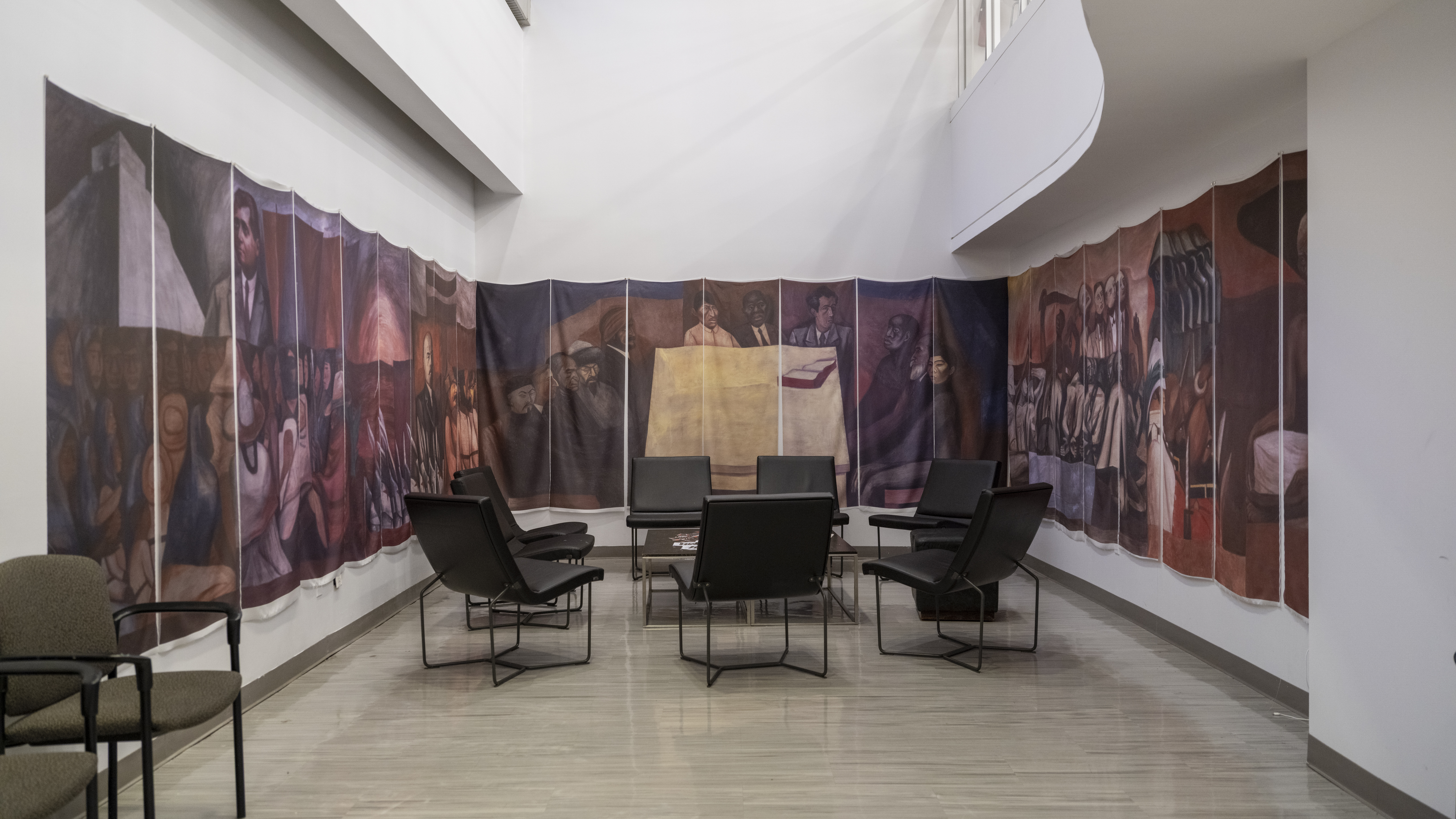
The 11th Street Eugene Lang College basement lounge underwent an unexpected shift earlier this semester. What had long been a practical space, home to printers and benches, was gradually cleared out. As the semester progressed, the room sat empty, hinting that something new was in the works.
On Nov. 12, the lounge reopened as a student-run exhibition space, drawing small crowds into an overlooked chapter of campus history. The project, Unveiling Orozco’s Room, was assembled by students of Professor Alhena Katsof’s course Practicing Curating. Tasked with creating a “bootleg” exhibition for Lang’s 40th anniversary, the class turned to a legacy many students hardly know: the long-hidden Orozco Room.
When third-year visual studies student Anna Knyshova proposed the idea of recreating the room to make it accessible again, her suggestion quickly won unanimous support — setting the direction for the exhibition now occupying the lounge.
“[There’s] a group of students at The New School who completely obsess over these murals,” said third-year culture and media and visual studies major Nikki Hassig, one of the students who helped with the exhibition. “You’re either a part of the group of people who have never heard of them, or you are so mentally fixated on them that you can’t get them out of your head. And there’s really no in between.”
The murals Hassig is referring to are in fact one continuous room-sized fresco, Call to Revolution and Table of Universal Brotherhood, created by Mexican muralist José Clemente Orozco in 1930-31 as the West 12th St. building was still being constructed. The fresco — like many of Orozco’s projects and those of Diego Rivera and David Alfaro Siqueiros, who also rose to prominence during the 1920s to ‘50s Mexican Muralism Movement — takes on subject matters of revolution, class struggle, and social justice. Many people over the years, including university leadership, visitors, students, and alumni, have found it controversial due to its subversive themes.
In those early years the fresco wrapped around the four walls of a cafeteria in the building, becoming a communal space for students. Today, it is otherwise known as the Orozco Room located on the seventh floor and accessible only by request to the curator of the New School Art Collection.
Though the mural was closed off in an effort to conserve the murals, which have begun deteriorating as a result of the room’s humidity, obsessive fans of the fresco like Hassig and their Practicing Curating classmates longed for a way to experience it. Concerns have also been raised that closing off the Orozco Room to visitors defeats Orozco’s original intentions to make his art accessible.
“We wanted it to be like the ghost of Lang,” Knyshova said. She was one of the few students who had been able to see the mural in person, and spoke of its haunting essence. The students tried to emulate this ghostly quality with their own recreation, by printing three of the walls on a series of tapestries that depicted the mural on almost the exact same scale when placed next to each other.
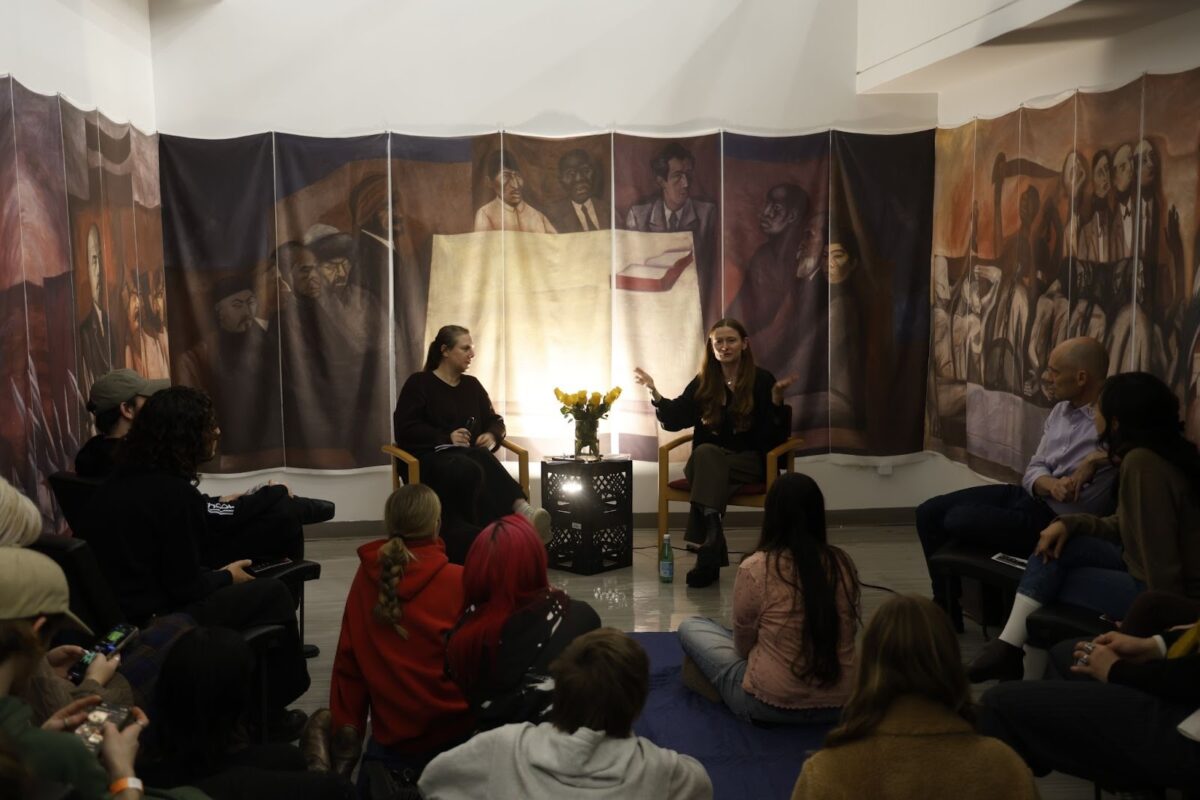
Photo by Ephrem Davis
Before the central mural, Table of Universal Brotherhood, which shows 11 men of varied ethnicities gathered at a table, the students arranged their own version: a warmly lit crate with yellow flowers and two chairs. Along the walls where Struggle in the Orient and Struggle in the Occident faced each other, the students set out chairs so viewers could sit up close and even lean on the fabric, echoing how people once experienced the originals.
“It’s more delicate, … we wanted it to flow,” said Luca Celestino, one of the students in charge of printing and installing the fresco reproduction, when speaking about their decision to use silk. “That’s why there’s only the magnetic pushpins at the top and not at the bottom because we wanted to incorporate a bit of the movement.”
The students, Katsof said, were thinking about “a space or an object that was kind of haunting their experience of being students at the new school … that they were curious about but couldn’t actually hold on to, right? Like the way you sort of put your hand through a ghost. It’s very ephemeral. You can’t really grasp it.”
Knyshova expressed that the history of the mural reflects issues of accessibility and censorship still ongoing within The New School today. During the onset of the fifties McCarthyism era, a campaign to spread fear of communism, the fresco was a target of controversy due to its depictions of members of the Mexican and Bolshevik revolution. As a response, administrators at the time decided to cover these depictions with a curtain, a move that quickly sparked student protests. Knyshova drew a parallel to the protests against Israel’s war in Gaza last year that resulted in a number of arrests, during which students experienced a lack of support.
The exhibition’s title, Unveiling Orozco’s Room, is an acknowledgement of the fresco’s history of censorship, and a resolve to recover its accessibility. For many visitors, unaware the room ever existed, it truly is an unveiling.
“I think there’s a lot of power to be held in a recreation,” said Celestino. “Thinking about workers’ rights, the history of strikes at the New School … Right now [we’re] in a moment of an extreme shift in representation and hiring practices. We’re at a turning point for the university. So how does this very explicit mural in terms of workers’ rights, in terms of togetherness, and also fighting, what does that speak to?”
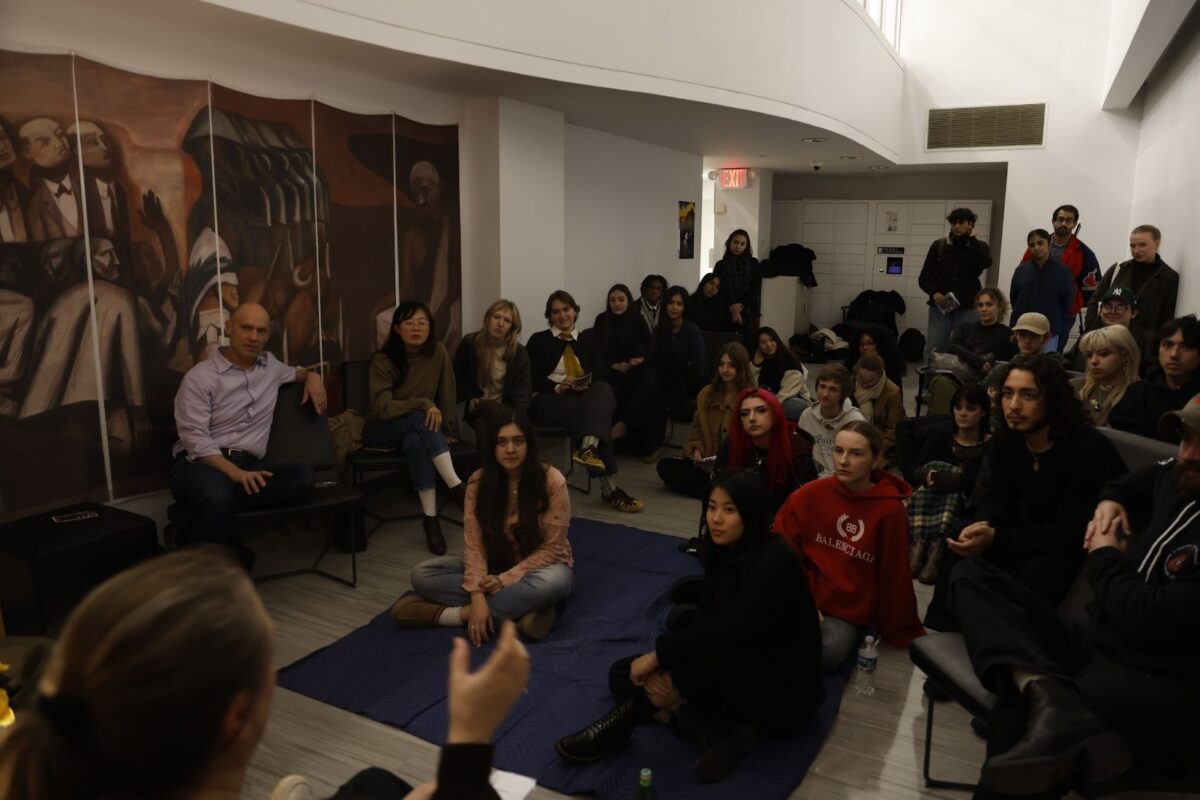
Photo by Ephrem Davis
The evening of the exhibition’s opening was an intimate, communal experience. Katsof sat with Senior Art Collection Manager Emily Clayton to discuss the conservation project and her own encounters with Orozco’s murals, while the students handed out handmade zines about the murals. Students, alumni, and administrators, including Dean Christoph Cox, sat together on chairs and filled the space on the floor as they listened and engaged in discussion. It felt distinctly like a gathering space, a simulation, almost, capturing the spirit of what the Orozco Room must have been like back then.
“By looking at art from the past, we can develop a stronger skill set for how we deal with the conflicts we face today,” said Katsof. “Some people like to think of time as a linear progression, right? And that something is always improving or always changing. But I think it kind of just spirals and goes around and around.”
Leave a Reply