
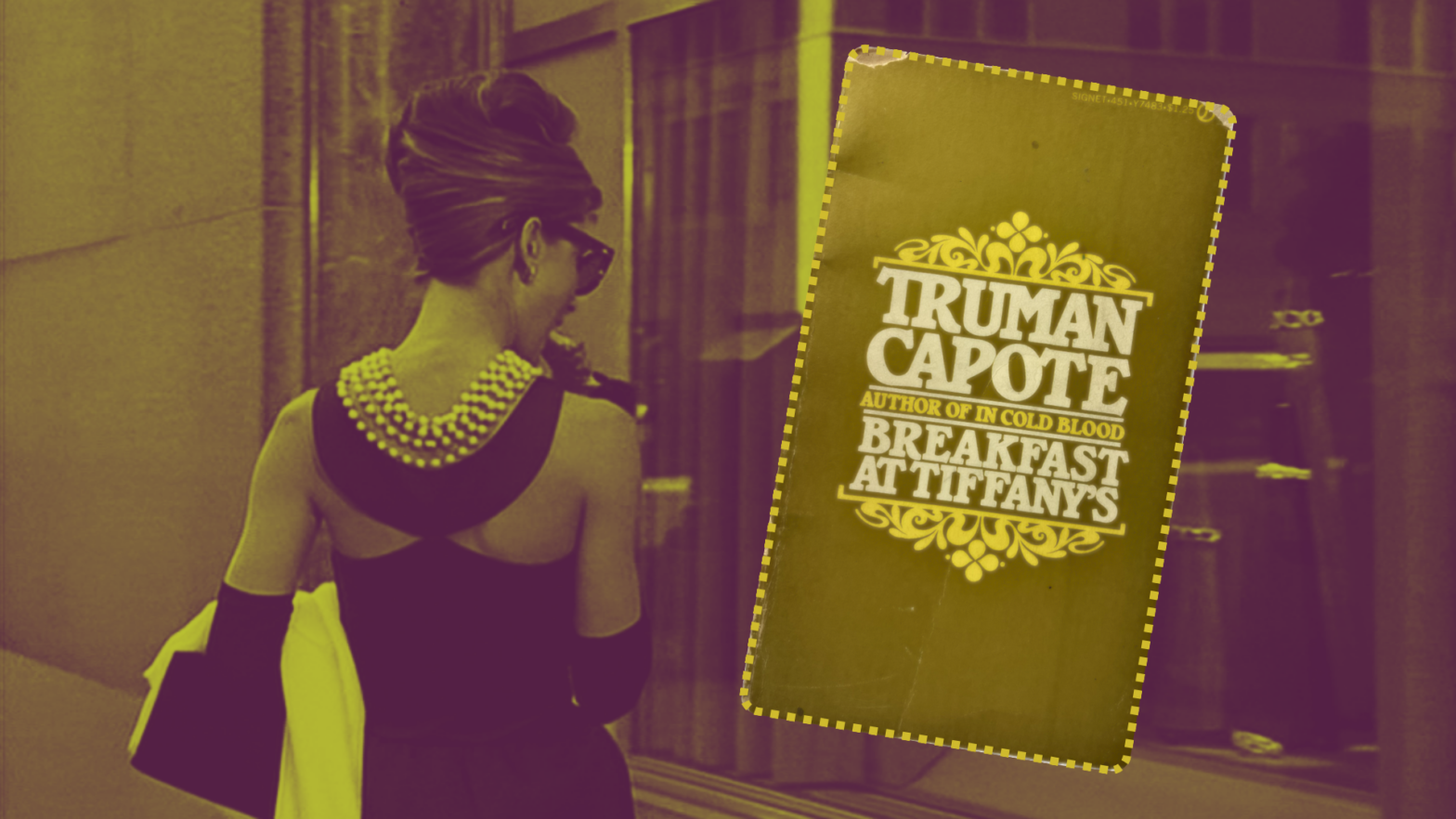
I fell in love while reading “Breakfast at Tiffany’s.” The first time I picked up my copy of the book, initially published in 1958, was in Karma Bookstore on the Lower East Side. A boy that I loved bought it for me. I found the tiny copy on a stuffed bookshelf; it had an almost ancient chartreuse spine, and upon closer inspection, beautiful cream-colored lettering printed on the front. The pages were delicate and yellowed. It felt old. He said he wanted to get it for me. He could tell how beautiful I thought it was.
So we sat in the park in the middle of New York summer. Hot sun and dry grass. I rested my head on his leg and held my new book up to read. He did the same. But neither of us could focus on the words. I was too distracted by the rise and fall of his breath and the heartbeat I could hear through his jeans.
He isn’t mine anymore, and this book was an agonizing reminder of that.
“Breakfast at Tiffany’s” is about a young aspiring author who’s just moved into a New York City apartment during World War II. This unnamed narrator is reserved, indifferent to the happenings around him. Eventually he befriends his upstairs neighbor, Miss Holly Golightly, who has lots of secrets and lots of suitors. Holly’s mysterious allure catches the attention of the narrator, prompting him to monitor her closely, even reading her mail when it’s left by her door. Eventually, a friendship blossoms between the two when she seeks refuge in his apartment one night to escape a drunken man in her apartment.
Holly is 19 years old, blonde, beautiful, and possesses the tendency to want to know everything about a person — but becomes defensive when they want to know about her. While some of her friends and acquaintances find this irritating, the narrator takes it as an intriguing challenge to try and uncover her secrets.
Holly is running. She has a mysterious past that she doesn’t want uncovered. She lives an extravagant socialite lifestyle, a facade that hides how scared and alone she feels while relying on the company of affluent men to keep her afloat. She hates the zoo because she can’t stand seeing anything in a cage, and she won’t name her pet cat: “I haven’t any right to give him one: he’ll have to wait until he belongs to somebody…we don’t belong to each other: he’s an independent and so am I” (35). However, she has no problem giving the narrator a name that is not his: Fred. She says he reminds her of her older brother with the same name who’s fighting in the war. He seems to be her only family, and Holly is terrified to lose him. As the story unfolds, the narrator discovers that Doc Golightly, who married Holly when she was a vulnerable 14-year-old runaway named Lulamae, is in New York looking for his lost bride.
These complex backstories and characters are contained in less than 90 pages. Truman Capote’s writing style is rich in vivid imagery, allowing us to perceive nuances that remain unspoken.
The narrator doesn’t seem to want anything from Holly, except maybe to be loved by her. But what he can’t understand is her grief — and Holly’s grief is what I find the most relatable when reading this story. She has so much despair and sadness that she must keep hidden with nowhere to put it. It can be isolating. Like a child, she’s given a name to her feelings: “The mean reds are horrible. You’re afraid and you sweat like hell, but you don’t know what you’re afraid of. Except something bad is going to happen, only you don’t know what it is” (35). This feeling of dread haunts Holly; it consumes her and it drives her to push people away and destroy the things she loves.
“Breakfast at Tiffany’s” earned its film adaptation in 1961 directed by Blake Edwards, starring Audrey Hepburn as Holly and George Peppard as the narrator. Hepburn’s Holly appears more mature and brunette than her literary counterpart. Even more shocking in Capote’s original story is that Holly never steps foot into Tiffany’s, the book’s own namesake. The scenes of Holly perusing Tiffany’s (and quipping, “it’s tacky to wear diamonds before you’re forty”) are iconic to film and fashion enthusiasts everywhere. Hepburn’s costumes were designed by Givenchy, giving the film an air of classic elegance and poise. Capote’s Holly felt more discombobulated yet still undeniably fashionable.
Capote created a literary world that became unforgettable on the screen. His novels and short stories have been adapted into over 20 films and TV productions. Capote’s most famous novel “In Cold Blood” was published in 1966, and his unfinished manuscript “Answered Prayers” from 1986 was supposedly fiction, however, the plot too closely resembled the scandalous lives of the New York City socialite group he belonged to. The book ruined his relationship with his friends and members of high society; women referred to as “the Swans.” The 2024 TV show “Feud: Capote vs. The Swans” directed by Gus Van Sant, brings Capote’s “Answered Prayers” to the screen, with Capote being portrayed by Tom Hollander, and actresses like Naomi Watts, Diane Lane, and Chloë Sevigny playing real-life Swans like Babe Paley, Slim Keith, and C.Z. Guest. Capote’s legacy transcends his literature, but his most beloved and nuanced character is undoubtedly Holly Golightly (even if we all picture her as Hepburn).
Deep down, below the film adaptation and Capote’s own scandals, “Breakfast at Tiffany’s” is about a girl who has fled her first life and continues to run even while standing still. The world thinks of Holly as glamorous Audrey Hepburn, but in reality, she’s a 19-year-old former child bride who just wants to belong in a new city. My own heartbreak haunted me as I read, and despite the melancholy ending, I felt a bit more healed when I finished the book than when I began. Wherever Holly goes, grief follows even when she tries to dodge it, the same way that I attempt to avoid the bookstore where my former love gifted this book to me. I must allow myself to feel the grief, sadness, and longing, or else it will consume me. So I try to let the love I felt pass through me, no longer with a place to go. Or perhaps I should follow Holly’s lead and just keep running, away from those I am too blind to see love me.





Leave a Reply