

The Collegiate Journalism Network, a new support and solidarity organization created by and for collegiate newspaper editors, brings you its first collaborative piece. American University’s The Eagle, Emporia State University’s The Bulletin, Oberlin College’s The Oberlin Review, Swarthmore College’s The Phoenix, and The New School’s The New School Free Press, reviewed how their respective universities are contending with increasingly hostile attitudes toward diversity, equity, and inclusion programs, beginning with President Donald Trump’s Jan. 20, 2025 Executive Order 14151 ending DEI programs.
American University
Norah Aycock
On May 2, 2025, American University announced that it would rename its Center for Diversity and Inclusion to the Center for Student Belonging. This comes after Trump issued a slew of anti-DEI executive orders in January 2025, including one threatening to pull federal funding from universities with DEI programs.
Elizabeth Deal, assistant vice president and deputy chief communications officer at American, denied any correlation between Trump’s attacks on DEI and the renaming. The University began planning how to better support students before his second term began, she said. Some students interviewed by the Eagle saw the change as necessary to protect American’s funding and therefore its inclusive work, while others saw it as a betrayal of their liberal values.
Although American is not formally under investigation by the Department of Education’s Office for Civil Rights for DEI-related practices, it has faced some repercussions for DEI-related work. The Guardian reported on internal documents from the State Department proposing that American, among other universities, be suspended from the Diplomacy Lab, a program aiding university research, because of its engagement in “DEI hiring practices.” Additionally, STEM research grants for American that surpassed $3 million were terminated because of perceived DEI language.
Emporia State University
Isabel Ayala
On March 12, 2025, Emporia State University removed all pages related to its now-defunct Division of Diversity, Equity, and Inclusion from its website at the direction of the Kansas Board of Regents, the governing body of the six public Kansas universities, including ESU.
The Bulletin reported that KBOR had “provided direction to begin to make changes to DEI” and that ESU’s Division of DEI was trying to work with KBOR to determine the requirements to stay in compliance. At the time, ESU’s DEI resources were still available.
In April, the Kansas legislature passed Senate Bill 125, an appropriations bill that, in part, required state agencies to “eliminate positions, policies, programs and other areas” related to DEI, including public universities. By June 30, ESU quietly dissolved its Division of Diversity, Equity and Inclusion, eliminated the administrative positions within it, and axed its Intercultural Center.
Key programs housed under the Division of DEI were relocated to different departments within ESU. The Institute of Interdisciplinary Studies, also housed within the division, was moved into the School of Library and Information Management.
The Intercultural Center remained vacant for all of the fall 2025 semester until the space was allocated this spring to ESU’s Associated Student Government for office space as part of the Student Life Hubs. While the names of the donors remain on the wall outside the area, any mention of the Intercultural Center has been removed. The center, which opened in November 2024, was open less than a year.
Oberlin College
Swaranya Sarkar
Oberlin College has been largely unaffected by federal executive orders and guidance challenging DEI initiatives.
At a community forum in February 2025, President Carmen Twillie Ambar and former General Counsel Matt Lahey addressed the Department of Education’s “Dear Colleague” letter, reiterating Oberlin’s intent to follow the law without “overcomplying” by preemptively dismantling programs (“President Ambar Addresses Executive Orders, Attacks on DEI at Community Forum,” The Oberlin Review, Feb. 28, 2025).
Since then, many Oberlin programs have continued as normal. Oberlin maintains a Center for DEI Innovation & Leadership. Oberlin’s Office of Equity, Diversity, and Inclusion was renamed the Office for Institutional Equity in 2024, however this change came prior to the Trump presidency. According to Director of Media Relations Andrea Simakis, the alteration was made to avoid confusion with the newly established Center for DEI Innovation & Leadership. Identity-themed housing and academic offerings connected to DEI principles remain in place. Additionally, the Changemakers Fellowship, which is housed in the Center for DEI Innovation & Leadership and centers around racial equity in leadership, launched its first cohort in 2025.
However, multiple former employees of the Center for Intercultural Engagement, which coordinates most identity based-programming at Oberlin, have expressed concerns about increased caution around identity-specific language (Former Employees Express Concerns As CIE Undergoes “Realignment”, The Oberlin Review, Dec. 12, 2025).
Swarthmore College
Lucy Tobier
Swarthmore College, a private college in Pennsylvania, faces fewer threats to funding than public and elite research universities and benefited from an endowment tax exemption for small colleges in Trump’s One Big Beautiful Bill Act. “DEI initiatives” such as student affinity spaces and programming remain largely unchanged. However, national pressures forced stricter guidelines removing transgender athletes from women’s athletic competitions. Swarthmore competes in the National Collegiate Athletic Association Division III’s Centennial Conference. In February 2025, the NCAA banned student-athletes assigned male at birth or females in hormone therapy from competing on women’ s teams, just a day after President Trump’s executive order “Keeping Men Out of Women’s Sports.” The College faced a choice: protect transgender students or remain eligible for NCAA competitions and reduce federal negative attention. The College ultimately followed the national policy. Student-athletes were quietly asked to sign an agreement acknowledging compliance in fall 2025, as reported by The Phoenix.
The New School
Sam Brule
Shane Gomez
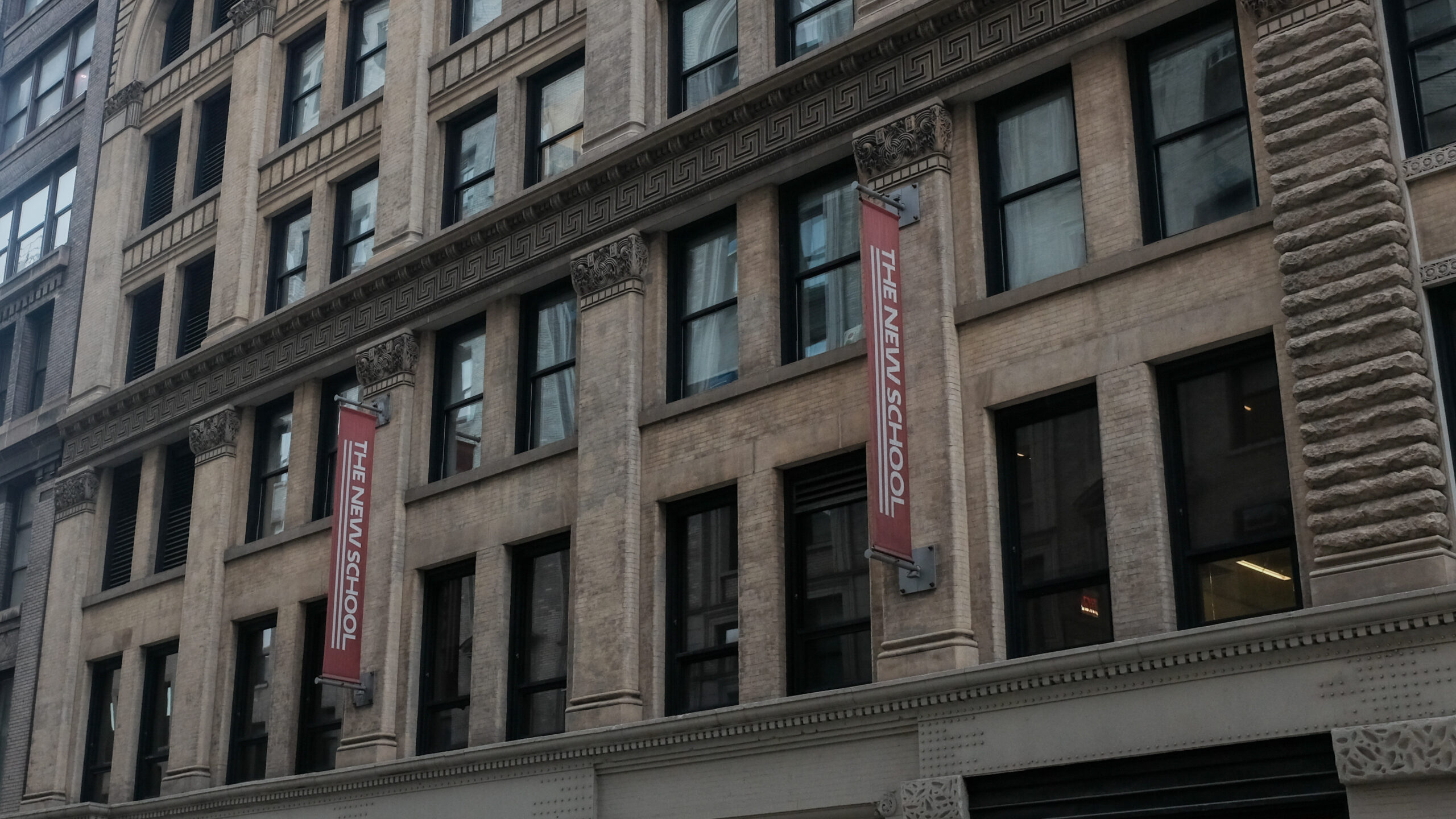
The New School administrators responded to Executive Orders threatening DEI programs with a commitment to uphold “values of diversity, inclusiveness, openness,” in a Jan. 29, 2025 email by University President Joel Towers and then-Provost and Executive Vice President for Academic Affairs Renée T. White.
However, students have told the New School Free Press that, historically, TNS’ DEI efforts are not enough. In recent years, faculty and students have also questioned the university’s progressive branding.
In the weeks following the orders, University administrators hosted events and sent several emails stating the University’s commitment to diversity and equity.
Despite the University’s diversity and equity-related offices, initiatives, and events, TNS has difficulties retaining students of color. Black students have the lowest retention rate after their first year: 69 percent, according to the October 2024 issue of IR Digest. The rate for Latino students is 73 percent. Both figures are below the university’s overall rate of 82 percent.
Students of color have previously told the NSFP that this is due to the high cost of attendance, a lack of students and faculty of color, and a lack of community.
The university’s vast ongoing restructuring, which includes the cutting of Chinese, Hispanic, and Japanese Studies minors, alongside the Critical Perspectives on Democratic Anti-Colonialism minor, has also led some to question the university’s commitment. Students and faculty have demonstrated three times in opposition. In December, TNS University Student Senate Declaration of Principles called the restructuring a threat to “the progressive legacy and integrity of The New School itself.”

Leave a Reply