

Efforts by administrators amid restructuring are restricting the ability of faculty, staff, and students to criticize The New School’s restructuring plan, community members told the New School Free Press.
Members of the Board of Trustees and Voluntary Separation Program signees are legally barred from talking. Faculty and students say town halls and meetings with administrators offer limited opportunities to raise questions. And community members say an atmosphere of fear and uncertainty discourages them from speaking out openly.
“I feel really disheartened,” Emily Li, chair of the University Student Senate at the time of the March interview for this article, said. “I think everyone can unequivocally agree that this has been handled in a ruthless way.”
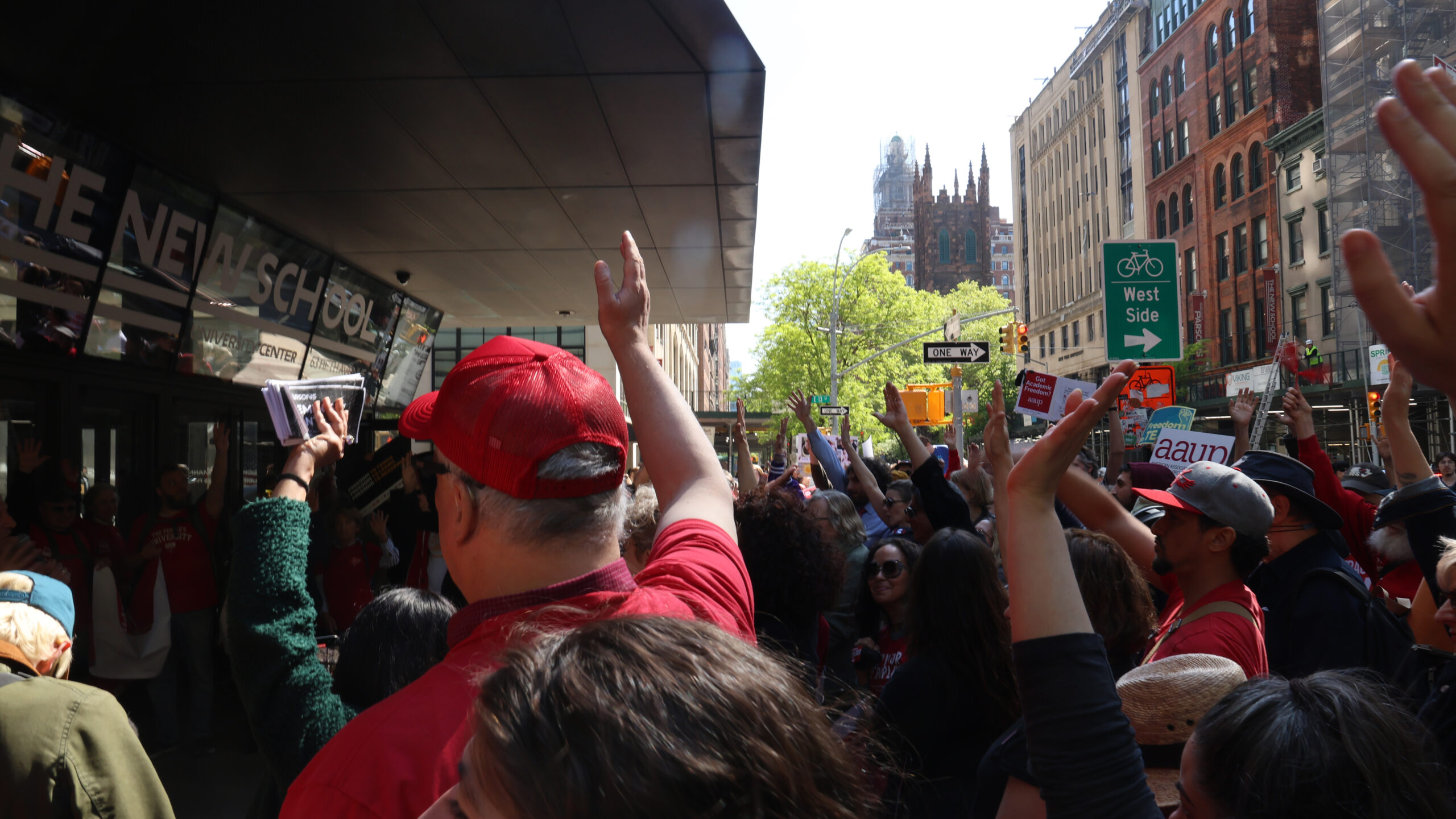
The efforts come amid the university’s massive restructuring plan, which is tackling a years-long operating deficit last shared by administrators in November 2025 to be $48 million. Community members, who have demonstrated four times and made a song and a poem, say the restructuring is slashing the liberal arts and, subsequently, the university’s identity, as majors, minors, and courses are cut, and employees are offered buyouts or risk future layoffs.
“The university is committed to navigating the workforce realignment we are undergoing with sensitivity, transparency, and a culture of mutual respect where every voice can be heard without fear or retaliation,” Merrie Snead, associate director of university communications, said in a statement.
“Commitment to Confidentiality” and non-disparagement clauses
Some community members are legally forbidden from speaking about topics related to restructuring and from saying so.
In February, members of the Board of Trustees were asked to sign a “Commitment to Confidentiality”, which functions like a non-disclosure agreement, ahead of their upcoming meeting. The university told NSFP that this was a reaffirmation of an annual requirement. Yet faculty and students told NSFP, amid increased media coverage of the restructuring and growing opposition, that they felt the restraint was also an attempt to limit transparency.
In addition, participants in the “voluntary separation program” (VSP) have to adhere to a similar legal requirement. VSPs are a buyout effort that, along with “voluntary early retirement” offers, are expected by administrators to result in a 7% reduction of the university’s total employees.
Any faculty or staff member that took a VSP was required to sign “non-disparagement” and “confidentiality” clauses as part of the separation agreement, according to a copy of the agreement obtained by NSFP.
Snead said the university wouldn’t comment on the terms of the separation agreements, saying they are “personal and confidential.”
The “non-disparagement” clause bars VSP signees from producing “written or oral statements or remarks, on social media or elsewhere, (including, but not limited to, the repetition or distribution of derogatory rumors, allegations, negative reports, or comments) that are disparaging, deleterious, or damaging to the integrity, reputation, or goodwill [of the university].”
The “confidentiality” clause requires VSP signees to keep the separation agreement entirely confidential, with minor exceptions like disclosing details for unemployment insurance or Medicaid.
“I spoke to an attorney about that language, and her perspective was like, ‘Wow, this is obviously overbroad,’” a faculty member at Parsons School of Design said. The faculty member, who was granted anonymity out of fear of retaliation from administrators, received a VSP but did not take it.
The faculty member said employees are unable to speak about the agreement or condemn the university the moment they sign the agreements, which were sent in December to eligible faculty and staff, and in February to Local 1205’s clerical and professional units.
“I was like, I’m not willing to never say that for the rest of my life,” the faculty member at Parsons said. “I’m just not.”
Interactions, especially forums, with administrators are limited
Meetings, townhalls, and presentations with administrators and leadership offer limited opportunities for speaking out, faculty and students say.
“It’s no secret that admin has never been a fan of an open or genuine, two-sided conversation between the community,” Li said.
Examples of restrictions, Li said, are who gets to attend, how the conversations are facilitated, which administrators are present, how questions are selected, and which questions are answered.
Administrators’ offices on the eighth floor of Alvin Johnson/J.M. Kaplan Hall are impossible for non-administrators to access — the stairway door is locked, and the elevator button doesn’t work without a special key card — making these forums rare opportunities to converse with administrators face-to-face.
Li said that, at a town hall last semester, students were “lining up” to have their questions answered, and “tons” of students online were submitting questions.
Li said some questions were “ignored [by administrators] in favor of something a little bit more digestible and easier, because facing the actual, real human impact of this restructuring has never been in the administration’s interest.”
The USS hasn’t had a meeting with the President’s Office since the semester started, Li said.
Similarly, faculty at Eugene Lang College of Liberal Arts and The New School for Social Research have urged the Board of Trustees to meet with faculty, according to the faculty member at Parsons and another faculty source. Instead, the board is meeting with a small, select group, the faculty members said.
“Events such as town halls, hosted forums, smaller group gatherings, and community meetings have and will continue to provide another opportunity for employees to share their viewpoints,” Snead said.
The concerns follow complaints by faculty that administrators are “ignoring” the recommendations faculty produced this summer as part of the Summer Working Groups, which the university “constituted itself.”
“Employee insights into workflows, activities, and systems are essential to a successful transformation process and to building a more integrated university,” Snead said. Snead said faculty and staff can share input with “their College/division lead, department head, HR Partner, and the senates and the Financial Transparency Committee.”
Faculty and students are experiencing an atmosphere of fear
Fear and uncertainty as layoffs approach has left faculty, staff, and students concerned about vocalizing condemnation, or making them avoid it altogether.
“[Restructuring] is creating a culture of fear and a culture of anxiety amongst not just students, but staff members,” Li said.
Jeremy Varon, professor of history at Lang and NSSR and president of The New School’s AAUP Chapter, said unclear criteria about layoffs — a “very, very anxious situation” — is partially responsible for faculty and staff’s concerns.
“The main thing the university has done is dangle this sort of dagger of termination over us, without telling us who, based on what criteria,” Varon said.
“We recognize that while the decisions around the university restructuring are necessary for the health of the institution, they are also deeply personal for those whose jobs, careers, livelihoods, and families will be impacted,” Snead said in her statement.
NSFP has increasingly used anonymous sources amid the restructuring. Faculty, staff, and student worker sources have cited fears of retaliation from administrators.
Varon said there is no evidence that faculty or staff who vocally criticize restructuring are being targeted for layoffs, and that he and his colleagues hope that will not be the case, but the fear remains. Varon described it as a “pre-emptive withholding of one’s thoughts.”
Additionally, Varon said that because of his structural privilege, he is able to be especially vocal, while others may not be.
“Others of my colleagues, for reasons of gender, sexuality, seniority, or immigration status, might feel especially vulnerable,” Varon said.
What can be done?
Over the last months, the community has released a plethora of petitions, letters, analyses, consultations, and motions, opposing the restructuring in addition to holding four demonstrations. The community told NSFP they felt frustrated and hopeless, but it is important to still take action.
Li said it is crucial to continue to organize with “other students, especially undergraduate students … having students from all parts of the university coming together and demonstrating in different ways.”
In April, nearly a month after speaking with NSFP for this article, Li resigned as chair of USS in protest of the restructuring. Li said “in good conscience”, they could not “sit idly on stage for my own commencement” as layoffs loom.
Li said student workers should also be considering their employment at this university going forward.
“Now is the time you see what they’re doing to staff and faculty,” Li said. “Who says that they’ll give a fuck about you?”
Faculty members also mentioned the importance of collective action.
“Whenever I go to a conference, someone says to me, ‘Oh my gosh, you’re at The New School. I’m so sorry. What’s going on over there? Are you okay?’” the faculty member at Parsons said.
The faculty member said there are communication issues about the restructuring, where students and faculty in less-impacted programs may not know about the severity of the cuts, but added that “students are doing a really good job organizing internally.”
“We have a really big history, a long history at The New School, of pushing back on attempts to undermine our educational mission,” they said.
Varon said “there’s mistrust within a larger feeling of profound frustration,” and that “people are beginning to lose faith there’s any way to stop or even slow what [administrators] intend.”
Varon also emphasized that “any amount of vocal criticism is valuable.”
Throughout the opposition to restructuring, the unions and USS have worked together. Li is not new to organizing and has been involved in campus organizing efforts before they were USS chair.
“Whatever it takes,” Li said.
Leave a Reply