

Would you be able to determine what makes someone a productive and upstanding person, and based on that, if they should be allowed into the United States? This impossible task is one of the main dilemmas Maneesh, a talented, young computer programmer, faces in the off-Broadway production of DATA, currently running at the West Village’s Lucille Lortel Theater until March 29.
DATA, written by Matthew Libby and directed by Tyne Rafaeli, follows Maneesh, played by Karan Brar (Jessie, Diary of a Wimpy Kid), and his increasingly fraught work life at Athena Technologies, a hyper-competitive predictive software firm in Silicon Valley. At first, Maneesh enjoys his work in user experience, and is grateful to work at the same place his late brother once worked at. He wants to make his immigrant parents proud, and feels pressure to work his way up to the highly sought after data analytics team. Maneesh was an impressive, young student who spent his undergrad working on data analytics, even creating a revolutionary algorithm that made predictions with unprecedented accuracy, but is fine staying in the ‘lower-level’ UX team.
While following Maneesh’s story, the play tackles different themes: surveillance, toxic office and tech bro culture, human rights and ethics, whistleblowing, existential crises, and familial pressure. These may seem like a lot of big ideas, but the plot is clear, the story is appropriately paced, and the intimately-sized cast allows for many powerful moments, even when overwhelmed by tech jargon.
The other characters, Maneesh’s coworkers, include Jonah, a not-so-bright, stereotypical jock-type, played by Brandon Flynn (13 Reasons Why, Hellraiser), and Riley, played by Sophia Lillis (It, I Am Not Okay with This), a programmer from Maneesh’s college cohort. Riley moves in and out of scenes with a jittery urgency and works for the coveted data analytics division, where she’s involved in the company’s top secret project. Riley needs Maneesh’s help — not because of the impressive predictive software, but because she wants him to help blow the whistle. After a meeting with the team leader, Alex, played by Justin H. Min, (The Umbrella Academy, After Yang), Maneesh is quietly strong-armed into joining the project, where it is revealed that the so-called secret initiative is supplying the Department of Homeland Security with software that would score human beings and determine whether they should be allowed into the country. Alex tries to pressure Maneesh into giving his impressive undergrad algorithm to the project, which Maneesh increasingly stresses over the ethical concerns, especially as a child of immigrants. Riley, who is also concerned about ethics, is already in contact with a journalist, and pleads with Maneesh to get his help, saying, “Every day I make the world a worse place.”
The not-so-simple question that haunts the play is: Will Maneesh sell out by giving his algorithm to the project, or will the ethical tensions that eat him and Riley alive be enough to inspire him to fight back?
The general energy of the play is tense and frantic, feeling like a real office environment. Costume designer Enver Chakartash had the characters dressed in tech-bro chic — khaki pants, button-downs, and careful incorporations of athleisure. The set, designed by Marsha Ginsberg, had bare, plain grey walls and a harsh, bright office lighting scheme.
During scene transitions, the stage would fall into darkness except for a neon flashing perimeter, loud club-like beats blaring, before abruptly turning off. The blinding, mundane brightness of the fluorescent office lights reemerging would feel less like a transition and more like a visual shock to the system.
In an interview with ArtsAtl, Libby shared that he was inspired to write this play after watching Mark Zuckerberg testify in front of Congress in 2018 about Facebook’s Cambridge Analytica involvement. Libby, a cognitive science Stanford graduate, almost pursued a career in the data field and talked about having a quarter-life crisis that stemmed from his time in Silicon Valley. He found himself wondering if his peers felt the moral weight of their jobs as much as he did.
His concerns about ethics are clearly communicated, and his depiction of quarter-life crises is more relevant than ever. Young workers increasingly find themselves caught between building meaningful careers, maintaining their values, and simply paying the bills — a difficult balance when some of the most lucrative jobs seem to carry the heaviest ethical baggage.
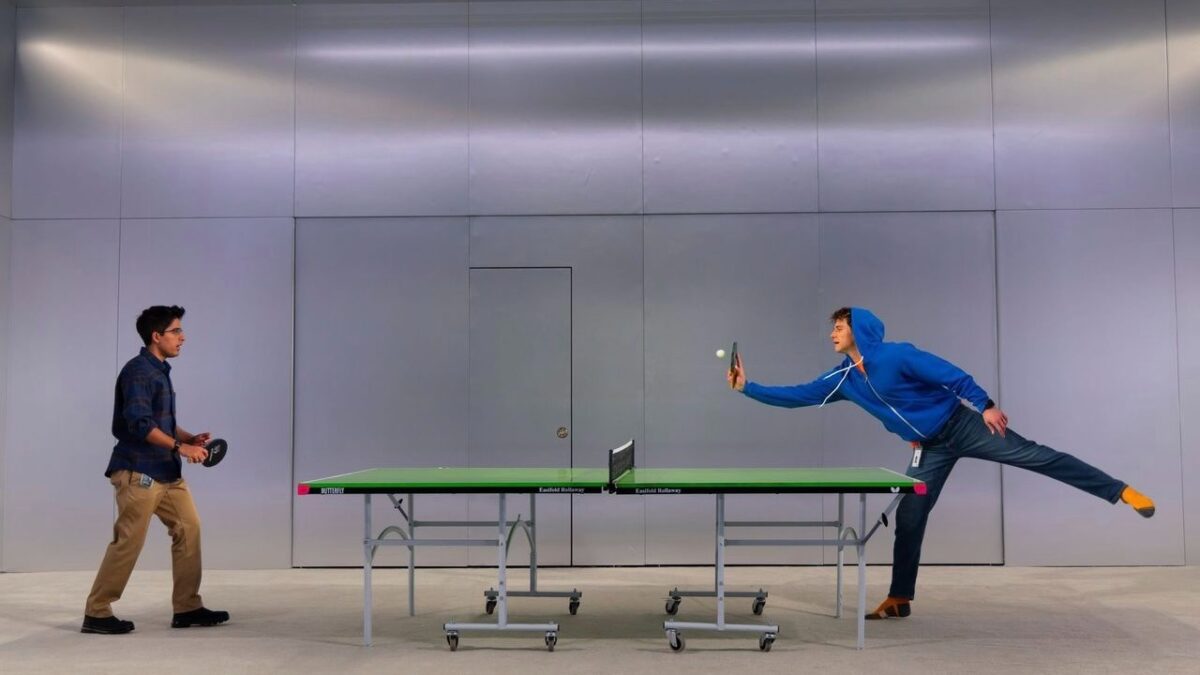
Photo by T. Charles Erickson courtesy of Polk & Co.
All of this pushes the audience to sit with uncomfortable questions: does your paycheck matter more than human rights? What role do individuals play in systems that cause harm? And how much power do we actually have to resist them? The play doesn’t provide clear answers, and neither does the real world. We still haven’t figured out the ethics of data capture. Mark Zuckerberg once again testified last month about the role of ethics in the business models and worlds of social media — eight years after the initial congressional hearing that inspired Libby to write this play.
Libby’s choice of incorporating immigration into Maneesh’s story, through the elements of his family life, and the incorporation of the top-secret Department of Homeland Security (DHS) project shows the real-world stakes of data. There is more to statistics than numbers, it’s human life. As Alex says, while trying to quiet Maneesh’s moral concerns, “We are our data,” and it’s not difficult to imagine what DHS could do with a predictive software like this, one that would rate people as beneficial additions to the country or not, in turn rejecting or accepting them into the U.S., if it existed at a larger scale.
In fact, we don’t have to use our imaginations. With the use of artificial intelligence, machine learning, and biometric identification in order to “secure the homeland,” as the DHS website claims, we’re already seeing in real-time what artificially intelligent technology like that depicted in DATA is capable of, and what it inspires government agencies to do. Recent U.S. Immigration and Customs Enforcement (ICE) raids, abductions, and murders have all been aided by technology, and that technology is created by everyday people working in offices, just like the one on stage in DATA.
It’s easy to feel disconnected from the people in charge of Big Tech, and even if tech bros can seem irritating or cartoonish, they are actively influencing the world — politically and socially — whether we like it or not. The medium of theater forces the audience to confront the calculating world of data companies, live and in person.
As Jonah tells Maneesh, after discussing their work’s potential harm to human rights, “[it’s] precarious times, bruh.” In a world where technology and data are evolving at incomprehensible rates, DATA urges its audience to reflect on their own participation in these systems, quietly asking whether the work we do — and the institutions we help build — might be making the world a worse place.


Leave a Reply