
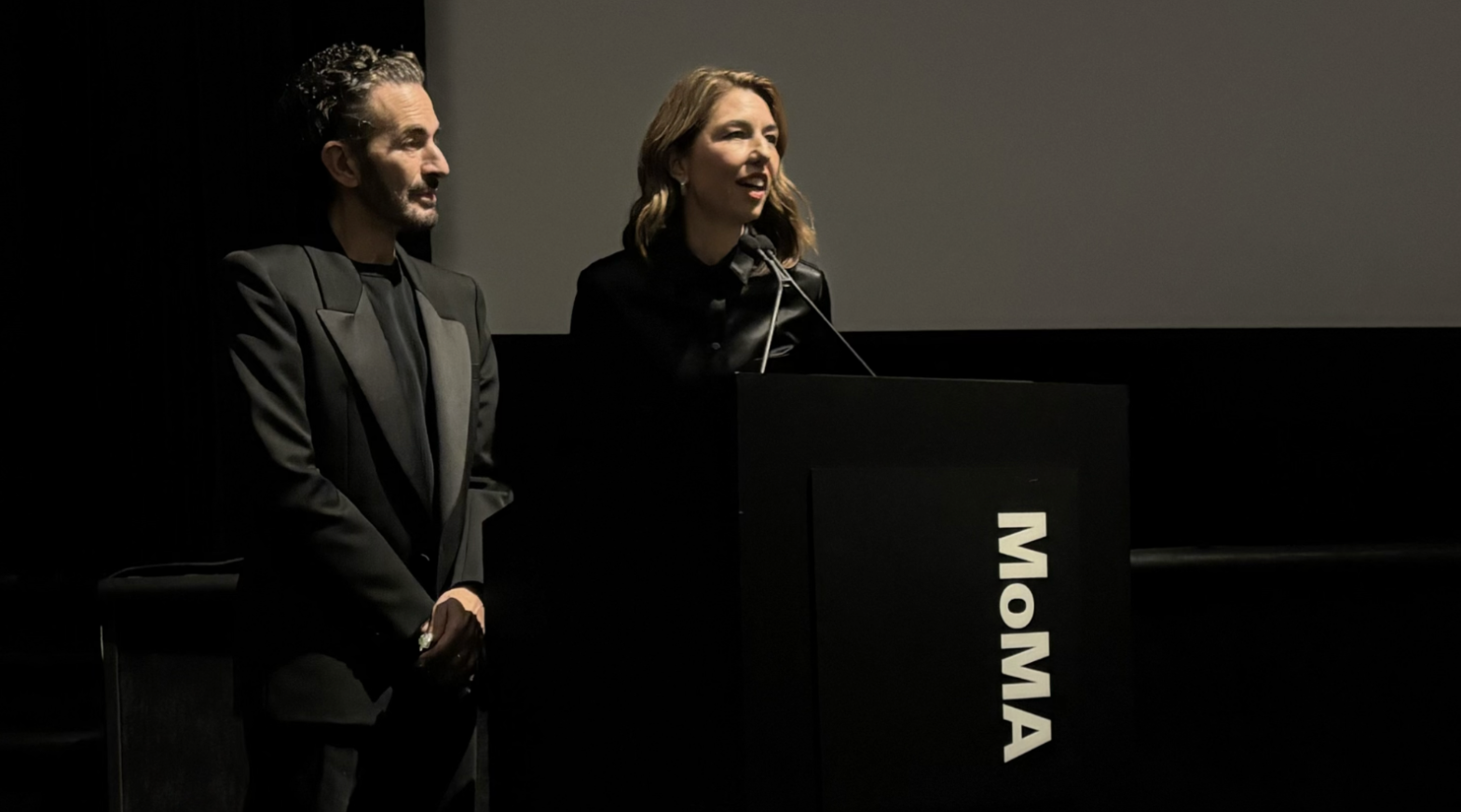
Marc by Sofia isn’t just a love letter to designer and Parsons School of Design alum Marc Jacobs’s history — it’s a collage of every inspiration and influence pertinent to the designer’s work and his living legacy within the fashion industry through the eyes of longtime friend Sofia Coppola. “I wanted [it] to feel personal and intimate, but also make sure the audience felt like a part of it,” Coppola said during the Q&A segment at the film’s New York premiere.
The New York premiere was held March 11 at the Museum of Modern Art, drawing a sold-out crowd of friends, family, and fashion devotees. Demand was high enough that theater staff made announcements warning that some attendees would not be guaranteed a seat. The audience dressed for the occasion — statement tights in bold colors, crisp tweed coats, and garments from Jacobs’s eponymous label scattered throughout the crowd. New School alum Anna Sui was a notable guest.
In the Q&A segment following the screening, Coppola and Jacobs expanded on their friendship and the process of creating the film. For Coppola, the project was not without its anxieties. “I don’t know how to make a documentary. And it’s my friend, so I have to do a good job. It’s too much pressure,” Coppola said.
While Marc by Sofia is Coppola’s documentary debut, she is not new to sourcing true stories. Her 2013 film The Bling Ring drew inspiration from a series of high-profile Los Angeles burglaries. In many ways, The Bling Ring acts as a sort of predecessor to Marc by Sofia, with its semi-linear narrative incorporating scrapbook-style editing of headlines, posts, and music.
That foundation gives Coppola the confidence to push against documentary convention with a rebelliousness that mirrors Jacobs’ design ethos. The film moves fluidly between sit-down interviews, backstage runway footage, and childhood photographs, all set against a 90s grunge soundtrack. “I thought the visuals were so beautiful. I kind of loved how it wasn’t super traditional,” Norah said, a 21-year-old student at the Fashion Institute of Technology who attended the showing with her friends.
Though the documentary spans Jacobs’ story up to the present, it is anchored by his creative process behind the spring 2024 collection — framing the film as a meditation on beginnings, change, growth, and the particular anxiety that precedes both. “There’s so much fear in starting,” Jacobs said in the documentary.
The film also gave weight to the cultural references that shaped Jacobs’ creative identity. In fact, these references were what bonded Coppola and Jacobs: “We shared all these interests in photography and art, cinema, music, from the beginning.” Jacobs said. “We did feel that a lot of those things that we love, we share.”
With a friendship spanning decades, Coppola resists the role of detached observer, functioning less as a documentarian and more as a double to Jacobs — their histories intertwined into one, beginning with Coppola’s X-Girl “guerrilla” fashion show production intentionally held a few streets down from Jacobs’ Fall 1994 Ready-to-Wear collection.
Coppola’s approach to her subject is notably tender. Where her work in films such as Lost in Translation and The Virgin Suicides had often gravitated toward alienation and quiet anguish, she was deliberate here in defying that pull. Jacobs’s difficult childhood, of course, was a key facet in his development, but she understood Jacobs is a success story, not a tragedy.
What the film interrogates instead is how difficult upbringings inform a body of work without wholly defining it. “I was interested in where people’s creativity comes from … and how your childhood or developmental things affect what you create,” Coppola said. “So I wanted to tell a little bit about that without crying.”
Among the film’s more resonant moments, particularly for student viewers, is a segment tracing Jacobs’ years at Parsons. Ian Nicastro, a Parsons integrated design student at the time, appears in the film, asking Jacobs directly about how his time in school shaped the trajectory of his career.
During his time at Parsons, Jacobs became the youngest recipient of the Council of Fashion Designers of America’s Perry Ellis Award for New Fashion Talent for his senior thesis, which featured three sweaters he designed and his grandmother hand-knit. “I worked really hard,” Jacobs said in the film, recalling his school years.
That work ethic carried into his career. As the film makes clear, Jacobs entered the industry with an unusually clear-eyed sense of the distance between school and professional reality — so much so that his professors, by his own account, called him jaded.
Yet his jadedness gives him an edge that many designers lack. From being fired from Perry Ellis for his now acclaimed grunge collection, to introducing ready-to-wear collections to the then luxury luggage brand Louis Vuitton, the documentary celebrates innovation and nonconformity.
Marc by Sofia is bold, loud, and unapologetic — a must-see for any fashion lover and aspiring creative. Like his branding, in a world full of lowercase, Jacobs has always screamed in all-caps — and Coppola makes sure you feel it.








Leave a Reply