
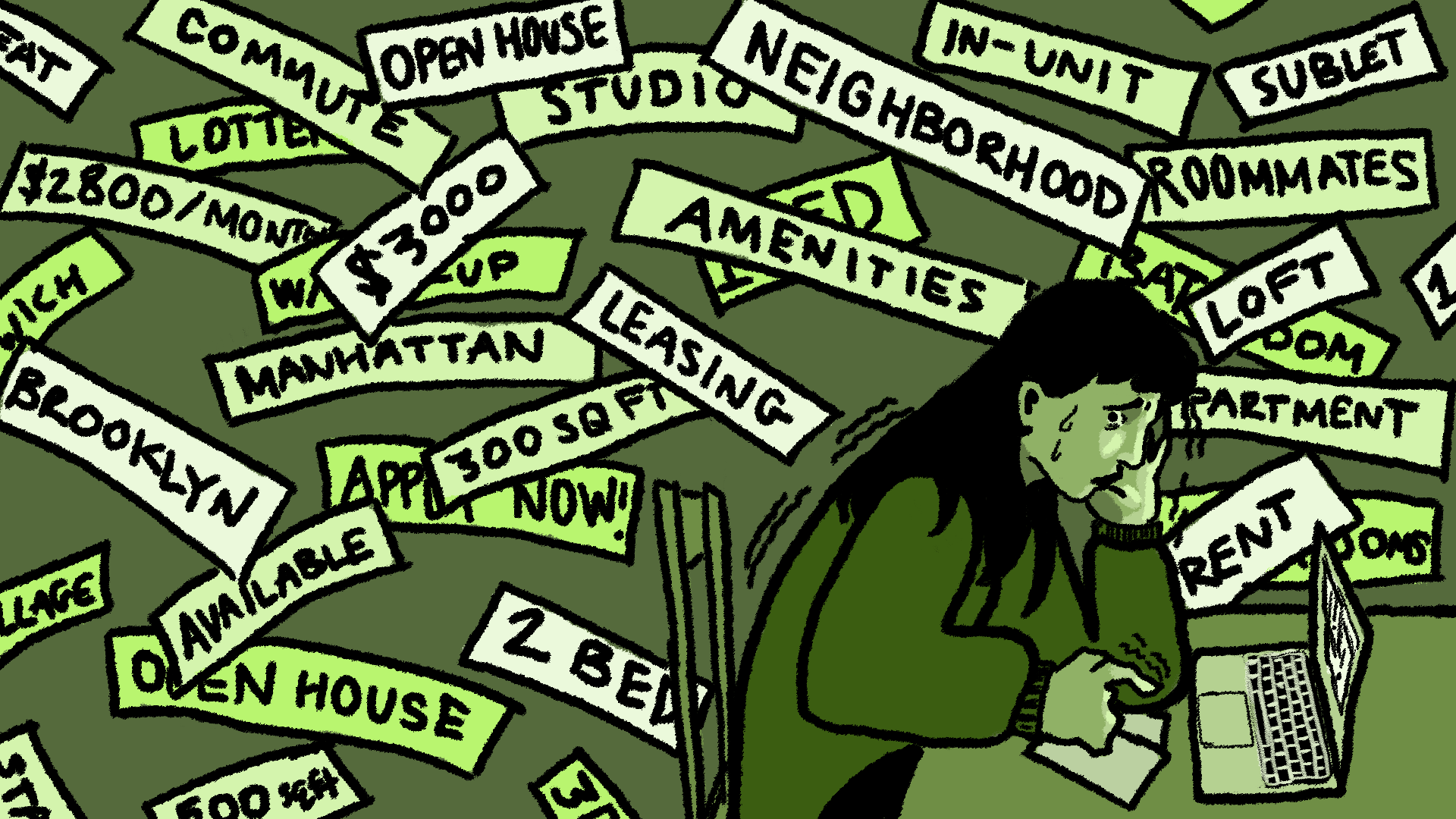
During breaks from a federal work-study shift at the University Center Library, second-year student Blossom Marquez scrolls through job boards, on the hunt for part-time work to help her afford rent. Marquez studies communication design at Parsons School of Design. A job within her field would be ideal, but in an effort to pay rent, she recently interviewed for a role at Chipotle. This choice is not uncommon among artists and creatives struggling to survive in New York City.
New Yorkers often proclaim, “New York or nowhere,” but in order to avoid nowhere, they must be able to afford rent –– a notoriously difficult feat. The most recent governmental data indicates that 43% of all renter households in the city are rent-burdened, meaning that they spend more than 30% of their income on rent. Some independent studies indicate that the number is even higher; a study from the NYU Furman Center for Real Estate and Urban Policy finds that more than half of all New York City renter households are rent-burdened.
In Manhattan, The New School’s home base, rent is even worse than in other parts of the city. The median monthly rent here in 2023 was $2,148 –– the highest of all the boroughs. By contrast, the median monthly rent in Brooklyn was $1,650, and in the Bronx — the city’s most affordable borough — median monthly rent was still $1,280.
Because TNS is a private university, its student body is often assumed to be wealthy. However, 97% of undergraduate students receive financial aid, according to the Integrated Postsecondary Education Data System. Steep housing costs on top of the university’s tuition and fees can add up, even with financial assistance.
That’s certainly true for Marquez. She lives in Flatbush, Brooklyn, with one roommate. Although her apartment is livable, Marquez spends a lot of time at her boyfriend’s family home to enjoy more space. She works multiple jobs to pay rent, including a federal work-study job as well as a custodial job at The Lighthouse.
Still, that income hasn’t sufficed. When asked whether Marquez can currently cover rent, she said, “Right now, no. I’m not getting scheduled enough for my other job.”
Finding another on-campus job isn’t a viable solution. “The issue of that is that, regardless of how many jobs I have here [at TNS], there’s a limit to the funding that I can receive,” Marquez said. As a work-study student, her award only allows her to receive $4,000 a year from her on-campus job, leaving her little choice but to seek additional income elsewhere.
John Mo, a second-year fashion design student at Parsons School of Design, doesn’t face the same challenges with federal work-study, but his rent is still burdensome. After a year spent in student housing, his family paid for him to move to an apartment in Long Island City, Queens.
“I think housing in general is definitely expensive in New York City, but I feel like that’s probably kind of expected,” he said. He added that his family “wants me to be reasonable, but at the same time, because I’m alone … they want me to have a good quality lifestyle.” That desire for a certain standard of living prompted the decision to move Mo off campus.
Mo expects that his family will continue paying his rent throughout college, and then he will pay it himself after he graduates. His little sister is not in college yet, but he expects that his family will support her as well, or she will live at home if her college is close enough to commute.
To avoid navigating the city’s rental market, more than 2,000 of TNS’s roughly 9,000 total students opt to live on campus. But that convenience comes at a premium. According to an email that University Housing sent this month about 2026-2027 academic year housing rates, a triple room –– the cheapest and most cramped room offered through on-campus housing –– will cost $9,010 total per semester, or roughly $2,252 per month. That rate is over $100 more than Manhattan’s median monthly rent. The second-cheapest room costs almost $500 more than Manhattan’s median monthly rent.
These high costs particularly impact TNS’s over 3,000 international students, who make up 38% of the student body. They face specific challenges with securing off-campus housing, such as a lack of a credit score, which can make signing a lease significantly more difficult.
Dasha Teres, an international second-year graduate student studying voice at the Mannes School of Music, experienced this struggle firsthand last year. She ultimately found an apartment in Prospect Lefferts Gardens that she described as affordable and suitable. Her one-hour commute to school wasn’t ideal, but it was doable since she lived right off the 2 and 5 trains.
Yet she faced considerable challenges when trying to pay her rent. “I was paying from my savings, essentially all I had saved up for school, because I’m an international student, so I couldn’t actually work anywhere other than on campus,” she said. “And no one would respond to all the job applications that I put in through the school’s workplace portal.”
During her second semester, she finally got an on-campus job as an usher after reaching out to someone she knew to schedule an interview. The income provided some relief. “But if I didn’t have those savings, I would have no way to pay my rent,” she said.
Determined to avoid similar financial strain this year, Teres left her apartment and became a resident assistant at the 301 Residence Hall. Her role provides free housing and dining dollars. “It’s been good,” she said. “I mean, I think it’s not an easy job, but I think … living for free is worth it.” She acknowledged that supervising fellow students can feel awkward at times, but she values having her own room within the shared suite.
Still, living with other people has meant adjusting her creative process by being more intentional about when she can practice her singing. For Marquez, constant job searching cuts into time that could be spent on design projects, and a daily, eighty-minute, round-trip commute similarly limits Mo’s creative energy for fashion design. Just knowing the commute that awaits him, Mo often opts to return home right after class instead of staying later to use the school’s equipment.
These constraints don’t bode well for New York’s artistic pipeline. The artistic community, already reeling from a tough job market and worried about affording basic needs, will continue to struggle if the students who fuel it can’t afford rent or are too tired from working menial jobs to create art. For anyone who cares about art in our city, skyrocketing rent should be a major concern.










Leave a Reply