
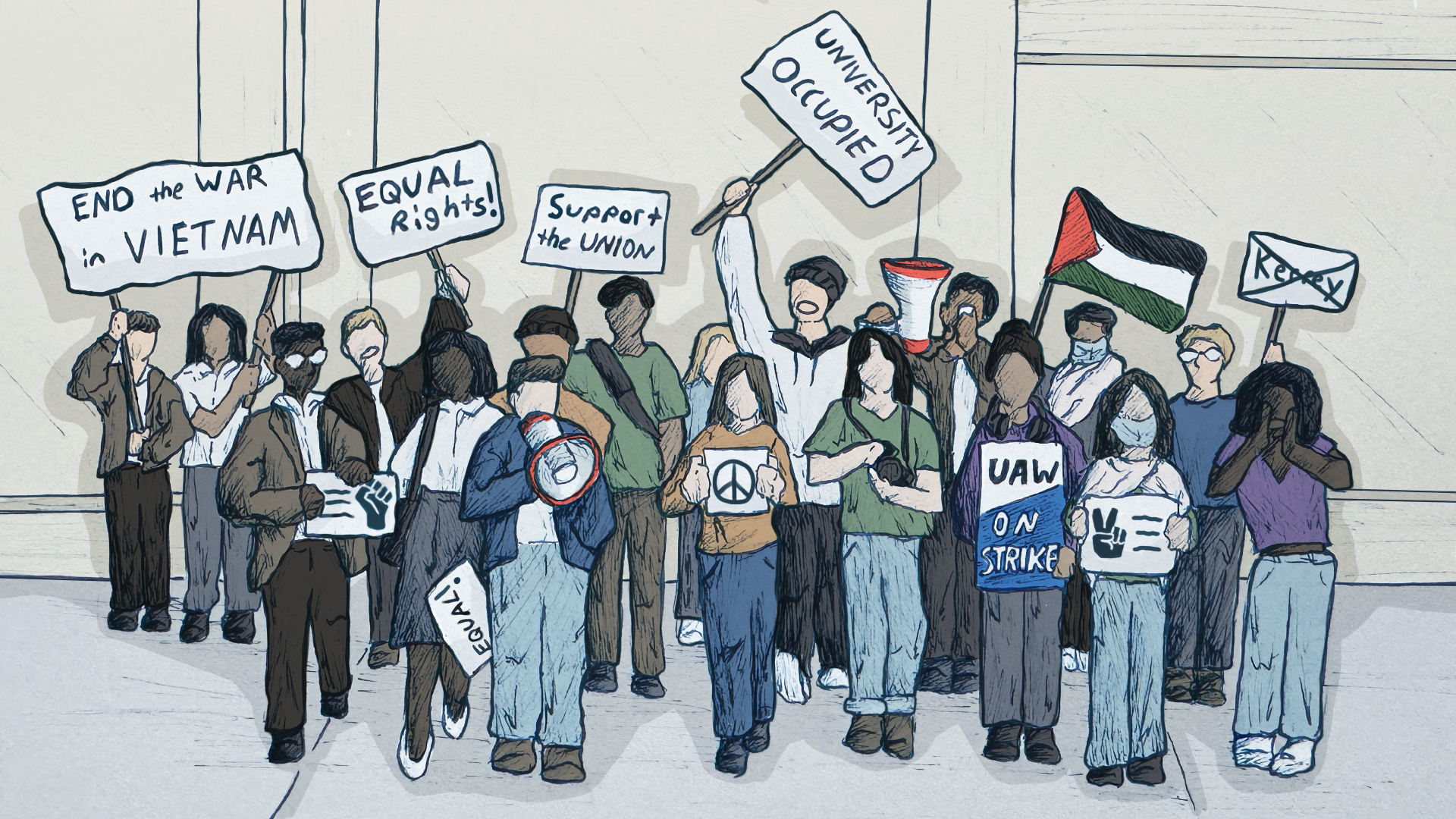
Upon its formation, The New School positioned itself in opposition to the mainstream — rooted in a forward-thinking vision rather than a traditional educational model. Founded in 1919 by a group of activists, educators, and scholars, it was conceived as a progressive experiment, creating a new academic model geared toward solving contemporary problems. By 1933, that mission expanded with the creation of the University in Exile, where philanthropic support allowed The New School to house fleeing intellectuals during World War II.
To this day, the school prides itself on its subversive roots, advertising on its website, “Discover a new kind of university … one where scholars, artists, and designers come together to challenge convention and create positive change.”
As such, it is no surprise that protesting has become an integral part of TNS culture. Despite the school’s founding progressive precepts, Director of the MFA creative writing program and author of A Drama In Time: The New School Century, John Reed, highlighted the school’s inherent ties to wealth and upper society. “Unfortunately, I think it’s in the DNA at the school,” Reed said. “We’ve always been a kind of establishment anti-establishment.”
What Reed called an “uncomfortable relationship” between the institution’s reality and its ethos remains in The New School’s history of resistance.
One major chain of demonstrations in TNS history was the student and faculty response to the Vietnam War during the 1960s and 1970s — a moment that underscored the global consciousness students and faculty have long claimed as central to the institution’s values.
In one circulated flier from around 1970, a student organizer wrote, “Business as usual in American Universities today means acquiescence and COMPLICITY with American government policies.” Their demands were simple: to end the war, the oppression at home, and “the prostitution of the universities in service to these wars.”
At the center of the unrest was board of trustees member Ellsworth Bunker, who was both a supporter of the Vietnam War and an ambassador to South Vietnam. Students, disapproving of his ties to the school, occupied buildings across campus, urging the removal of Bunker’s position on the board and the recognition of anti-war sentiments on campus.
Groups like the TNS chapter of Students for a Democratic Society (SDS) established student publications like New Speak and Granpa, a leftist student newspaper. SDS members and New School students Naomi Jaff and David Gilbert would go on to join The Weather Underground, a “revolutionary offshoot of SDS,” according to The New School Archives.
In a 1970 essay published in the New York Review of Books, the founder of TNS’ graduate anthropology program, Stanley Diamond, and New School for Social Research Professor Emeritus Edward J. Nell, reflected on the intensity of the protests, writing, “The school, it turned out, was not just their arena for routine and scholarly business; it was the central symbol of their lives.”
In the essay, the two framed the protests as containing both generational and cultural nuance. “One generation’s chaos is, after all, another’s cultural style,” the article said. Even then, these two faculty members pointed out a dissonance between the students’ economic statuses and their demands. “It would, however, be wrong to assume that this cultural style cannot be negated by certain social realities. These are, after all, children of the bourgeoisie,” they wrote.
Alongside anti-war protests, The New School community also mobilized around racial justice amid the ongoing civil rights movement that was sweeping across the nation. In 1969, students in the sociology department called for the hiring of more Black faculty, and the next year, New School staff observed the first Black Solidarity Day. Two decades later, the school would face backlash on campus about an artist’s work on display, which Reed referred to as “the Shin Matsunaga Affair,” and in the 1990s, students formed the Mobilization for Real Diversity, Democracy, and Economic Justice to protest the denied reappointment of a prominent Black professor.
The Shin Matsunaga affair once again brought to the forefront the failings of the university’s commitment to diversity in spite of its socially conscious roots. In 1989, Parsons School of Design exhibited work by Japanese designer Shin Matsunaga, including an image depicting blackface, used as the logo of a popular Japanese soft drink. Leading the dissent against this exhibition, poetry professor Sekou Sundiata drew an “X” onto the image, and 40 others followed suit. Sundiata told the New York Times, “The New School doesn’t have the right to invite someone into my community to insult me.”
Though the work remained on display, the protest galvanized a deeper institutional reckoning around race and representation. This momentum carried into 1996, when students rallied against the denied retention of visiting Eugene Lang College of Liberal Arts professor of gender studies, M. Jacqui Alexander. Protests included demonstrations, forums, and, ultimately, a 19-day-long hunger strike.
“Faculty of color come here through a revolving door,” Alexander told The Chronicle for Higher Education. “We come, and we leave.”
With the new millennium came new problems.
A wave of unrest took shape in the 2008-2009 academic year, and again in 2011, sparking multiple student-led occupations across campus. Campus culture at the time was not dissimilar from our present: students were increasingly dissatisfied with administrative leadership and handling of finances.
The first protest unraveled in December 2008, following the sudden resignation of Joseph Westphal as provost — the fourth turnover of the position in five years. Just two days after receiving the news, Senior Faculty Senate Chairs Jim Miller and David Howell held an emergency meeting where members voted 74-2 in a motion of no confidence against university president Bob Kerrey.
The following week, on Dec. 17, students occupied the cafeteria in the old 65 Fifth Ave. building. This student coalition would later be known as The New School in Exile (NSIE), a name that deliberately echoed the university’s past. Building up the momentum from the faculty council meeting, students further condemned Kerrey’s adamant support for the Iraq War and his alleged war crimes in Vietnam and demanded his resignation. Amid confrontations with security and Kerrey himself, students and administration made efforts to negotiate on the terms of ending the occupation. The occupation concluded with administrators agreeing to the students’ core demands for greater administrative transparency and student inclusion.
By the 2009 spring semester, however, NSIE organizers were already preparing further action and demanded Kerrey’s resignation by April 1. When no resignation occurred, protests broke out on the morning of April 10, accompanied by the occupation of the 65 Fifth Ave. building. On the NSIE’s website, they wrote, “With their demand still unmet … students have once again reclaimed this neglected, symbolic building which housed the New School for Social Research.”
Unlike the December occupation, this second attempt ended on the same day after police responded and arrested demonstrators. The response sparked protest efforts around campus the following week.
After increasing pressure, Kerrey announced in early May that he planned to resign when his contract ended in July 2011. Yet, over a decade after his exit, Kerrey remains a catalyst for protest on campus, such as the recent graffiti of Kerrey Hall following revelations of his ties to Jeffrey Epstein.
In November 2011, a third occupation unfolded in solidarity with the Occupy Wall Street movement. “Today, the university is a supreme symbol of social and economic inequality,” NSIE organizers wrote on their website. “We will reclaim this elite space and make it open to all.”
Students occupied the 90 Fifth Ave. building on Nov. 18. Unlike the previous occupations, this one was supported by the school and functioned as an occupied space for any NYC college students, not just New School community members.
Another occupation occurred in May 2018, in light of May Day. Organized by The New School Communist Student Group, students fought against cafeteria worker layoffs and loss of benefits. Within a week, school officials announced via email that they were going to give cafeteria workers their jobs back, and the cafeteria occupation dwindled before coming to a close on May 17.
Concurrently, SENS-UAW, which represents academic student workers at TNS, held a strike during finals season, using the academic calendar to intensify pressure around financial demands. While students occupied the cafeteria, community members were picketing outside. SENS-UAW threatened to strike again in Nov. 2018 if they were unable to negotiate a new contract before then. After months of protesting, they were able to reach an agreement with the school just before the end of the year.
Four years after the labor strike in 2018, in the fall of 2022, nearly 2,000 part-time faculty members represented by UAW Local 7902 went on a 25-day strike, demanding contract renegotiations around wages, healthcare, and job security, among other pressing issues.
“Going on strike was not something I wanted to do,” Matthew Spiegelman, a part-time professor of photography at Parsons, said. “None of it would have happened had the essential position that the administration took been that instructors, professors, teachers are at the core of a university.”
Spiegelman echoed the sentiment the union shared — these efforts weren’t occurring on a whim. Rather, this was out of necessity, and, as Spiegelman asserted, it operated logically. It was that logic which led to a renegotiation of the terms of the contract, despite initial resistance from administrators.
“For the part-time faculty strike, we were protesting the idea that our knowledge and skill had no value,” Speigelman said. He also acknowledged the risks of escalation in a moment already defined by instability. “But I don’t believe in protest for the sake of protest,” Speigelman said.
He offered a reframing of The New School’s common narrative. “It’s not dissent that links us,” he said. “It’s the desire to build something that is available to the most amount of people.”
That desire for a just institution is what led to one of the most recent major waves of protests during the 2023-2024 school year. The New School’s Students for Justice in Palestine (SJP) and Faculty for Justice in Palestine (TJP) led various demonstrations in solidarity with the broader movement of encampments across college campuses. “We were always very straightforward about where our political solidarities lie, and what political coalition we were interested in building,” said Ryder Glickman, a third-year economics student at Lang and vice-chair of the University Student Senate (USS).
SJP’s mobilization included walkouts, a rally, and encampments as they demanded that TNS administration divest from companies complicit in the Palestinian genocide, disclose the school’s finances, and cut ties with the Conservatory of Tel Aviv, according to Glickman. “But again, it was also principally about protesting the genocide in Gaza, in Palestine,” Glickman said.
TNS FJP also established the first faculty encampment in support of Palestine during this time, named the “Reaat Alareer Faculty Solidarity Encampment.”
Multiple students, including Glickman, faced disciplinary action from administrators for their involvement in demonstrations. For Glickman, however, those consequences were secondary to the broader cause. “Any sort of personal things that happened to me were always just part of the larger movement, and part of a larger structure. But then, of course, we all had each other, which made it much easier.”
While often labelled as disruptive, Glickman instead emphasized the importance of “escalation,” to place pressure on administrators. “We took three buildings. We kept pushing and pushing and pushing it. And then eventually, there [were] arrest[s]. But that spurred further mobilization,” he said. “They only listened to us once we made it an inconvenience that they couldn’t ignore.”
What is the future of protests for The New School? With university-wide disapproval for the restructuring plans, new efforts to organize against austerity are already taking shape. This past winter semester, community members mobilized against the cuts outside of a board of trustees meeting, as well as delivering a ten-foot letter signed by over a thousand people protesting against the proposed cuts to President Joel Towers this past March. The efficacy of these protests remains in the hands of the faculty and students who continue to place pressure on their demands against restructuring.
The New School may remain at odds with its existence as an institution and as a progressive beacon — but this internal conflict isn’t new. “We have to honor these progressive legacies, but that can only go so far. At the end of the day, the university can’t support a movement antithetical to itself,” Glickman said. “It’s the students and some of the faculty that are really sort of believing this progressive radical vision.”
Leave a Reply