
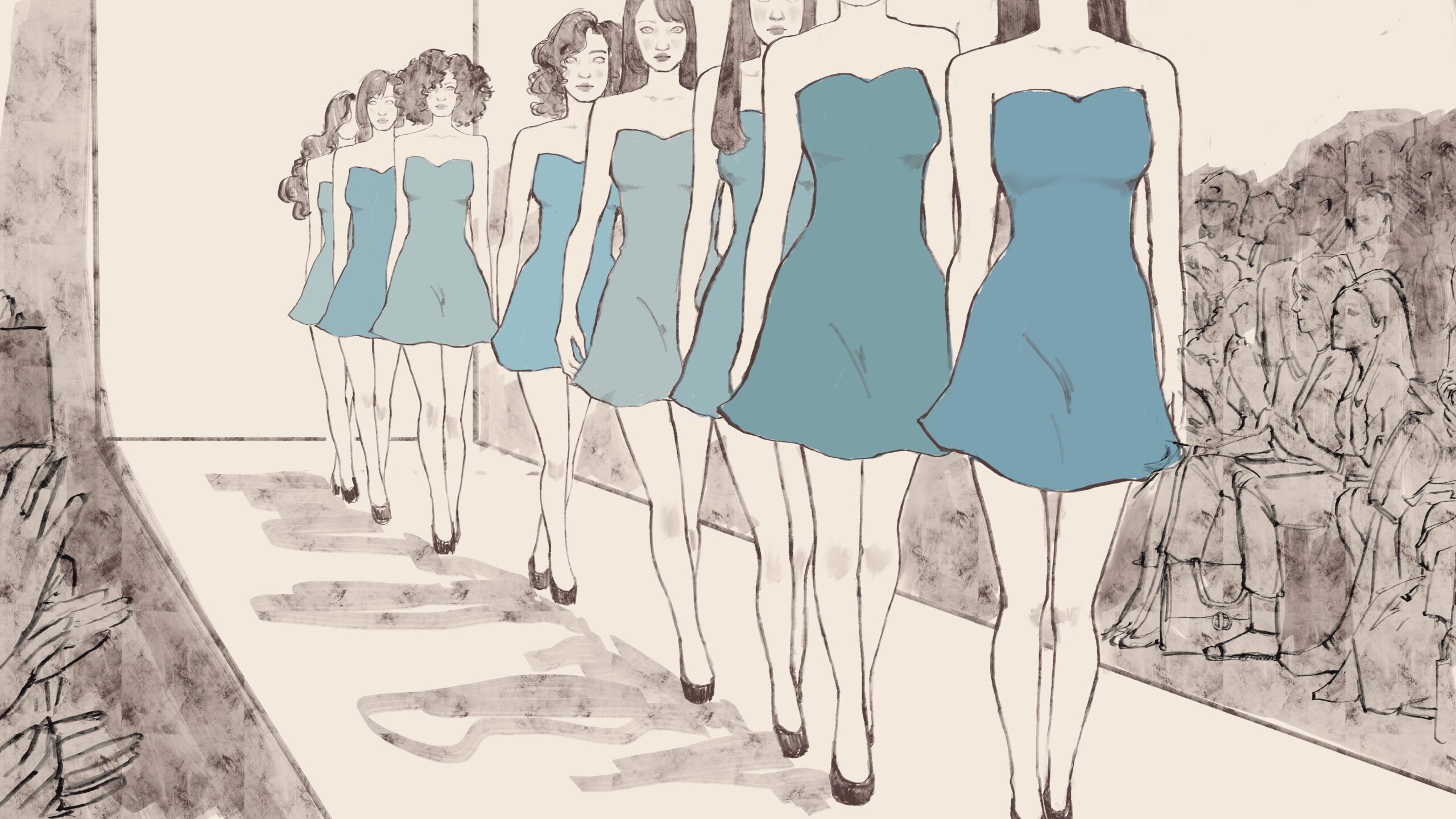
Think glamour, flattering silhouettes, and statement pieces that leave you jaw-on-the-floor drooling. That was New York Fashion Week. But what was once a cultural force that dictated how the world dressed doesn’t seem to hold the same charm anymore.
Perhaps social media and the short, vertical-format content makes one see trends differently. There is, without a doubt, a clear distinction between the trendy and the timeless when it comes to fashion.
Bandage dresses were introduced as an iconic statement piece back in the 2000s and early 2010s from Hervé Léger’s New York Fashion Week show by Max Azria. It showcased body-con, panel-stitched dresses emphasizing a sculpted, hourglass figure. Celebrities like Kim Kardashian and Paris Hilton further sensationalized the look.
This look slowly faded away as the style felt restrictive and exposed. By the late 2010s, it was seen as dated, being associated with the “Instagram glam look” rather than high fashion, as NYFW branded its clothes with more loose and experimental silhouettes.
Compared to the infamous 1992 grunge collection by Marc Jacobs that made headlines and shocked the fashion industry, today’s fashion shows are bland and, well, quite expected.
New York Fashion Week is where designers earn their legacy and collections become stories that live on. A chance for models to showcase themselves. However, when I ask fashion students, industry experts, and fashion lovers who collect magazines and attend events about this year’s fashion week, no memorable fashion pieces come to mind.
Is it the thrill of being part of something “big”? Is it seeing front-row celebrities? I’m not too sure about the answer, but as the shows seem to get more and more predictable, many fashion lovers and regulars at fashion shows are aware of the “vibe shift” and are criticizing publicly.
Leyla Tagi, from the design and technology department at Parsons School of Design, agrees fully. “I am a big fan of the Calvin Klein Spring/Summer 1994 collection,” she said.
“In the past, we could see the unique qualities of brands on the runway,” Tagi said. “For example, Calvin Klein always stood out with its minimal style. The brand’s colors, black and white, were not just colors; they carried the message of ‘this is who I am’ and ‘this is what makes me different.’ Now, whether it’s the new Calvin Klein or other brands, I can’t really say they excite me.”
As a Calvin Klein lover, she shows her disappointment. “Before, there were patterns I admired … ones my imagination couldn’t even think of, but now I feel like I’m just seeing the same things over and over again.”
Parsons illustration student Jorie Mickelson came to New York partly for its fashion scene, but she says the excitement she once associated with it has faded. “I have to say, NYFW feels dead,” Mickelson said. “The biggest evidence is that I don’t hear much about it anymore. Media coverage isn’t that great, there’s so much happening in the world, and fashion feels like it’s being pushed aside.”
Mickelson believes much of the industry’s creative energy has dulled because of its fixation on trends. “A lot of brands just follow what’s popular. Bows are everywhere, and cheetah prints are making a comeback,” she said.
“But they’ll die out soon because everyone’s doing the same thing. My reaction to watching these trends is always, ‘Okay, what else?’”
She feels that New York Fashion Week has lost the edge that once made it a cultural force. “It’s chilled out,” she said.
Mickelson hopes to see a return to risk-taking in design. “Fashion should be about ideas no one’s ever thought of,” she said. “Society shapes fashion, and right now, people view unique things as ‘cringey.’ If we start embracing uniqueness, maybe fashion will, too.”
Dual-degree New School student Nehir Unal, who studies economics at Eugene Lang College of Liberal Arts and interior design at Parsons, agrees that NYFW is dead.“Back in the days … it had more … personality.”
She believes the front row, that once meant prestige and authority within the fashion world, has lost its essence. “Guests are all influencers or celebrities who don’t seem to have an impact on fashion itself,” she said. “‘Front row’ used to mean something big; it was reserved for major names like Victoria Beckham, Beyoncé, or even Paris Hilton.”
Unal also feels that fashion itself has become too standardized and predictable. “It’s something very boring and basic now, something anyone can make,” she said.
“I want to see something big again. Brands are always inspired by each other. Ralph Lauren did a boho chic collection, and then Michael Kors added boho touches to theirs. It’s always one following the other instead of showing off their own identities.”




Leave a Reply