
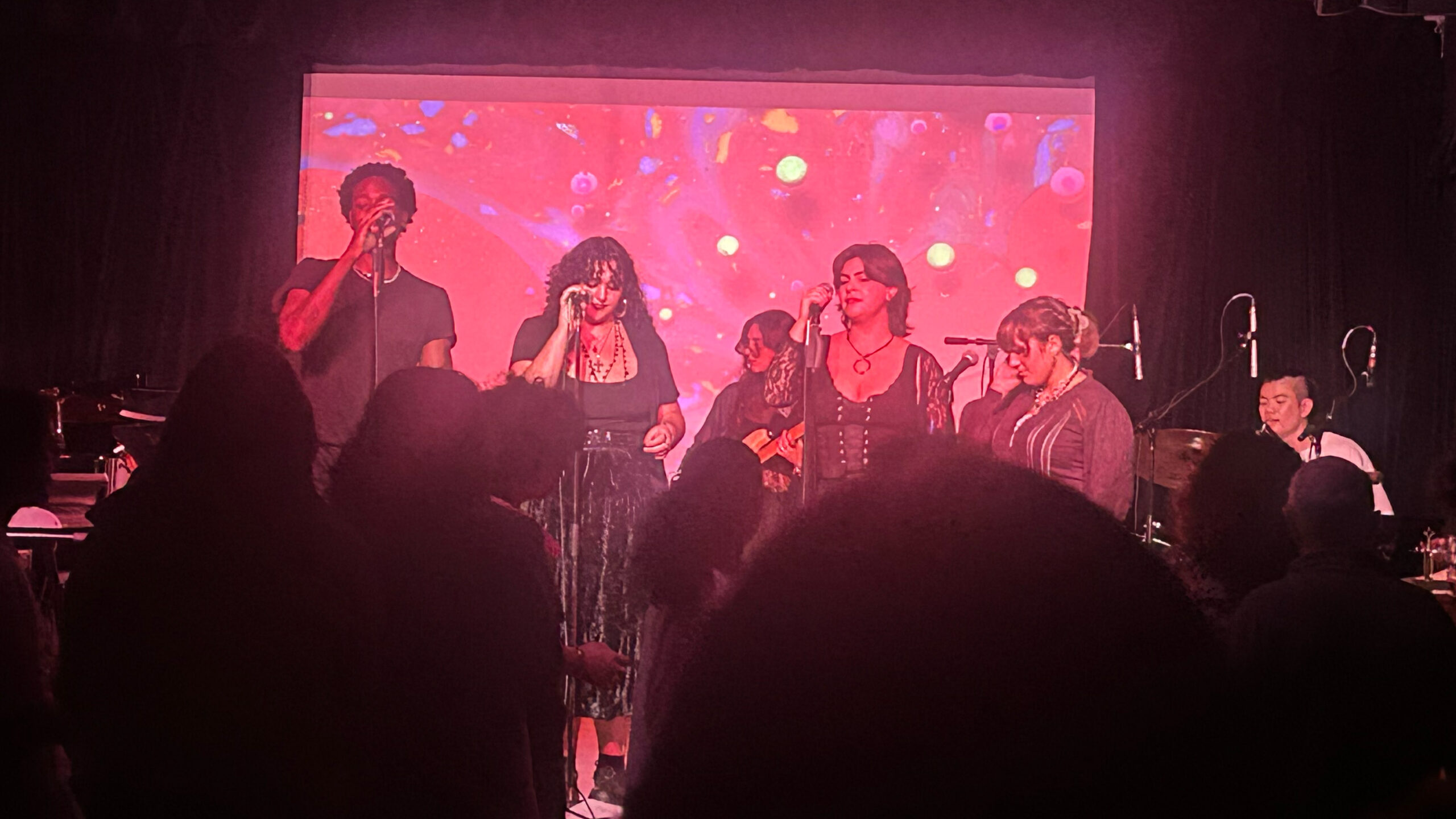
For one hour on a Friday night, Arnie Lawrence Hall turned into a time capsule of a “far-out” sound — steady, hypnotizing percussion, dreamy guitars, and passionate vocals reverberated through the dimly lit room. On Sept. 26th, the Psychedelic Rock & Soul Ensemble returned for its third annual performance at The New School.
Formed and led by Dirk Freymuth, professor at the School of Jazz and Contemporary Music, the group featured four singers, two drummers, one on congas, shakers, and tambourines, a bassist, a keyboardist, a saxophonist, and Freymuth himself on guitar. The Psychedelic Rock & Soul Ensemble, part of the School of Jazz and Contemporary Music’s five-week ensemble program, met to rehearse twice a week for five weeks before ending the class with a live concert.
The band delivered a number of colorful and meditative interpretations against a backdrop of hallucinatory visuals. Fractals and paisley patterns flowed colorfully behind the band as they danced and interacted with the audience. The crowd, encouraged to get involved with the show, was on their feet — dancing, clapping, cheering, and singing — by the end of the night.
The group draws from the mind-bending psychedelic movement of the late ’60s and early ’70s, a time when pop, rock, and soul were all inevitably influenced by the social unrest of the time.
“That [baby boom] generation couldn’t be ignored politically or culturally … There was the anti-war side of things, there was the hippie culture … [and] there was the civil rights movement,” Freymuth said. “There were so many young people, and they were able to voice protests, alternative lifestyles, and community.”
That social charge still resonates with students today. The ensemble itself began in 2023 from student interest, with the set list to change and evolve with each semester’s lineup. “A lot goes into [it],” Freymuth said of selecting this year’s songs. “Part of it is having contrast between the songs. It is a class, so I’m trying to present different musical challenges.”
This time, the show placed particular emphasis on the forward-thinking and funky soul roots of the movement.
“I have a master psych-rock and soul playlist with over a hundred songs on it,” Freymuth said on how he went about choosing this year’s tracks. He also noted that certain songs might be better suited to different performers and that it was nearly impossible to boil down songs until the final roster was decided.
This show’s set list pulled from artists like War, Funkadelic, Sly & The Family Stone, and K.D. Lang, with a special nod to Mothership Connection, the 1975 Parliament album celebrating its 50th anniversary, one of Freymuth’s favorite records.
Freymuth explained that by the late ’60s, the boundaries between psychedelic rock and soul had nearly disappeared. “Soul really picked up … on these psychedelic rock bands in terms of new effects [and] studio techniques … especially in San Francisco and Los Angeles,” he said. “Jimi Hendrix was all about those new guitar pedals, and, arguably, you could call him psychedelic soul music. There’s not a real clear demarcation.”
The ensemble has made a point since its inception to showcase the way soul was inspired by psychedelia, but this time Freymuth wanted to pay homage to soul pioneers like Parliament and Sly Stone, who passed away in June, a man who Freymuth described as the “OG of psychedelic soul music.”
Freymuth, who also teaches audio production, said that era’s recording innovations continue to inspire him. “That was a really pivotal time in how music was recorded and produced. They were starting to use the recording studio in different ways.” Between the new technology and the progressive attitudes, the period certainly had a permanent and irreversible impact on the way music is both created and heard.
Recreating that sound wasn’t easy. Freymuth said the biggest challenge for the group was matching the feel of those original recordings.
“It’s easy to listen to and go, ‘I can do that!’, but then … [once you start, you’re] like, ‘What’s wrong here?’ … [It’s] challenging to capture the vibe of it,” he said. “We don’t have that gear, but we can emulate it.”
“It was challenging even for those groups,” Freymuth said in reference to the trailblazing bands of the time, “but we have more flexibility with the live show. There’s a lot of tools available to us — keyboards [with many] preset sounds, the [assistant] has effects … that they wouldn’t have had back then. The wah-wah pedal, certain types of distorted guitars … echoes … create a more ‘trippy’ sound.”
When the ensemble took on KD Lang’s 1997 cover of The Hollies’ 1974 “The Air That I Breathe,” they used those same “trippy” effects to provide a hauntingly meditative interpretation of the original hit.
“That’s sort of our oddball,” Freymuth said when going through the years covered in the set list, “but it’s in a very hypnotic, psychedelic style.”
By the end of the night, the show’s interactive, communal energy — and the group’s trippy sound — perfectly captured what Freymuth loves most about the psychedelic era. “Just that sonic quality,” he said, “All these new … effects were introduced … They never went away; they just became … normal … And this is when it started.”


Leave a Reply