
It’s October 1985. It’s your first year at the Seminar College, a fairly new approach to higher education. Founded in 1972 under graduate school The New School For Social Research as the Freshman Year Program, it expanded in the mid-’70s into a four-year undergraduate degree program. A hub for progressive young thinkers encouraged to form original ideas about the world, it has already developed a rivalry with its Greenwich Village companion, New York University. Suddenly, the news breaks: millionaire educational philanthropist Eugene Lang (1919–2017), who liked to impulsively pay students’ tuitions and still ride the subway, has donated $5 million to transform your school into “the best of its kind.”
This was the case for Dana Hokin, a student who was part of the very first class to experience their freshman year at Eugene Lang College (she would graduate in 1988, but not before meeting her future husband Robert Garvey, a fellow Lang student). She wrote about it in a 1985 article as part of Insight Out, a student-run newspaper at Lang and a predecessor to the New School Free Press. It’s now part of a storied collection of historical items held by our very own archives.
Today, the Seminar College is known as The New School’s Eugene Lang College of Liberal Arts. That donation was the beginning of the fully-formed institution we know today. Much like the broader New School itself, Lang began as an experiment in progressive education — one that could not only match the times, but shape them. The New School Free Press sat down with Lang’s current executive dean, Christoph Cox, to reflect on where Lang has been, understand what it is now, and consider where we might be headed.
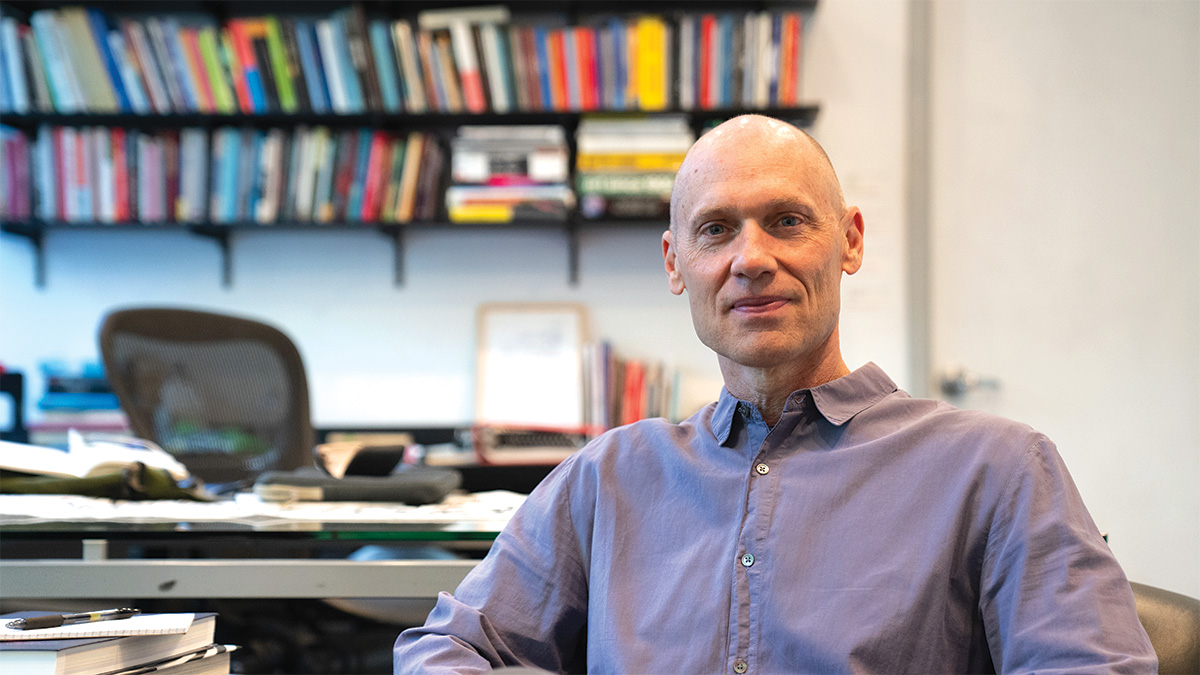
The first step to speaking with Dean Cox is understanding what it means to be a dean. He smiled as he said that students often stop by his regular office hours in the Lang Café just to ask, “What do you actually do?” His answer: he’s a curator of sorts — not of art, but of education. He oversees every part of the college, focusing primarily on new course development and faculty hiring.
“The main thing is just to lead the college in terms of: What is Lang? What do we want to be?” he said. Cox acts not only as an overseer, but also as a figurehead, representing the school to both the outside world and upper-level university administration.
He began his own educational career with an undergraduate degree in Semiotics (later to be renamed Modern Culture and Media) from Brown University before moving on to earn a PhD in the History of Consciousness from the University of California, Santa Cruz. Both were interdisciplinary programs designed to allow students to follow where their passions led. They allowed him to combine his love for philosophy with his interest in art, music criticism, and curation.
When he started teaching, he didn’t play up the fact that he was still doing art criticism and curatorial work. “I was trying to frame myself as a fully legit philosopher,” Cox said. Yet he never stopped allowing his passions to blend in his research and teaching, and when he was offered the position of executive dean at Lang in 2022, it felt like a perfect fit. “All of that … my colleagues tell me it makes me a good fit for this place,” he said of his versatile studies. “I feel like I have a sense of the whole curriculum.”
Much of Lang’s original structure hasn’t changed since its founding. “It’s pretty wild — we are still, forty years later, a seminar college,” Cox said. There have been some changes, like the introduction of majors rather than concentrations in 2008, but the college has worked to keep as much of the original school’s sentiment alive as possible. Students still have the option to design their own concentrated degree if they choose — just as they could in 1985.
Cox cited a speech by namesake Eugene Lang about the values of the college. “He talks about the importance of civic engagement, talks about the importance of a school to address pressing political and social and economic issues,” he said. “Those things are still there.”
Like all higher education programs in the United States, Lang now faces new challenges — some of which come from the White House. President Donald Trump’s view that American universities are run by “Marxist maniacs and lunatics,” and the administration’s interference with federal grants for academic institutions isn’t something The New School has escaped. “It’s affected some of our colleagues in powerful ways, colleagues whose grants were terminated,” Cox said.
Trump-era deportation policies have put new pressures on international students seeking higher education in America, reshaping the environment for university recruiting. “[At Lang,] we were on a small but significant upward trajectory in our international student enrollment, and it dropped this year,” Cox said. He also mentioned that it increased competition among liberal arts colleges for “domestic students,” or U.S. citizens. “Other universities and colleges were working hard to attract the same students, and we lost some of those students, which is not great,” he said.
This concern comes at a time when The New School is already struggling with enrollment and retention rates. But unlike some schools, Dean Cox is adamant that the university will not falter in the face of threats from the President. “We have this history; we’re not changing that to make ourselves more palatable to this political climate,” he said. He credits The New School’s radical and progressive history as the reason Lang attracts the students it does, which is why it’s important to keep Lang’s identity alive.
The conversation around higher education in the United States, however, isn’t just about which college to attend, but increasingly about whether to go at all. Similarly to Lang theater professor Marcos Steurnagel, with whom the New School Free Press spoke earlier this year, Dean Cox observed the phenomenon of trade-specific educational paths becoming increasingly unstable in the face of rapidly advancing technology. “In this particular age, training to be a particular something … [is] super risky,” he said.
What were previously called “soft skills,” or broader life skills such as communication, collaboration, or creativity, are now seen as “durable skills,” and are necessary for career success. Where does one go to learn those skills? Liberal arts college. “I want students to come here knowing that the liberal arts is actually a really good pathway toward excellent career options,” Cox said. “I would say a lot of America doesn’t know that.”
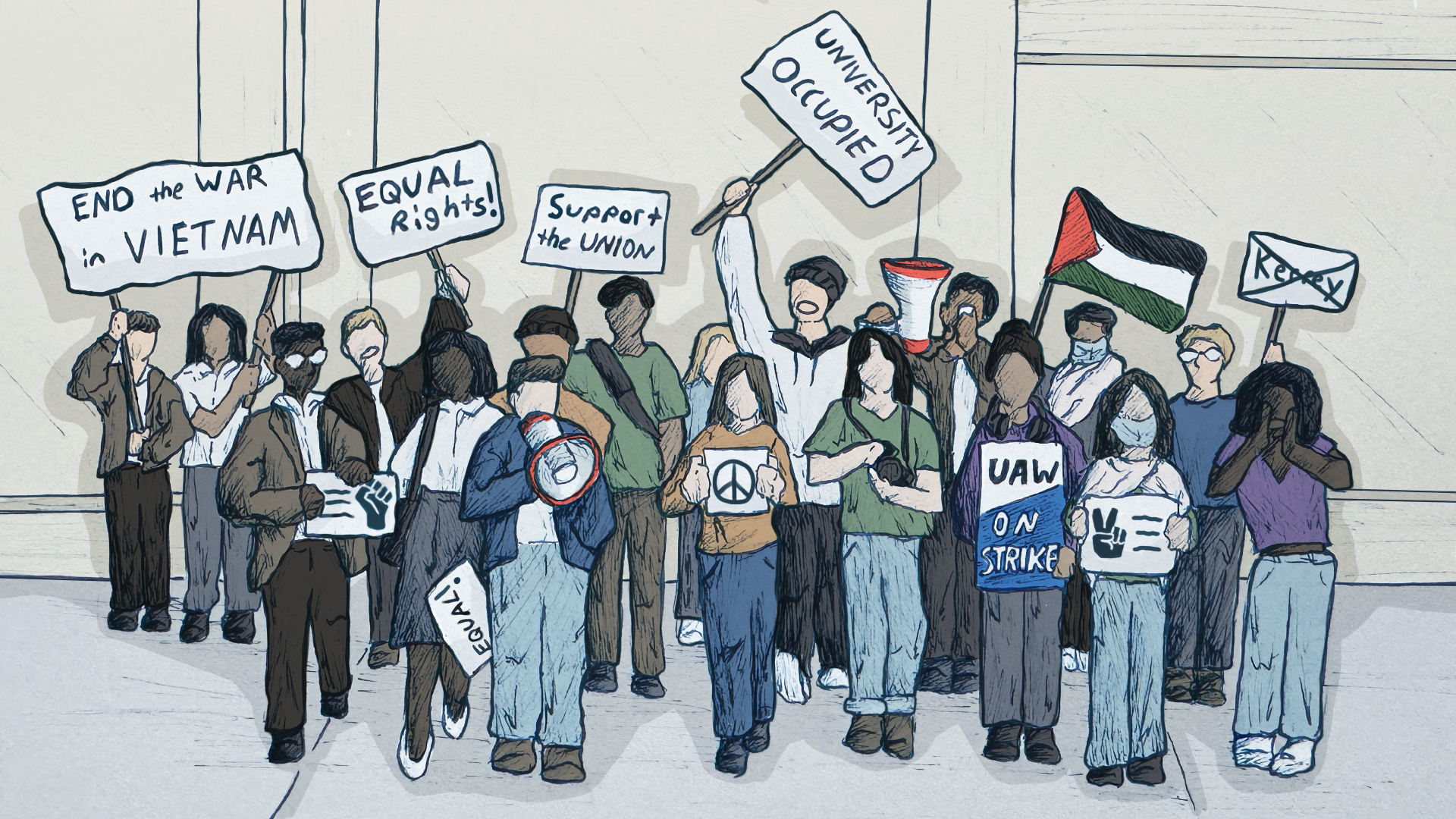
In the past three years, Cox has witnessed significant change at The New School. Encampments, faculty strikes, and three presidents in three years have all been features of his short time here. He doesn’t feel that the change is a bad thing.
“People always said to me when I came, ‘Oh, you came at such a hard time, I’m so sorry, TNS has not always been so disruptive,’” he said. “My response to that has always been, ‘This is progressive higher education, there’s no settled normal!’ Every interesting place of higher education in the United States, there’s a lot of change and turmoil.”
That change will continue. “Entering in 2025 is different from a student entering in 2015 or 2020 or 2030,” he said. It’s also different from a student entering in 1985. Both then and now marked major turning points for higher education, and there are still more to come.
Throughout Lang’s evolution, Cox aims to ensure the college continues to uphold the values of progressive education. When asked if this might be Lang’s “final form,” Cox returned to the meaning of the word used so often in the college’s marketing and curriculum: progressive. “I take it to mean politically progressive, but I also take it to mean pedagogically, culturally, even structurally,” he said. “The world is changing, and we want to change with it but also lead that change. So I know that it’s not the final form, and I’m also glad that it’s not the final form.”
We don’t know what the next 40 years will look like, but Cox hopes Lang will remain at the forefront of boundary-pushing education. In the meantime, there’s much to celebrate in looking back at the first four decades of our school. 40 years on, Lang continues to evolve — just as it was designed to do. Happy anniversary, Eugene Lang College.

Leave a Reply