
The New School (TNS) stands at a critical crossroads. Facing a projected $48 million deficit, the administration has issued voluntary separation offers to roughly 40% of the full-time faculty, alongside proposed cuts to PhD programs and reductions in employee benefits. These measures are being advanced without meaningful shared governance, placing not only livelihoods at risk but also the university’s identity as a progressive, critically engaged institution.
This moment demands clarity. The crisis confronting The New School is the cumulative outcome of decades of top-heavy decision-making, not excessive faculty salaries or instructional costs. Long-term debt tied to real estate development, disproportionate growth in executive and administrative compensation, and strategic choices that expanded managerial authority while constraining faculty governance are reasons for the school’s significant financial struggles.
Such decisions produced a harmful structural imbalance.
Austerity now presents itself as an inevitability, when it is, in fact, still a choice — one that shifts the burden of past misjudgments onto the university’s core academic mission.
That choice runs counter to the university’s founding logic. The New School was built on the premise that education is a public good sustained by faculty judgment, intellectual risk, and civic responsibility. Universities, at their best, are federated communities where faculty shape curriculum, research, and pedagogy through deliberation rather than decree.
When authority is centralized and faculty governance weakened, the institution loses more than procedural fairness — it loses its capacity for independent thought, civic imagination, and democratic purpose.
The alternative to austerity is not denial. It is ambition, organized through faculty leadership.
Faculty governance as innovation infrastructure
Faculty governance is often framed as a constraint, when in reality, it is a form of institutional intelligence. Around the world, universities that trust faculty to lead curricular and research strategy have demonstrated that fiscal responsibility and mission integrity can reinforce one another.
University College Maastricht and Amsterdam University College operate faculty-governed, interdisciplinary liberal arts models that attract international students while maintaining financial balance.
The Oslo National Academy of the Arts integrates craft, design, and public engagement through applied programs supported by public funding and partnerships.
Across Europe, “Science Shop” models embed university research in community problem-solving, producing tangible public value while sustaining institutional relevance. Design Factory and Fab Lab networks — from Aalto University to Barcelona — demonstrate that making, applied research, and public-private collaboration can generate revenue, workforce development, and civic engagement without sacrificing academic rigor.
These precedents share a simple principle: when faculty shape priorities, institutions invest in what they do best — and make that work legible to the world.
A faculty-led vision for renewal
The New School already possesses the intellectual and material resources required for renewal. What is missing is a governance structure that allows those resources to be organized productively. A faculty-led strategy for renewal clusters around three interdependent areas.
1. Curriculum and learning pathways
Faculty-led program redesign can reduce administrative duplication while preserving interdisciplinarity and depth. Integrated learning pathways — combining liberal arts, design, performance, technology, and public engagement — prepare students for creative, civic, and vocational futures without flattening intellectual ambition.
Apprenticeship-based certificates and degrees, developed in partnership with New York City and state workforce and cultural initiatives, can provide paid learning, professional pathways, and new revenue streams.
Digital and hybrid programs, curated and governed by faculty rather than vendors, allow The New School to extend its reach while maintaining rigor. Structured integration of adjunct faculty through mentorship and professional development strengthens continuity and instructional quality.
2. Innovation, making, and public work
Faculty-led innovation labs can translate teaching and research into public-facing work. A Public Works and Ideas Incubator — organized as a network of semi-autonomous studios — would allow faculty and students to contract with civic, cultural, and mission-aligned partners. These studios would integrate credit-bearing courses, applied research, paid graduate fellowships, and public or commercial-facing projects, generating diversified revenue beyond tuition.
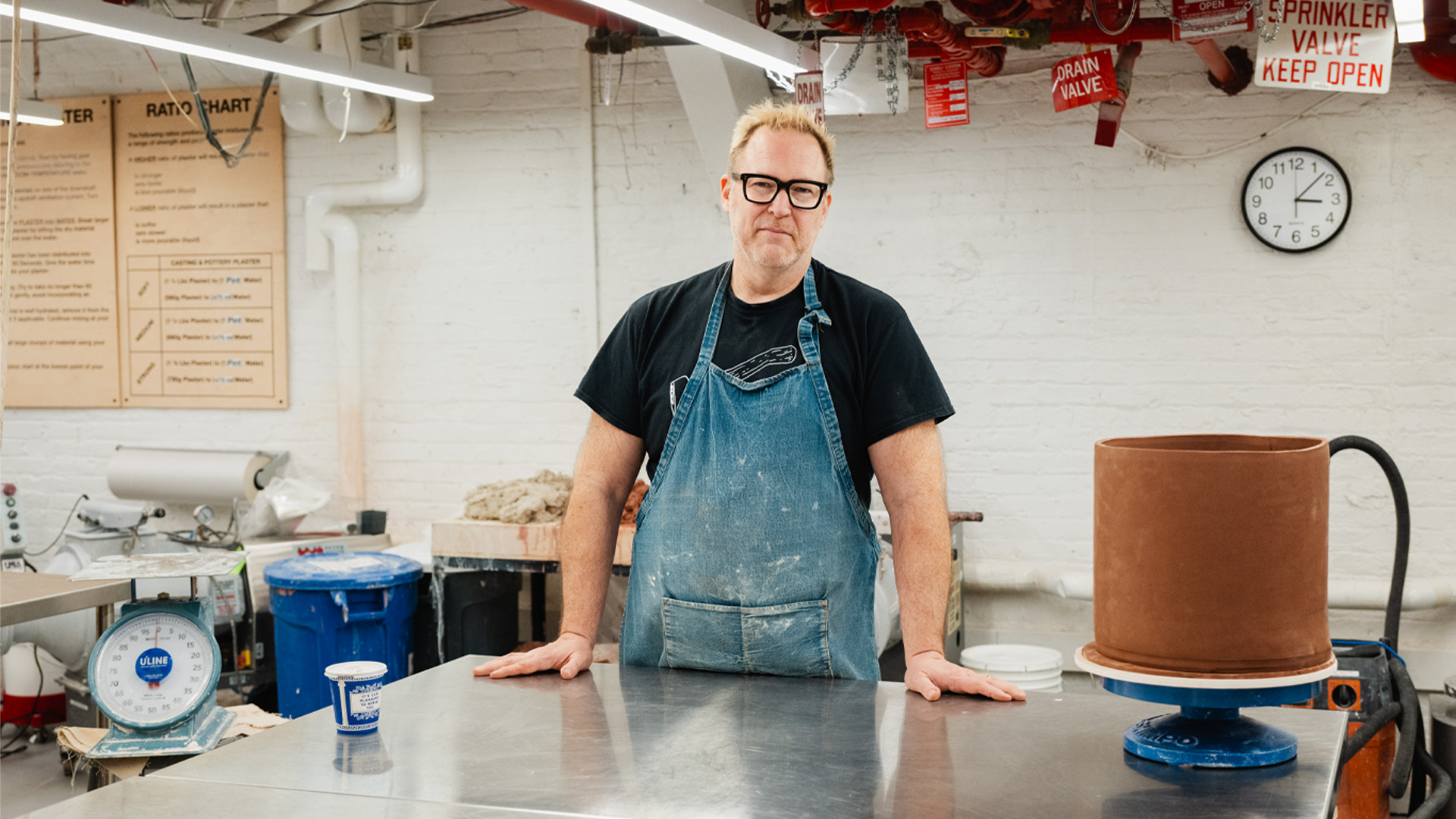
The Parsons Making Center is particularly well positioned to anchor this model. Reimagined as an open public-private fabrication hub, it could support prototyping, small-batch production, applied research, and apprenticeships in digital fabrication, materials, and craft. Revenue from partnerships and fabrication services would subsidize operations while providing students with paid, real-world experience.
Short-term, faculty-led global residencies and public humanities programs — workshops, certificates, and performance-based civic engagement — extend the university’s reach while reinforcing its mission.
3. Financial and civic governance
Renewal requires structural change. A faculty-majority budgetary oversight body, empowered to review financial strategy, would realign fiscal decisions with educational values. Mission-centric philanthropy should prioritize teaching, research, and public engagement rather than branding.
Alumni engagement can shift from symbolic affiliation to active participation through funded projects, advisory roles, and mentorship.
Community-embedded partnerships — particularly with New York City public institutions — can create pipelines into higher education while producing measurable civic impact.
A thought experiment: “How might we…?”
At Parsons School of Design, where I have taught for over two decades, we teach students to treat constraints not as limits but as material — problems to be reframed, not managed.
One of the simplest tools we use is the “How might we…?” question: a prompt from strategic design practice that opens up so-called wicked problems by making them collective, provisional, and actionable rather than fixed or foreclosed. It shifts the conversation from what can’t be done to what could be built.
So the question becomes unavoidable: How might we reimagine the university itself — not as an austerity problem, but as a site of shared invention?
The childcare proposal that follows is a thought experiment with a specific purpose. Take a problem the university has long underfunded, add faculty expertise and the kind of public-private partnerships described above, and see what comes back. The goal isn’t to solve childcare in the abstract — it’s to demonstrate a method. If it works here, it works elsewhere.
Let’s see how we might apply this strategic design method to envision fiscally sustainable futures for our university and the communities we serve.
A vision for faculty-led imagination: Childcare and early education at The New School
For decades, faculty, staff, and students who are parents have asked why The New School cannot provide childcare. The response from administration, at least to faculty, has consistently been framed as fiscal impossibility.
This is not fiscal realism; it is a failure of imagination.
A faculty-led childcare and early childhood education lab would treat care as both essential infrastructure and educational opportunity. Serving faculty, staff, students, and families across the city, the center would function as a teaching, research, and apprenticeship site.
Students in associate, BFA, MA, and PhD programs — spanning art education, art therapy, psychology, and early childhood education — would learn through supervised practice. The faculty would guide research on learning, care, and development.
Funding would be braided across city and state universal pre-K and childcare programs, federal support, foundation grants, sliding-scale fees, and tuition-supported apprenticeships.
Staffing would combine licensed educators with paid student apprentices. Over time, the program would sustain itself financially while producing measurable social benefit.
This is precisely the kind of integrated, problem-based model The New School teaches — and should practice.
Reclaiming our roots
The New School was founded on the belief that education, when integrated across disciplines and embedded in public life, strengthens democracy. One of our school’s founders, John Dewey understood this. The Bauhaus practiced it. The university’s own academic history insists upon it.
The choice before us is stark. We can continue down the path of top-down austerity — shrinking ambition, eroding governance, and hollowing out the academic core. Or we can organize the intelligence already here and build something durable, generous, and publicly accountable.
The problem is not that The New School is too ambitious. It is that ambition has been rendered illegible. Faculty-led renewal makes it visible again.
The roots are still there. The question is whether we are willing to draw them — and build from them — once more.
A call to action
This is not only an institutional crisis; it is a democratic one. The question before us is not whether The New School can survive austerity, but whether it can remember what it was built to do.
We ask the community — faculty, students, alumni, staff, and leadership alike: How might we reimagine The New School?
Challenge assumptions. Share proposals. Help chart a course for a university in which faculty governance, public purpose, and financial sustainability reinforce one another.
Let’s practice what we preach and envision what our flourishing future looks like. Share your new ideas about the future of our community. You can send them to this open forum at the New School Free Press.









Leave a Reply