

Every fashion enthusiast knows that Fifth Avenue is one of the best places to go shopping. But here at The New School, Fifth Avenue is more than that — it’s a runway. From statement bags to standout shoes, Fashion on Fifth is here to give you weekly, front row access to some of The New School’s chicest looks. This week, we’re focusing on highlighting international TNS students!
For international students at The New School, fashion becomes a language of memory — the beauty lies in how they carry home with them. Within each texture and silhouette are traces of their origins and the dreams they’re pursuing here. Blending tradition with the pulse of New York City, they create something entirely their own.
Cammy Feng
She/her • From China
First-year Fine Arts student at Parsons School of Design
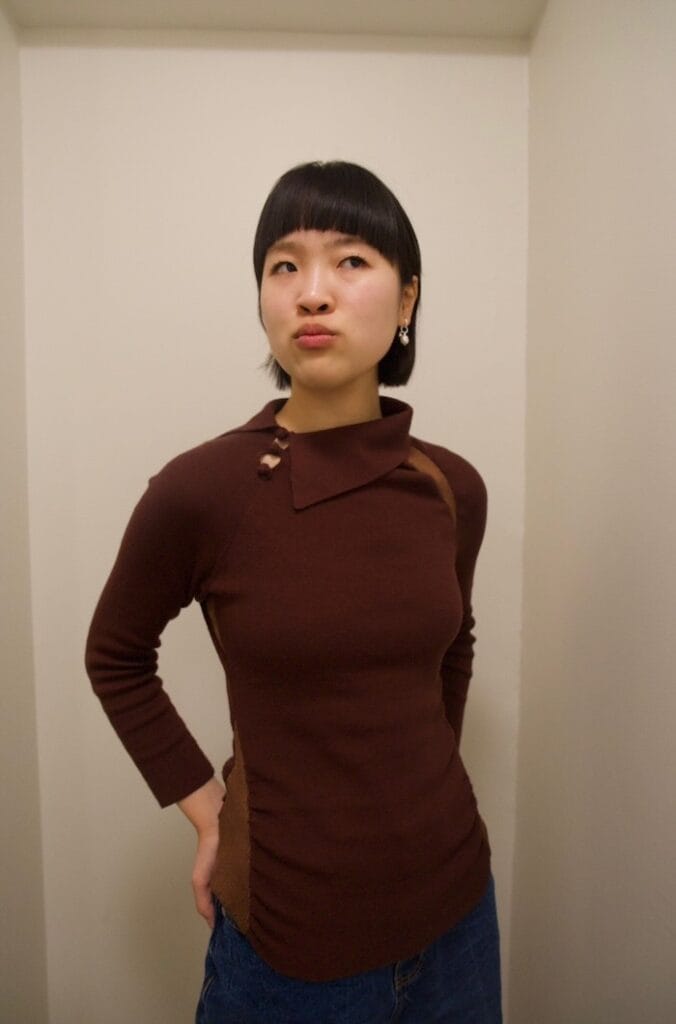
Photo by Cozette Calderon

Photo by Cozette Calderon
When Cammy Feng walked into the room, my first thought was elegance. Fitted and sleek, the piece’s asymmetrical design and side slits gave it an artful edge – a subtle nod to traditional Chinese fashion.
Feng said the look is inspired by the qipao, a classic Chinese dress often made of red silk with gold embroidery, and distinctive diagonal buttons or knobs. “The color is red … a bit more of a mauve version — but red,” she said. “You’re supposed to show all the collar, and your hair would be either short — like I have a bob — or … if you had long hair, you would tie it up in a bun so that you wouldn’t cover any part of the dress, because the collar is very important.”
Feng pointed out the diagonal buttons on her sweater, one of the main elements inspired by the qipao. Feng brought up looking similar to her mother in old photographs wearing traditional qipao, which made her love wearing this modern version. That sense of familial connection extends to how Feng accessorizes. She hopes to continue the Chinese culture of passing on jade to future generations.
“I love the way jade looks. Green on red is beautiful. My mom wears a jade bangle, and a lot of the time … they’ll [Chinese families] pass down jade jewelry to their children, so next time you’ll probably see me in a jade necklace of some sort.”
The combination works visually, too. With the right red and a dark or very light green reminiscent of the jade Feng mentioned, the two complement one another elegantly. But for Feng, the deeper beauty lies in what the pairing represents.
“I feel confident — like I’m reminded of my family and where I came from,” Feng said. Sharing her culture through clothing, she added, often acts as a conversation starter to bridge differences.
Dina Romanus Olsson
She/her • From Sweden
First-year Photography student at Parsons School of Design
@DinaOlsson_
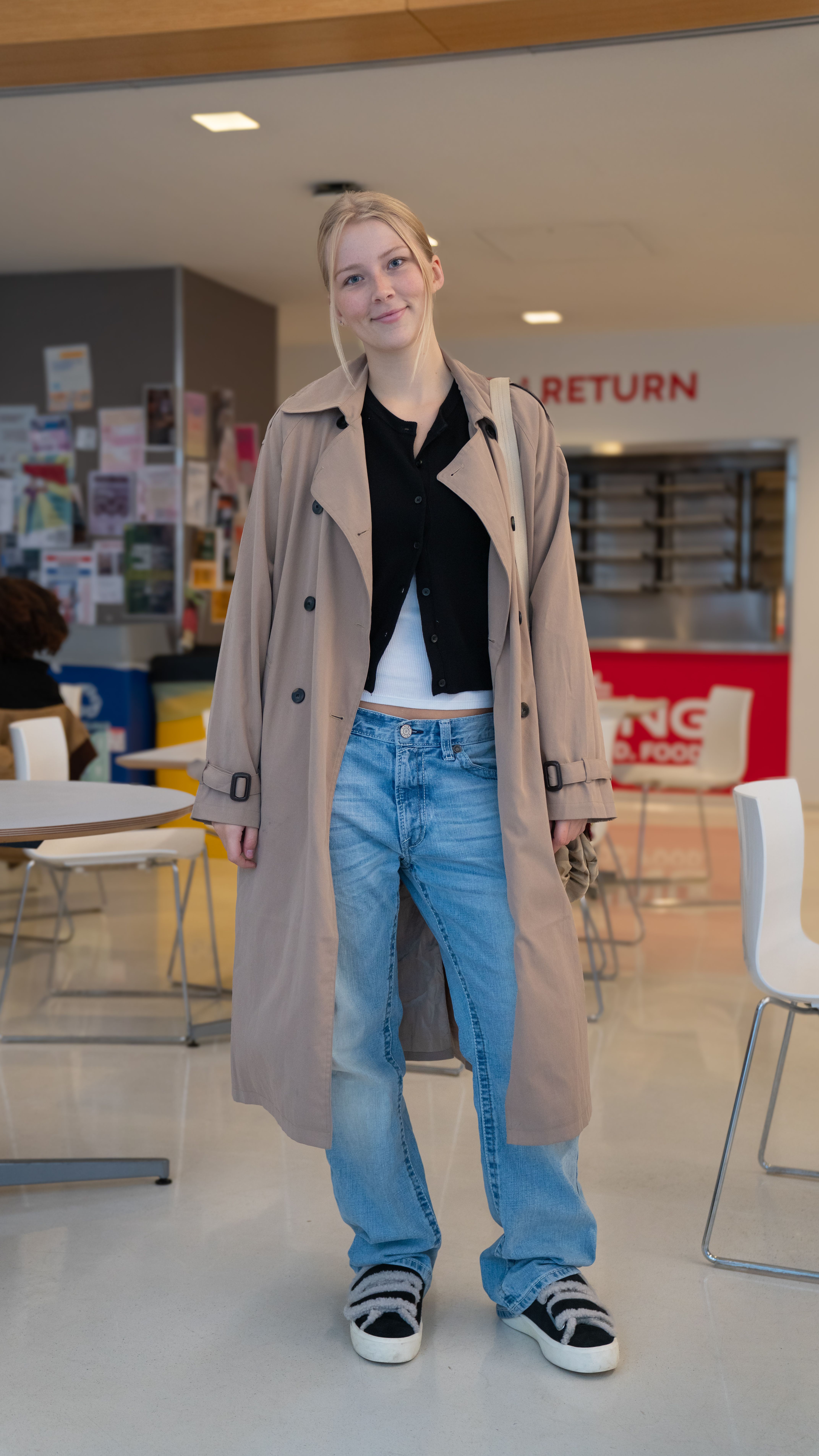
Photo by Ada Chu

Photo by Ada Chu
In the University Center Dining Commons, Dina Romanus Olsson embodied the quiet sophistication often associated with Swedish style. “It looks very effortless… [people] won’t wear a lot of patterns, a lot of colors … it’s very neutral, very simple, but you can have a lot of layers, because in Sweden, it’s very cold.” I could definitely picture this outfit being a fair representation of the common outfit in Sweden.
Of course, this outfit is just as adorable in New York City. The look — a crisp trench coat layered over soft neutrals — was clean and composed, balancing practicality with subtle polish. The trench coat is an essential in both Stockholm and New York, bridging business and street style.
I also loved how she stayed in the realm of neutrals, mixing them in a chic manner to add a vibrancy to what one might consider a plain outfit. Take it from Romanus Olsson’s Swedish style — neutrals don’t have to be boring!
A fuzzy shoe has always captured my attention and affection. Romanus Olsson’s shoes were no different. “[Inuikiis are] like UGGs … but it’s not so mainstream, I would say.” However, “they’re definitely on the same level as UGGs would be [in Sweden],” Romanus Olsson said.
Fuzzy shoes are a must in Sweden to keep one’s feet warm against the bitter cold. The same can be said about New York. Recently, I’ve seen an increase in people on the streets and in TNS donning fuzzy boots. If you’re looking for an alternative to the trending UGGs here in the United States, these shoes might be a great option to consider!
Olivia Lee
She/her • From Singapore
Second-year Strategic Design and Management student at Parsons

Photo by Ada Chu
Drishya Viswanath
She/her • From Singapore
Second-year Product Design student at Parsons
@drishya.vish

Photo by Ada Chu
Though I ran into both these women in different buildings, they shared more than a sense of style: both are from Singapore!
Singapore’s tropical climate offers little variation, while New York certainly has seasons. Such weather has impacted their outfit choices. “After coming here, I started experimenting more with … fall fashion … and layering up, which has been really nice,” Viswanath said.
“I don’t bring back my winter clothing at all when I go back. I leave it here in storage,” Lee said. Lee’s brown leather jacket stood out — effortlessly chic, but, understandably, bringing it back to a humid climate would not be the most comfortable.
Both students spoke about how Singaporean fashion is shaped by warmth and patterns. “There are patterns called Peranakan patterns that are … traditional but now [are] getting more infused into … different types of clothing … and more modern clothing,” Viswanath said. Lee added, “Some trends I see are, I would say, a lot of … the clean girl aesthetic … but more of, like, this summer version of it.”
When asked if there is an article of clothing that she misses from home, Viswanath said, “I feel like more, just, beach clothing, like swimsuits … and shorts — like a lot of shorts … and tank tops. I do wish I had more of them here but, then again, I feel like they wouldn’t be as useful here.”
There’s always that one pair of shoes that just couldn’t squeeze into the suitcase or a shirt lost in the laundry. Although the weather seems to be the culprit stealing away some favorite pieces, it paves the way for experimentation — and these two are flourishing with the details of layering.
Antara Manurkar
She/her • From India
Third-year Fashion Design student at Parsons
@AntaraManurkar
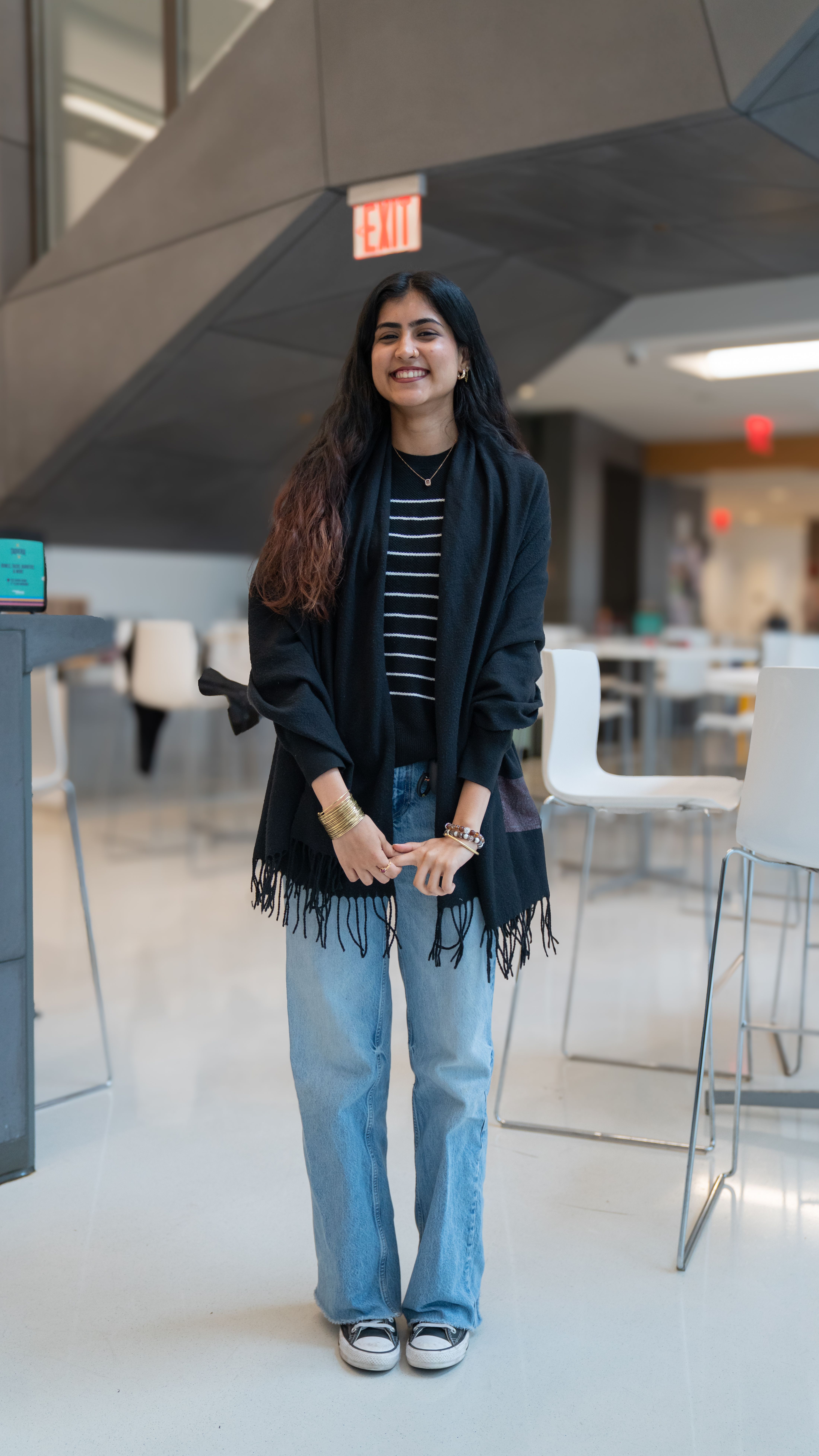
Photo by Ada Chu

Photo by Ada Chu
Antara Manurkar is from Pune, India, and though she is far from home, she has never left her traditional style behind.
When describing Indian fashion, Manurkar immediately mentioned its richness in color, pattern, and jewelry. “It’ s very intricate,” she said. Though embroidery and beading are both common, they lack nothing in complexity.
On the day we met, Manurkar wore neutral tones with a chunky, gold bangle shimmering against her sleeve. Jewelry is often a large piece of one’s ensemble in India. And though not wearing them on the day I got to meet her, she “wear[s] a lot of jhumkas,” she said. Jhumkas are a traditional type of earring in India that resembles a bell or end of a tassel.
Manurkar and I discussed how India’s fashion trends are spreading throughout the world, though without proper recognition. Manurkar said, “There are so many things from India that now the world is getting to see, and everywhere, people are … whether it is given credit … or not … taking inspiration from it.”
The two main trends in question were “Scandinavian scarves,” which are really inspired by dupattas, and lehengas, a long skirt paired with a fitted blouse. However, there are many other articles of clothing that draw inspiration from India’s vast traditional wear.
Perhaps some of the things you own are also inspired by another culture, so take the time to find the history behind the pieces you love so the significance of their creation makes them even more special.
International students are integral to The New School community, making up more than one third of the student body — one of the highest rates in the country. They remind us to understand what we wear, so we can recognize the many hands and histories that shape it and love it dearly.





Leave a Reply