
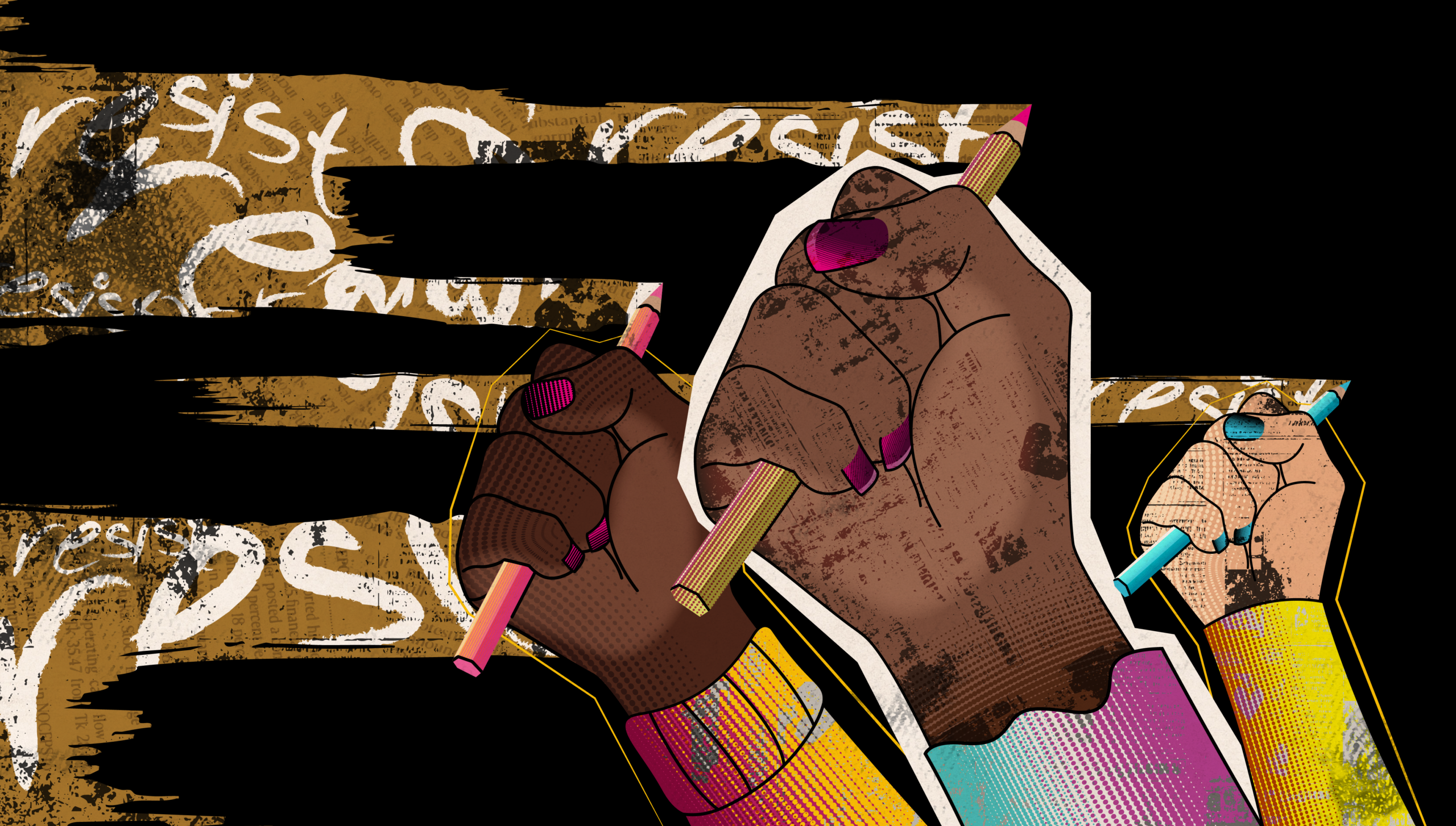
For international students in Trump’s America, security is rarely certain. Since his second term began, Trump has issued executive orders to limit immigration and ramped up ICE raids with the purpose of deporting undocumented immigrants. He has tried to curtail academic freedom on college campuses by withholding funding from elite universities whose diversity, equity, and inclusion practices he deems problematic. This May, his administration even attempted to eject international students from Harvard University entirely.
International student journalists are particularly vulnerable. The Trump administration has been consistently hostile toward journalists in general; Trump recently curtailed reporters’ access to White House offices where they have been able to ask officials questions for decades. Being a student journalist has been especially fraught — the Trump administration has targeted student protests, which are often first covered by student reporters. On top of the existing risk of being an immigrant during Trump’s mass deportation campaign, these threats place international student journalists in a difficult position: censor themselves out of fear that their writing could result in visa revocation (or worse), or continue reporting on the very systems of power they’re living under.
For Luan Rogers, a master’s student at the CUNY Craig Newmark Graduate School of Journalism who moved to New York from Ireland, that choice is always in the back of his mind. “You’re definitely second-guessing yourself in a way I wouldn’t if I were reporting in Ireland,” he said. “Always when I’m here, I know I’m on a visa and at the discretion of whoever. I don’t have a right to be here, so I can be thrown out at any point if I don’t toe the line.”
To be cautious, Rogers has steered clear of potentially controversial stories. “As much as you hope you can cover whatever you want, you have to be practical and cut your losses sometimes and not pursue something if it’s too risky,” he said.
Protests, deportations, and the ongoing genocide in Palestine are among the risky topics for international students to write about. An Austrian student also studying at a journalism school in New York City, who was granted anonymity due to safety concerns, has made the difficult decision to avoid those subjects. “We don’t want to self-censor ourselves as journalists, but you don’t want to risk your visa status or status in the [United States],” she said. “When the goal in the end is to publish something with your name and byline, you don’t want to make it too easy for authorities to see you reporting on an issue that’s of particular interest to them,” she added.
The Austrian student and Rogers’ professors have advised them to proceed with caution and reach out if they have concerns. Even so, the Austrian student feels a bit lost. “No one could really give us clear guidance — it’s up to you to weigh your own risk,” she said.
She doesn’t feel actively censored as an international student journalist, and she’s noticed that reporters in the United States are more forthcoming with their political views than those in Austria. “Friends from home ask if the [United States] is a dictatorship now, and I’m like, ‘No, you can still step on a balcony and scream whatever and nothing will happen,’” she said. Still, she holds back. “That’s a subtle pressure, not something very obvious.”
Constantly experiencing that pressure has consequences, both for reporters’ personal interests and for broader access to free speech. One international student journalist at The New School, who was granted anonymity due to safety concerns, came to the United States to report on politics, particularly U.S. relations with Latin America. This year, she had to pivot and turn down a job because she felt that reporting on the topic could get her into trouble.
At this point, the anonymous student didn’t know what she should and shouldn’t censor anymore. “At the beginning, a clear limit was the issue with Palestine,” she said, referencing graduate students like Mahmoud Khalil and Rümeysa Öztürk, whom ICE detained for pro-Palestinian activism and an op-ed in a student newspaper, respectively. “But then I was trying to write a piece on regional politics in the [United States] and found myself circling around certain things because I didn’t know the extent to which it could be interpreted as animosity against the U.S. government,” the student explained.
To cope, she looks to the past for inspiration, and to the future for hope. “I’ve always admired revolutionaries from Latin America, and they have had it much worse,” she said. “I’m choosing to be here right now in this country, and these are the limits we face, and this is the moment we’re in. I’m just very stoic about that, and I guess at some point I’ll be able to write about this.”
Even international student journalists who haven’t felt as much of a need to limit their work still recognize the effects of censorship. Stella Roos, a Finnish CUNY student who worked in Berlin before moving to New York for her journalism program, initially worried that the United States would be an oppressive, “authoritarian-turning” environment. Instead, she was pleasantly surprised to find that her professors pushed her to write about contested issues. Recently, she covered trials related to the censorship of pro-Palestine students, which she says she couldn’t have written for a mainstream newspaper in Berlin. Yet simply entering the United States was extremely difficult for her and other students.
In May 2025, the Trump administration paused interviews for student visa applicants, throwing many students’ academic plans into disarray. As a Fulbright scholar, Roos began preparing to come to the United States over a year ago, but she couldn’t get an embassy appointment until late July of this year. She secured her visa only a week before school started. “It was really hard and put me in a whole spiral,” she said. “I think a lot of international students had a similarly hard time getting a visa.”
Fulbright scholars like Roos have faced additional challenges since this spring, when the program began doing extra reviews of all scholars’ study plans. “Another woman in my cohort couldn’t go. They rejected her proposal because it had to do with race,” Roos said. “This has happened everywhere, and it’s very bitter because I am implicated, being a Fulbright scholar, in really blatant censorship that no one is willing to talk about.” The result of this institutional censorship is fewer opportunities for international students and more confusion about the ability to write freely in the United States.
An environment where people are punished for their writing causes anxiety not only within the United States, but also when international student journalists are entering the country. The aforementioned anonymous student felt the need to remove data from her device when re-entering the United States after a trip. “When I came back, I deleted everything — WhatsApp chats, Signal chats, email apps — kind of hoping for the best, not because I have anything illegal or compromising, but it’s just terrifying,” she said. “I think the fear comes out of the arbitrariness.”
“What’s at stake when I choose not to write about something or accept certain kinds of jobs is not just my career as a writer and journalist. It’s life as I know it and how the fragile routine I [have] built over the last one and a half years can disappear in the blink of an eye without me having a say,” she continued. “That’s to me what’s most terrifying — the arbitrariness — and that’s why one chooses to censor oneself.”
The effects of this censorship vary. Students from countries targeted by Trump’s policies may exercise more caution than students from non-targeted countries. The choice of when and how to speak up is nuanced and specific to the individual student. Rogers has found solace in his network of fellow international student journalists but remains hesitant to test the waters. Roos, meanwhile, sees more possibilities for her reporting.
“The image in the [United States] is so dismal right now if you’re not in America so coming here has been a positive surprise, and there’s still so much freedom and space to cover any topic,” she said. “We have to utilize it as much as possible.”



Leave a Reply