

What do you think about the changes to The New School? NSFP wants to hear from you. Tell us how you feel here.
Faculty, staff, students, and union leaders are pushing back against The New School’s restructuring process.
The gradual escalation comes as a comprehensive restructuring plan was endorsed by the Board of Trustees last week. The initiatives composing the plan aim to stabilize the university’s finances — a shortfall that’s ballooned over the years into what is now a nearly $50 million deficit, according to administration.
Under the plan, academic programs will be cut, staff will be laid off, and benefits will be reduced, among various other proposals-turned-initiatives, according to a Nov. 17 email from the Office of the President.
Members of the community have called the process opaque and lacking input and the initiatives profit-driven and austere.
Some cuts and layoffs are already unfolding. PhD admissions, except for clinical psychology, were paused on Nov. 6 by University President Joel Towers and Provost and Executive Vice President for Academic Affairs Richard Kessler. Conversations about what services, academic programs, and classes to curb have also begun.
Now, members of the community — from the University Student Senate (USS), to faculty at Eugene Lang College of Liberal Arts, to economists at New School for Social Research (NSSR) — have increasingly been organizing and speaking out.
University Communications declined an interview with Prisca Wood, assistant provost of compliance and accreditation. Wood was selected in October to lead the proposals into action plans and timelines. Amy Malsin, vice president of University Communications, said it was too early to answer questions about implementation.
Students are getting involved
“It’s a lot, trying to have a coherent understanding of what restructuring is,” Ryder Glickman, vice chair of the USS, said.
Students have had two formal opportunities to review the proposals and ask administrators questions since they were drafted this summer. Most recently, administrators held a town hall on Nov. 19.
Still, students have condemned the university for a lack of student involvement. Administrators have called the process “student first.”
Administrators officially guaranteed student involvement in October, after Glickman and USS Chair Emily Li say they repeatedly raised concerns. Glickman and Li first learned about the proposals when they were tipped off by another student this summer.
Student feedback at the request of administrators has been chiefly through the USS. Li and Glickman described the role as “symbolic” and “reactive.” They have reviewed slides for the student presentation on the proposals, pushed back during conversations with administrators, and tried to come up with alternative proposals with the little information and time they have.
“I don’t think they’re interested in that,” Li said, adding that administration is concerned with delivering changes to students and wanting feedback but hasn’t considered what student involvement could have looked like.
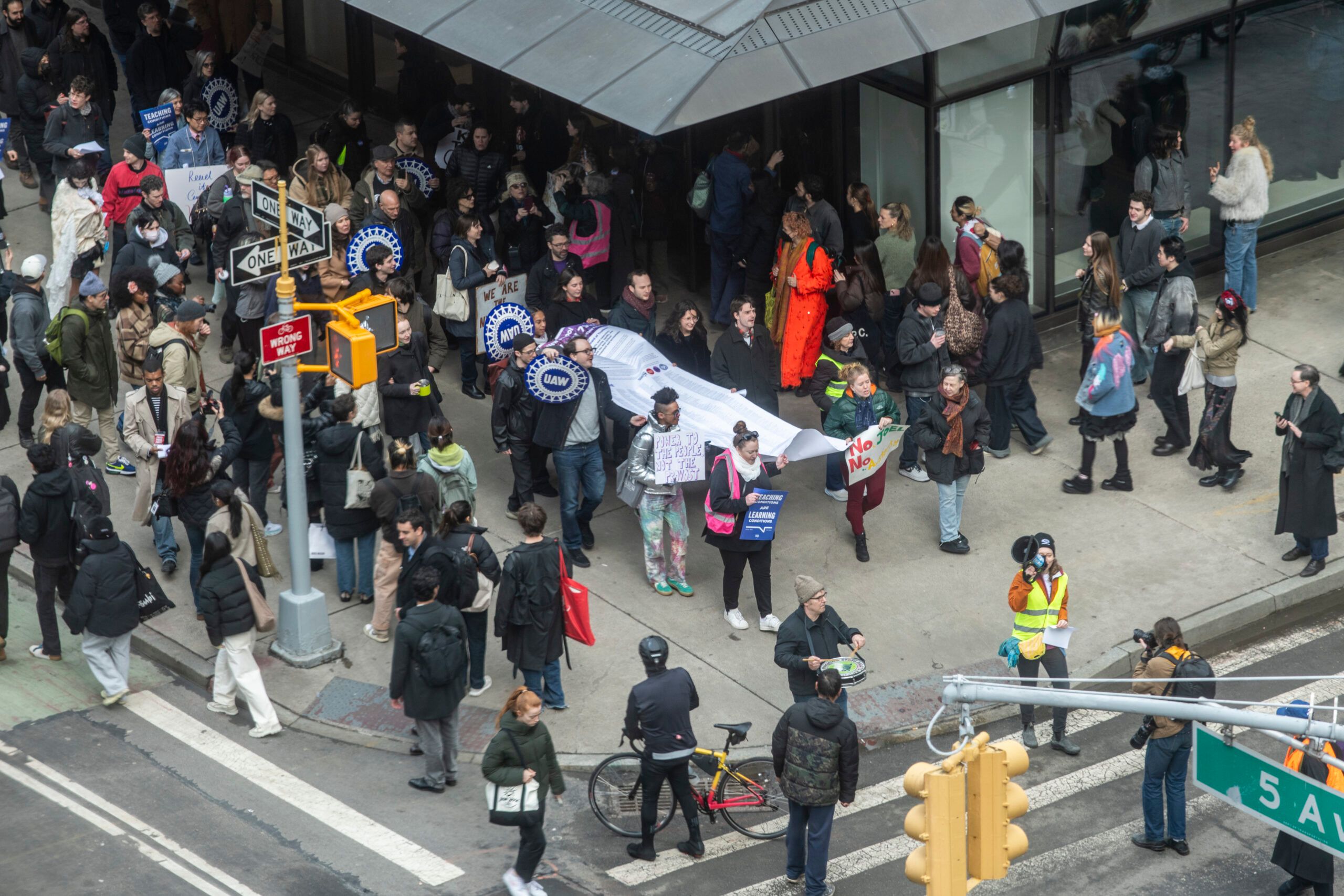
USS is also trying a different route. On Nov. 21, they helped organize an informational picket outside the University Center named “Kill the Cuts.” They also helped organize a rally against the university’s downsizing named “We Are The New School” on Nov. 6. Both demonstrations drew students, staff, faculty, and union leaders.
“Restructuring is a fancy word for job reduction,” Li said.
The USS Instagram has posted students’ thoughts from a survey asking for their responses to the cuts to Student Health Surveys. They also posted a statement on Nov. 15 endorsing a restructuring counterproposal by NSSR faculty.
The USS statement called the current process “irresponsible” and “ideologically driven” and turning the university into a “purely profit driven body to be governed solely by the executives, administration, and board of trustees.”
Li and Glickman said they are trying to use the unique powers of the student senate to empower the community.
“We aren’t firm institutionalists. We don’t really believe and love whatever the student senate is,” Li said, referring to its reputation among some students. “We just believe that it is something we can use to better advance student interest and support them on campus.”
Faculty, especially at Lang, are raising concerns
Lang is the university’s undergraduate liberal arts college. Since the pandemic, enrollment at Lang has declined by 37%, with only 1197 students this semester, mirroring national trends at similar colleges. Lang is expected to run a deficit in the next couple years. NSSR and CoPA already operate at a loss.
Some Lang faculty, according to Lang Faculty Council (LFC) meetings, believe the restructuring process overlooks faculty involvement and reflects misguided priorities.
The LFC filed a motion in October creating a Lang Task Force to tackle these challenges by drafting a Lang-focused plan to present to Towers and the Board.
Julie Beth Napolin, a member of the Lang Faculty Council and chair of the Lang Task Force, said the college also faces external pressure to make a change.
“Some of the more extreme sides of the Board wonder if The New School needs a liberal arts college anymore,” Napolin said, “whereas other parts of the administration, including the president, see the value that the liberal arts brings to the university.”
In a Lang Faculty Council meeting, Christoph Cox, dean of Lang, substantiated Napolin’s comment. He said, however, that closing Lang is not under consideration.
The Board wants Lang to have a stable enrollment of 1,000 to 1,200 students, according to the text of the motion creating the Lang Task Force. The motion, which was adopted by the LFC, said some faculty believe this implies the Board has “given up on us growing back to where we were, if not given up on us more generally.”
If Lang does not reach the Academic Working Group’s recommendation of growing enrollment to more than 1,500 students, and other steps across the colleges are not taken, The New School could in effect “become Parsons University, with NSSR folding and Lang becoming an appendix for gen ed courses,” according to the motion.
The Lang Task Force has also provided feedback for Lang Unbound, a document drafted by Lang leadership detailing a plan to highlight the allure of Lang and advocate for its future.
The document was meant to be presented and discussed at a Board retreat on Nov. 6, but the Board canceled without giving an explanation. Instead, administrators invited Cox to an all-day meeting the same day to go over the document. The document will be shared with the Board at a later date.
The LFC has also raised concerns about the pausing of PhD admissions at NSSR.
In a motion emailed to Towers and Kessler, the LFC called it a “shortsighted” and “reckless” decision that will “damage the university’s academic reputation, trigger a worsening financial spiral, and create teaching capacity shortages that directly harm student experience.” The motion called for administrators to reverse the decision and adopt the temporary reduction proposed by NSSR.
“On the one hand, this is all happening really fast, and in some ways, probably too fast,” Napolin said, adding that some decisions could have involved more faculty. “But on the other hand, the conversations about restructuring The New School have been around for a really long time … So in some ways, it’s just that now we’re at a moment where something is actually being done.”
Economists cast doubt
Faculty at NSSR have been outspoken in opposing the restructuring process.
NSSR faculty passed a motion asking the university to cap salaries at $200,000 per year for 18 months instead of cutting retirement benefits, according to a statement opposing the restructuring by AAUP-TNS Leadership Council and the Full-Time Faculty Union.
Faculty at the NSSR economics department have produced an analysis which found that pausing PhD admission will lose significantly more money than it will save and put jobs at risk.
The “financial death-spiral” will begin as soon as spring, as some master’s students have said they will leave after this semester, according to the analysis. NSSR requires a master’s degree before entering the PhD program. Most master’s students at NSSR plan to pursue a PhD at NSSR, the analysis said.
The analysis found that for a year-one savings of around $500,000, a conservative estimate of lost master’s student revenue will result in an over $1 million loss in the first year of the pause. $6 million will be lost by the fourth year of the pause.
Moreover, PhD students, who serve as teaching assistants and research assistants, contribute income for the school which far exceeds the cost of their stipends.
Another analysis by faculty at the economics department found that the university’s $30.2 million deficit last year could have been a $7 million surplus if spending in certain budget categories had grown at the same rate as revenue.
“Excess spending” in administrative salaries, professional services, facilities, and real estate totalled $37.1 million, according to the analysis. Spending on these budget categories grew at a rate higher than the 2.9% growth in the university’s revenue over the last ten years.
Individual NSSR faculty have also cast doubt, like Sanjay Reddy, an esteemed economist. Currently on leave, Reddy sent an email on Oct. 29 to his colleagues summarizing his thoughts.
“Some crucial issues have not been adequately discussed, and that adequate arguments have not been made for the proposals put forward,” Reddy wrote.
The accounting basis at the university is obscure and uncredible, according to Reddy. He questioned the magnitude and sign of deficits and surpluses.
“For this reason, I view with a big dollop of salt all such figures circulated by the institution,” Reddy wrote. He’s previously criticized the university’s financial decisions in a 2020 opinion piece for the New School Free Press.
Reddy pointed out “one must look at recent changes in the ostensible surpluses and deficits,” not just the numbers. The biggest drop in revenue at the university is coming from a drop in surpluses at Parsons.
A self-analysis focusing on student experience, marketing, and financial investments is essential, according to Reddy, as is finding the needed remedies.
“In the language of economists,” Reddy wrote, “the best policy is to correct the distortion (or the failure) at the source, but are we doing so?”










Leave a Reply