
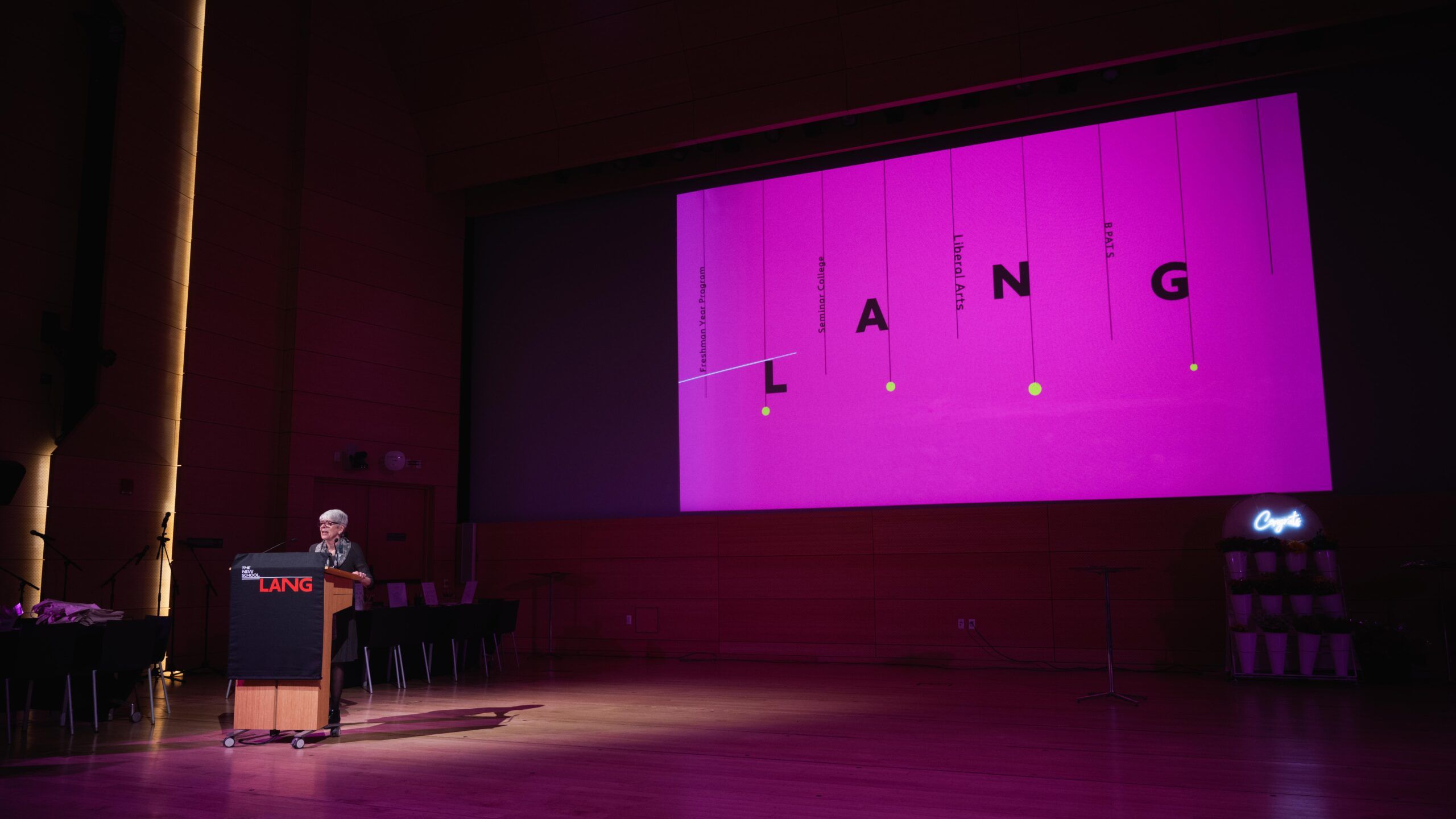
The trajectory of the Eugene Lang College of Liberal Arts has taken many turns. First named the “Freshman Year Program,” and later “The Seminar College,” it was officially established in 1985, named after philanthropist and businessman Eugene Lang, who contributed to the school’s inception through a major gift. The college saw rapid changes, from the creation of departments to significant enrollment surges and declines in a short span of time.
This year, an exhibition in the UC lobby — now moved to a permanent location in the third-floor lobby of the Lang Building — revisits the school’s past to celebrate its 40th anniversary. On Oct. 22, students, faculty, administrators, and alumni gathered for the opening of UNBOUND: Liberal Arts at the New School. Organized as a chronological timeline, the exhibit traces the educational experiments that eventually led to Lang’s founding, featuring a variety of artifacts, from photographs and catalogs to newspaper clippings — even physical tickets from a 2006 spring dance performance.
Lang professors Mark Larrimore, co-chair of the Liberal Arts program, and Julia Foulkes, professor of history, oversee Histories of The New School, a website devoted to exploring “the unusual history and far reach of this institution.” The two partnered with third year liberal arts student researcher, Sonny Caterini, to comb through Lang’s archives. They aimed to assemble a comprehensive timeline of Lang’s history, a process that proved more demanding than Larrimore anticipated.
“But along the way, it also forged great relationships with people in the registrar’s office, and the archives,” Larrimore said. “We spoke to various people who have been at the New School for a long time, some alums and faculty, including some retired faculty.” Eventually they ended up with too much, and then the question became about how to present it. From there, two Parsons design professors Eva Perez de Vega and Ian Gordon stepped in, and came up with the idea to make it three-dimensional.
“It’s structured around these beautiful, sort of triangular things that they call stackable seats that you have to move around in order to see. So it’s really, really dynamic and interesting and all of these are things that I couldn’t have imagined beforehand,” Larrimore said.
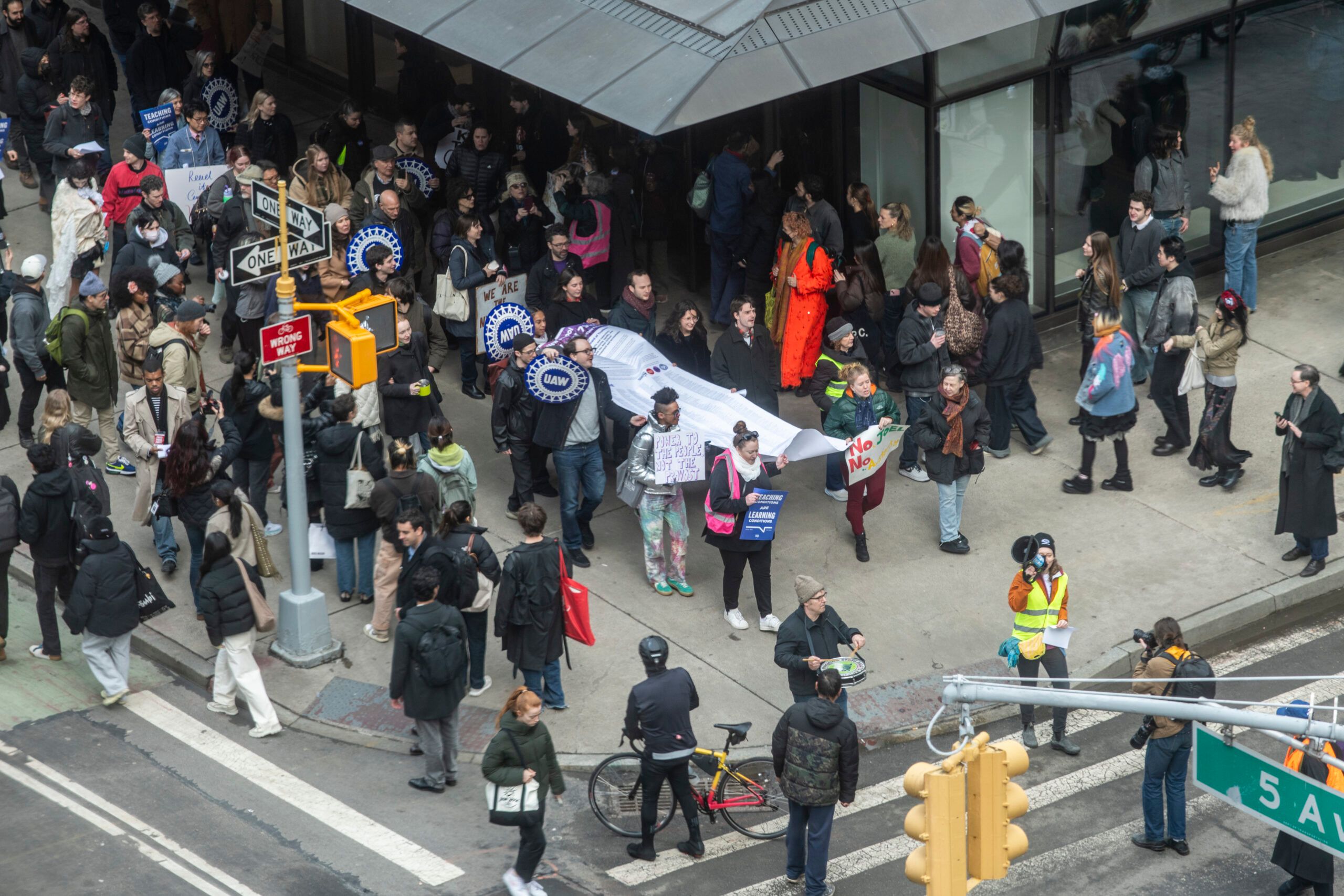
As a whole, it reflected the story of a college in constant criticism of itself. Photographs of various protests took up a large portion of the exhibit, detailing Lang’s history of student activism and advocacy for institutional change. This included everything from Occupy Wall Street in 2011 to the Free Palestine encampments in 2024.
“I was really interested that they trace the history of the Occupy movement at The New School and also the Part-Time Faculty strikes,” said fifth-year BAFA student, Sarah Rose. “I thought it was interesting to think about how so many of Lang’s values that we learn in classrooms are applied in practice in our community … and also the way that the university represses them, like when they arrested everybody at the encampment.”
These events reflect many of the same concerns that were present at Lang’s inception. The front page story of the first volume of the Lang paper in 1990 — titled Bang! before it was called The New School Free Press — had a headline that read, “The Student Union Speaks Up,” arguing for formal student representation in the college’s administration. Following this was one headlined “Racial Diversity?” drawing attention to the lack of racial diversity on campus, which still persists today, as more than half of Lang’s students are currently white. Since the beginning, Lang students have not been afraid to point out when the college’s progressive values contradict its actions.
But it’s different now than it was then.
“[Lang] was intensely political and very small and very close-knit,” said Caren Wean, a 1995 alum. “And there was an absolute freedom in what everyone was able to say and do politically and otherwise. It was a very healthy debate in a very safe, small, divorced space. And my understanding now is everything’s more integrated with other divisions and all that kind of stuff. My sense is it’s probably more like a normal college now… I don’t know current students. I don’t know what the level of appreciation is, but it was special, and I think there wasn’t anything else like it. And I think it’s sad to see that go.”
Wean expressed how a sense of closeness can be difficult to emulate when a college expands. Lang now includes departments such as Contemporary Music and Code As A Liberal Art that didn’t exist in the early ‘90s. “Why integrate everything and then still be a separate college?” she said.
Foulkes, one of the curators of the exhibition, also felt that something has been lost as Lang has adapted to a larger student body with the creation of new departments. State-certified majors didn’t exist at Lang until 2008, ranging from “the arts” to “interdisciplinary science,” which still exist today.
“I’m not a fan of departments,” Foulkes said. “One of my favorite things about Lang is that it didn’t have departments for a long time.” Wean was one of the students enrolled during that time.
“I feel like it’s a different kind of conversation that occurs intellectually, pedagogically, with students, with your faculty, with your colleagues. And I would love to bring back more of that kind of conversation rather than ones that tend to happen in disciplines,” Foulkes said.
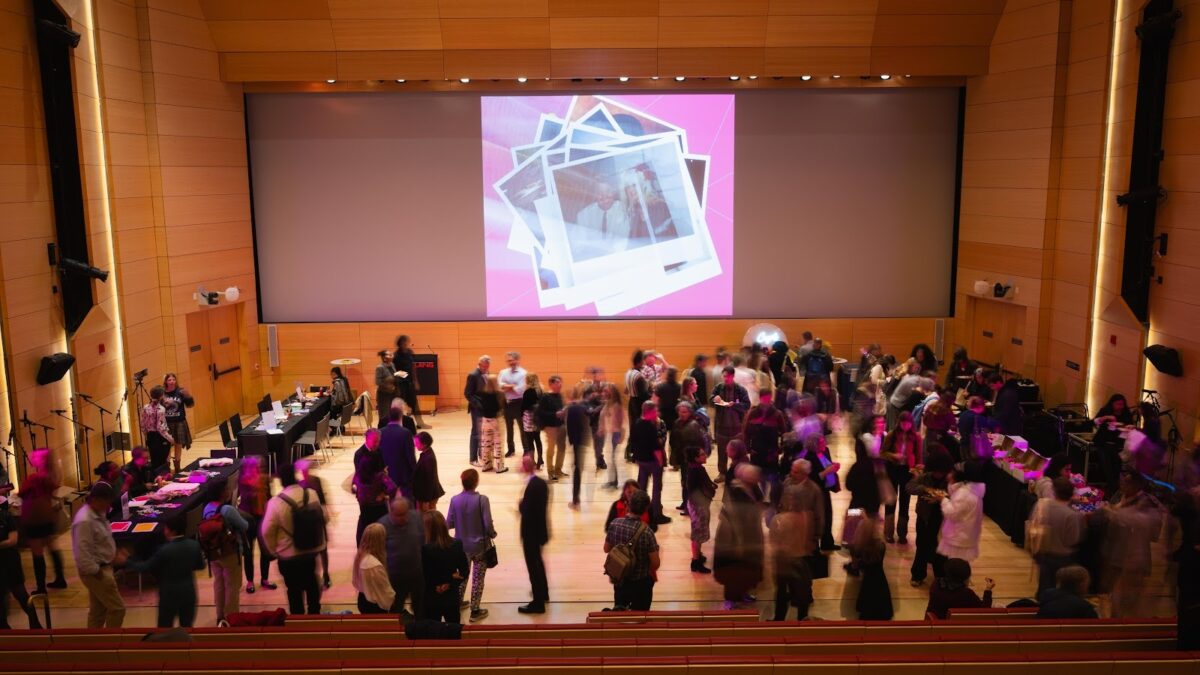
Photo by Dove Williams
Dean Christoph Cox envisions this remerging of disciplines in Lang’s near future.
“What I predict is that we’re going to kind of go back to the future, the founding vision of The New School, in which these things were all meshed together. Art, design, liberal arts, you know, social research,” he said. “The version of Lang in, you know, 2035 is going to look like a much tighter connection of those things … I think we’re working to become one university more than we have been over the last, say, 20 years.”
During the ceremony and reception, the conversation about Lang’s future continued to unfold as attendees moved from the UC lobby to Tishman Auditorium. A cassette tape recording of the dedication of Lang, spoken by Eugene Lang (1919-2017) himself, was played alongside subtitles on the projector screen to initiate the ceremony. Several short speeches were given by student researcher Sonny Caterini, Dean Cox, and Grace Lang — alum and granddaughter of Eugene Lang — and a video of current students and alumni was played.
“The primary purpose of this exhibit is to imagine Lang’s future by looking at its past for guidance,” Caterini said. Grace Lang encouraged people to write down their “hopes and dreams” for The New School on slips of paper, a part of the exhibition proposed by Larrimore.
The 40th anniversary of Lang has come at a time where liberal arts education is being targeted under the Trump administration.
“Donald Trump is Donald Trump. So we really don’t know what he’s going to do in the next year,” said Larrimore. “The main way they were affected by Donald Trump is that he’s making the United States a place that no sane person from another country would want to study in. That doesn’t affect Lang directly because we don’t have that many international students, but we’re part of this larger New School, which is very international.”
Rose, on the other hand, spoke to a feeling of security at The New School during this time.
“We exist in a really awesome bubble at Lang, where we know we’re in a safe community where ideas and values are shared and it might not be so safe in other places. Especially under this current administration, there’s been a lot of suppression of free thinking, suppression of ideas. I just think it’s critical more than ever to have a space like this.”
As attendees mingled on the auditorium stage, that sense of safety lingered. Alumni reconnected with faculty and spoke with current students, and optimism radiated.
“All the really big turning points in The New School came as a surprise to everybody. Like when The New School merged with Parsons in 1970, nobody knew that was coming,” Larrimore said. “And now that gives us this amazing set of unique possibilities that nobody quite planned. So if we know anything from the past, it would be that something will happen. And it will catch a lot of us by surprise.”



Leave a Reply