
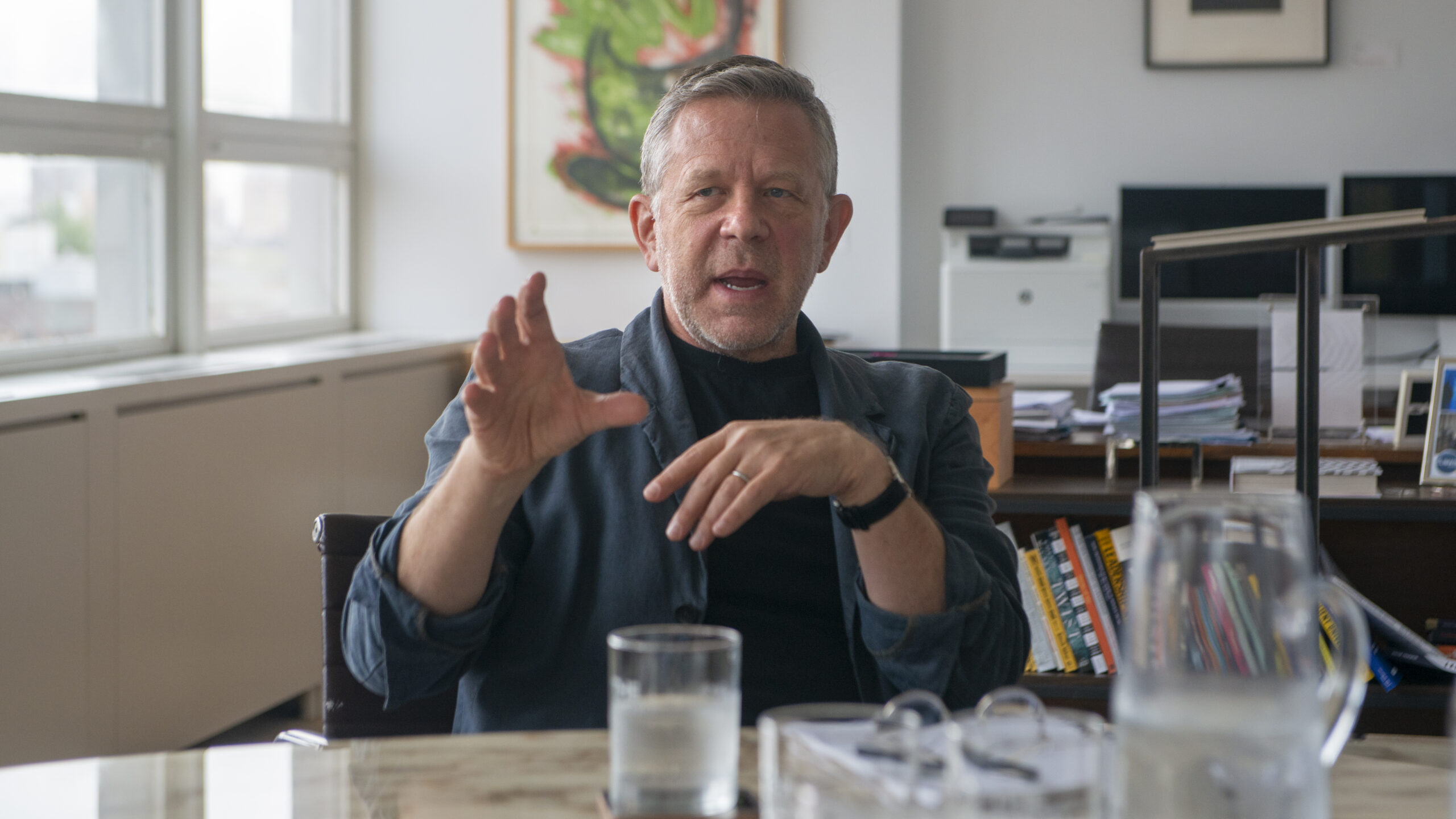
The New School faces a turning point, University President Joel Towers told the New School Free Press.
Looking to overcome years-long financial loss and enrollment decline, the school aims to decide the early stages of a plan for its future by December. Administration said no idea is off the table. The most recent proposals could reshape The New School.
The decisions will be largely informed by Summer Working Groups, a collective of over a hundred faculty and staff who brainstormed solutions this summer.
“It isn’t new what we’re proposing to do; what’s new is we’re actually doing it,” Towers said in a student presentation about the groups on Oct. 10.
The administration’s multi-year goal is to break even by 2028 and achieve a 4% operating surplus by 2030, according to the Financial Transparency Committee (FTC).
But the university also faces an increasingly difficult time for higher education in the United States: political headwinds, rising costs, and the lasting impact of the pandemic.
The New School Free Press sat down with Towers and administration on Oct. 13 to discuss how the school got to this point and where it’s headed.
Ongoing financial troubles and short-term fixes
About 85% of the university’s annual operating revenue comes from tuition and revenue from dining and residence halls.
A steady drop in enrollment and retention following the pandemic, overprojections of enrollment, and the university’s structure all fueled the operating deficit, administration said.
Between the colleges, only Parsons School of Design and Lang College of Liberal Arts operate at a surplus. Lang is expected to run a deficit within the next couple years, Towers said at the student presentation.
From 2012 to 2019, the university operated close to break-even, although there were concerns about generating revenue and the university’s future.
During the pandemic, the school had a $66 million deficit in 2021. Enrollment dropped by over 1,000 students and residence halls were empty, Vice President of Finance and Budget and Chief Financial Officer Loretta Ferrari said.
The following years were turbulent. The university had surpluses in 2022 and 2023. But in 2024, it operated at a loss of $30 million, and in 2025, $34 million.
In February 2025, Moody’s Ratings reaffirmed the New School’s rating of A3. That rating indicates a low credit risk for the university’s $605 million debt in the long term. But the school’s long term outlook was revised from stable to negative for the first time since 2021.
The outlook acknowledged potential for modest improvement, the statement said. “However, the inability to grow enrollment in fall 2025 could limit prospects for further improvement in fiscal 2026 and further constrain financial flexibility.”
Now, the university is projecting a $38 million deficit for fiscal year 2026, according to the FTC.
This semester, the university saw the lowest number of degree-seeking students in a decade: 8,900 students. Enrolling just 500 fewer students than projected contributed $15 million to this year’s deficit, according to the FTC.
“The $30 million is genuinely a crisis,” Towers said, “and its repeating nature over the last three years indicates something is just out of balance in our structure, and we can’t continue.”
The university has confirmed all their internal financial data with the consultancy Huron, with whom the university controversially worked in the past.
Towers said it isn’t enough to pay-off a year’s deficit with a one-time payment. The school’s financial troubles are structural and long term.
The university also can’t rely on its $500 million endowment. 40% is permanently restricted. Additionally, only $20 million can be spent per year, according to the FTC. Currently, that goes to scholarships and donor-specific programs.
A number of university-wide, cost-saving strategies have already been implemented within the last year, including a space analysis, zero-based budgeting, a staff hiring freeze, and cutting courses with low enrollment.
Last summer, The New School sold the president’s townhouse, providing cash to offset the university’s losses and eliminating a $250,000 annual maintenance cost for the house.
The dorms operate at a loss. Still, a new first-year housing requirement, earlier dorm application timelines, and an increase in students staying in dorms led to a 96% occupation rate this fall. Last year’s 80% occupancy lost the school $10 million.
There have also been efforts to grow enrollment through increased outreach to high school students domestically and internationally, according to an emailed comment from Merrie Snead, associate director of communications.
Admissions is expanding The New School’s partnership with the Center for Military-Affiliated Students and is looking to attract students from newer geographic areas such as Latin America and Africa.
But these strategies are not enough, administration said. Major structural change is needed. Transformation, administration told NSFP, means survival.
A ‘two college model’ and other recommendations
For 10 weeks, 103 faculty and staff in the Summer Working Groups produced recommendations. They range from ways the university can market itself better to a total restructuring of the school.
The proposals were presented to staff, faculty, and students in separate presentations at the end of September and early October.
The proposals are now at the “community engagement and disciplined implementation planning” phase, according to the financial transparency committee.
Simultaneously, Assistant Provost Prisca Wood is moving them into the “action plans and timelines” phase, according to an email to faculty and staff on Oct. 15.
“All of that needs to be done with pretty real clarity by December, and I would argue, closer to November,” Towers said. The Board of Trustees meets in December and the university needs a plan for the fiscal year 2027 budget.
The recommendations from the group were striking, but many have been suggested by the community over the years. The university first asked for proposals to aid its financial troubles in spring 2023.
“[The efforts] are not controversial. It’s actually stuff we needed to do,” Towers said at the student presentation.
A headline recommendation of the Academic Working Group is to consolidate the colleges into two: Lang and the New School for Social Research; the College of Performing Arts (CoPA) and Parsons. The idea was originally Towers’.
Many questions, like retaining identity and organizing governance, still remain, administration said.
The university has a history of reorganization. Parsons joined The New School in 1970, for example. Mannes School of Music joined The New School in 1989. In 2017, The New School weighed merging with another university.
Richard Kessler, provost and executive vice president for academic affairs, said Parsons and CoPA are usually distant, despite overdue potential to merge and successful collaborations in the past. But the partnership could be closer, administration said.
“We will break down the structures that are inhibiting this work and enable us maybe to get back to … 10,000 students,” Kessler said.
The school also received proposals to strengthen and expand on existing programs at Parsons, which consistently enrolls the most students. Plans to expand Parsons’ doctoral studies and the BA/BFA program aim to build on the reputation of the school.
The Space Working Group proposals looked to ensure space stays consolidated, optimized, and matching academic need, according to the presentation to students.
Other groups proposed ways to improve transparency in administrative decision-making and university data. They also focused on the school’s brand and recommended elevating names that draw people in.
The Finance Working Group modeled different enrollment scenarios and applied over 60 “levers” in order to create a budget that breaks even by 2028 and has a 4% surplus by 2030.
‘A kind of tipping point’
“I’m deeply convinced that this university will do the work necessary to create its future,” Towers said at the student presentation.
The university has repeatedly reinvented itself across its history. It’s reimagining itself again, in part, to match the times, administration said.
“I think a lot of people might look at this moment and sort of [say] … ‘Can’t you just make some incremental changes to the budget and we’ll get back to normal in a few years?’” Kessler said. “I think there is no normal in the foreseeable future.”
Considering the longstanding financial difficulties, Towers said the recent efforts are inspiring.
“I have 20 years of notebooks filled with sketches and ideas about the future of this university. The difference right now is that we’re actually going to enact these,” Towers said.
“Things build up to a kind of tipping point, and that’s where we are right now,” he said. “And it’s the most exciting thing, because we do know what we need to do … We have a team in place now that understands how to implement projects.”










Leave a Reply