
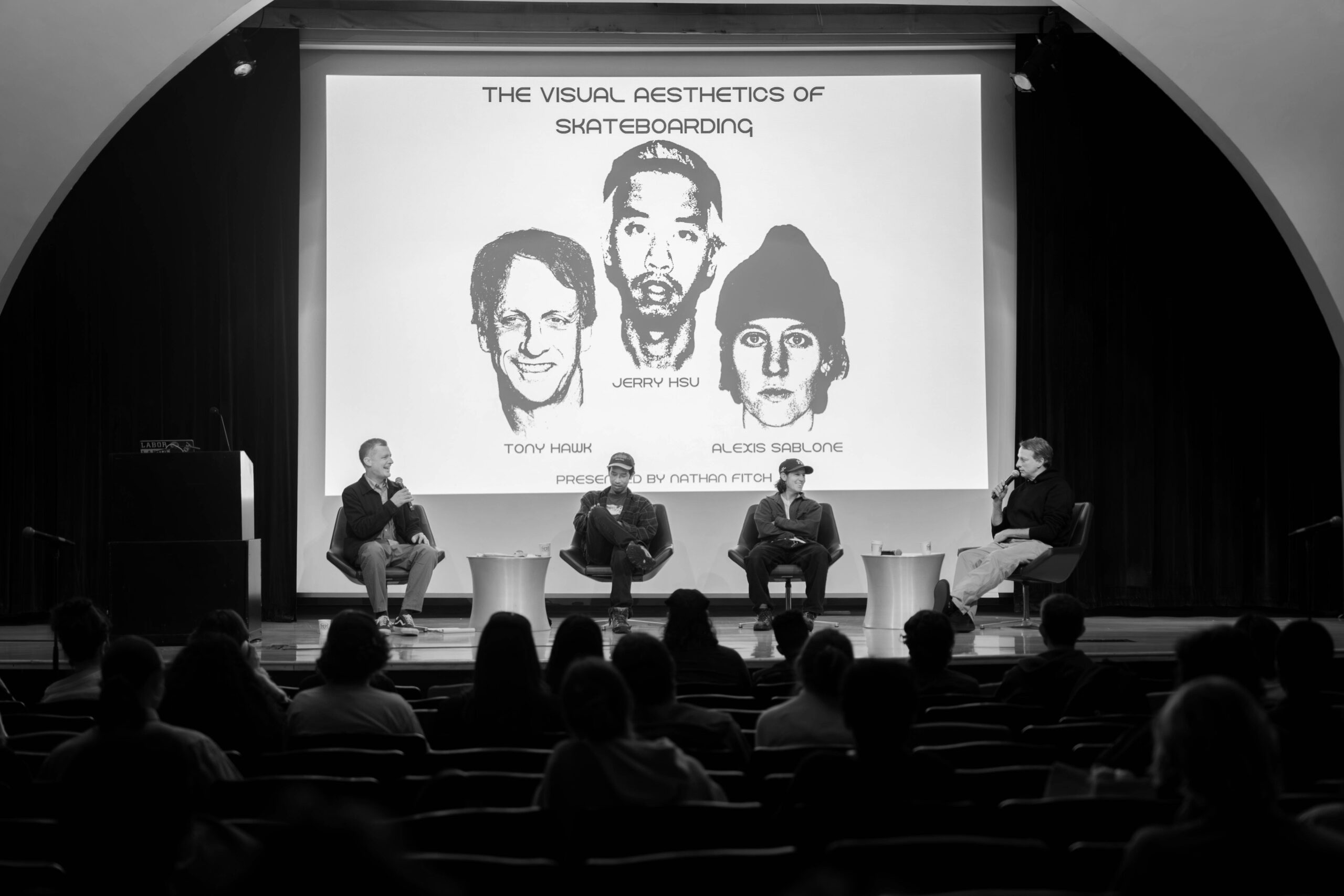
At any other university, a class called Aesthetics of Skateboard might sound unconventional. But at The New School, on Wednesday, Oct. 1, the auditorium in Alvin Johnson/J.M. Kaplan Hall was filled with students ready to hear legendary skaters Tony Hawk, Jerry Hsu, and Alexis Sablone discuss skating, creativity, and how passion turns into practice.
In true Lang fashion, the event blurred the line between classroom and culture, with a panel that felt as much about the creative process at large as it did about skateboarding.
The event was organized by screen studies professor Nathan Fitch, a filmmaker and skateboarder. The course examines how skate culture has influenced film, design, and visual language. It’s not just about the act of skating; it’s about how an underground movement evolved into a creative philosophy that shows up everywhere — from music videos to streetwear to the way people see motion itself. Courses like this represent a growing trend at Eugene Lang College of Liberal Arts: classes that treat subculture as both subject and method, inviting students to study creativity from the margins inward.
“This is such a New School opportunity,” screen studies student Anna-Sophia Kurtz said.
“I’m intending to go into the arts business, so it’s a good way to think about applying art and business skills to a talent you have,” Kurtz said.
Screen studies student Adina Alterman said she joined the course while researching the brand Supreme. “A lot of filmmaking tactics have stemmed from skate [and] DIY style, especially for independent filmmakers,” she said. “It’s so important to understand that at the root of all of it is being able to make stuff with no money, with your friends, with a video camera, and making it still valid.” The class shows how a subculture rooted in experimentation and collaboration mirrors the creative process that Lang students practice every day.
The panel discussion began with talking about early skate videos and how each guest found their visual voice. From there, it naturally shifted toward something broader: what happens when what you love becomes what you do for a living.
Sablone, who is also an architect and designer, said she is drawn to projects that push her beyond what she already knows. “If I can turn it into a project where I’m learning something new or in unfamiliar territory, that feels rewarding to me.” She mentioned wanting to design a chair and realizing she would have to learn to weld first — a reminder that the process of learning something new can be just as valuable, echoing the kind of curiosity familiar to many New School students.
Hawk, who has spent decades translating skateboarding into a global brand, offered a reminder to students that growth can’t just be about visibility. “Don’t make fame or fortune the goal,” he said. “The motivation has to be just to keep improving, not just at skating, but the creativity.” At a university where creative work is constantly being shared, graded, and posted, the idea of creating for creating’s sake is something to wrestle with.
From there, the discussion turned to community, the invisible glue that holds both skateboarding and the artistic world together. Hsu spoke about how skate culture has always been rooted in connection, both on and off the board. “One thing skateboarding has taught me to do was to go out into the world and experience a lot of different types of people,” Hsu said. “Find something in common with them.” In skating, a sense of community often forms in public spaces like parks or empty lots where people share ideas, teach each other, and create together.
She reminded students that they are already part of the kind of community most people spend years trying to find, noting the value of being surrounded by so many creative minds learning and thinking together.
That sense of community is exactly what makes a class like this valuable. It’s not just about learning to film or edit, or meeting legends of the skateboarding world, but about seeing how creative ideas move between individuals and disciplines.
If Aesthetics of Skateboarding sounds niche, that’s part of its charm. Lang has a history of courses that study culture from the edges — Rave Culture, How to Steal, Why Do Trans Women Make Awesome Music. When the New York Post ran a story on the Lang course, How to Steal, it criticized the class as proof that students were paying thousands for “weird electives.” What outsiders often miss is that these courses aren’t jokes — they’re experiments in how we learn. The How to Steal catalog puts it plainly: “This is not a course in petty crime — it is a study in moral ambiguity, radical ethics, and imaginative justice.”
At The New School, inspiration often comes from unexpected places. A class that seems random on paper can open up entirely new ways of understanding creativity. Lessons tend to stick when they come from unconventional experiences — experiences that make you actually want to show up to class. Courses like Aesthetics of Skateboarding remind students that learning doesn’t always have to follow tradition to be meaningful. Education can happen through community, experimentation, and play, which are often where the best ideas begin.






Leave a Reply