
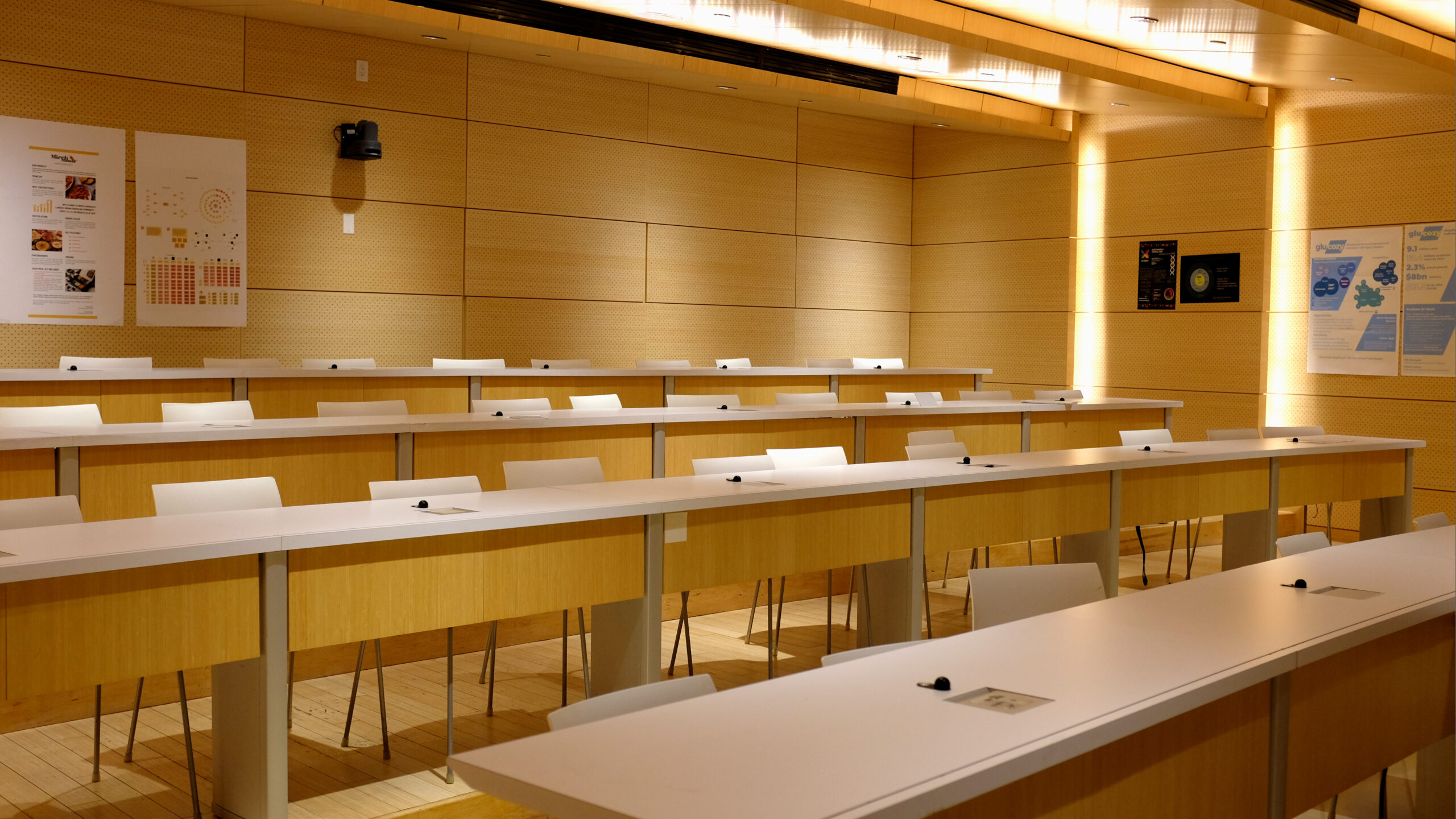
Nine students filed into the first session for Green Capitalism vs. Degrowth on Aug. 27 and sat in anticipation for 30 minutes for their professor to arrive until one student reached out via text. Had the student not reached out, they might have waited much longer, considering the professor was not only off-campus, but in Hong Kong on sabbatical.
Due to administrative error, the course had been listed on the roster and given a designated classroom when, in reality, no professor was teaching that course this semester.
Students later received an email from Urban Studies and Environmental Studies Chair, Jurgen von Mahs, apologizing for the chaos. He said, “There has been some miscommunication in course scheduling,” and suggested alternative courses to fill the elective requirement for the Environmental Studies social science concentration and other requirements for the Urban Studies track.
Von Mahs signed off, “We apologize for this blunder and hope you all find a satisfying alternative and wish you all a successful and rewarding semester!” Students had six days to figure out their new schedule before the add/drop period closed on Sept. 9.
Several other cases of last minute course cancellations occurred on campus at the start of the semester.
Valia Martinez, a second-year theatre student at Eugene Lang College of Liberal Arts, received a similar communication from The New School after a class was canceled prior to the first session.
Two of second-year graduate student Paige Roller’s courses were canceled the week before they were meant to start — one of which she planned to be a TA for.
“The university aims to avoid as much as possible cancelling courses after they have begun and this typically only occurs in exceptional circumstances,” Merrie Snead, associate director of communications, said in an emailed statement.
“Factors that may lead to course cancellation include faculty availability (when no faculty member is available to replace the instructor, or when the timing of the semester does not support hiring a new instructor), low enrollment, or other considerations,” she said.
According to Snead, degree requirements are reviewed yearly, and planning for the upcoming academic year’s roster begins in the preceding November.
Full-time faculty received assignments for both spring and fall 2025 semester classes on Dec. 2024, according to documents obtained from Parsons School of Design administration.
Part-time faculty makes up 87% of teaching staff, and they discuss tentative fall semester assignments in March and April directly before course registration opens; but they are not guaranteed until the summer.
The part-time faculty are appointed on a specific schedule which begins in June prior to the fall semester due to a provision in their collective bargaining agreement.
Roller said the school should follow up with students affected by sudden course cancellations, and offer them more support after the fact.
“I am still technically a substitute teacher and I wasn’t planning on doing that this year, because it is kind of exhausting… and I’m doing my classes in the evenings,” Roller said. Without the TA job, she said she’s struggled looking for other employment as well as finding a new class.
Martinez said the add/drop period should be longer so students have time to work out their schedule and get into the swing of things.
Most degrees require credits from several different categories of electives. The courses that fall under that category are listed individually as course codes on Degreeworks. In order to register for electives in the liberal arts requirement, the registration portal demands students search up each course individually, as it doesn’t have a filtering system for electives under specific degree requirements. There are 93 eligible courses under the Liberal Arts Elective requirement. This semester, 17 of them are being held.
“Elective courses, which may not be offered every semester, are subject to availability. For this reason, students are encouraged to approach electives with flexibility and use them as opportunities to explore a broader range of subjects across the catalog,” Snead said.
Mimansaa Rao, a second-year product design student at Parsons, said “I was searching for, like, minor classes and like half of the classes… I searched them on [the] course catalogue [for the upcoming semester] and they weren’t there… So I was like ‘wait, is the class like, is it like discontinued forever or is it just this semester?’”
Rao said course registration was chaotic and the online system to be unconducive to schedule optimization, although advising was helpful when she reached out.
“It was definitely a hurdle,” Rao said.
“It was really hard for me to navigate which electives we need to take, and if you have to take program electives or liberal electives,” Rao said. “I reached out to some advisors to help out with the situation, but even after that sometimes it confuses me.”









Leave a Reply