
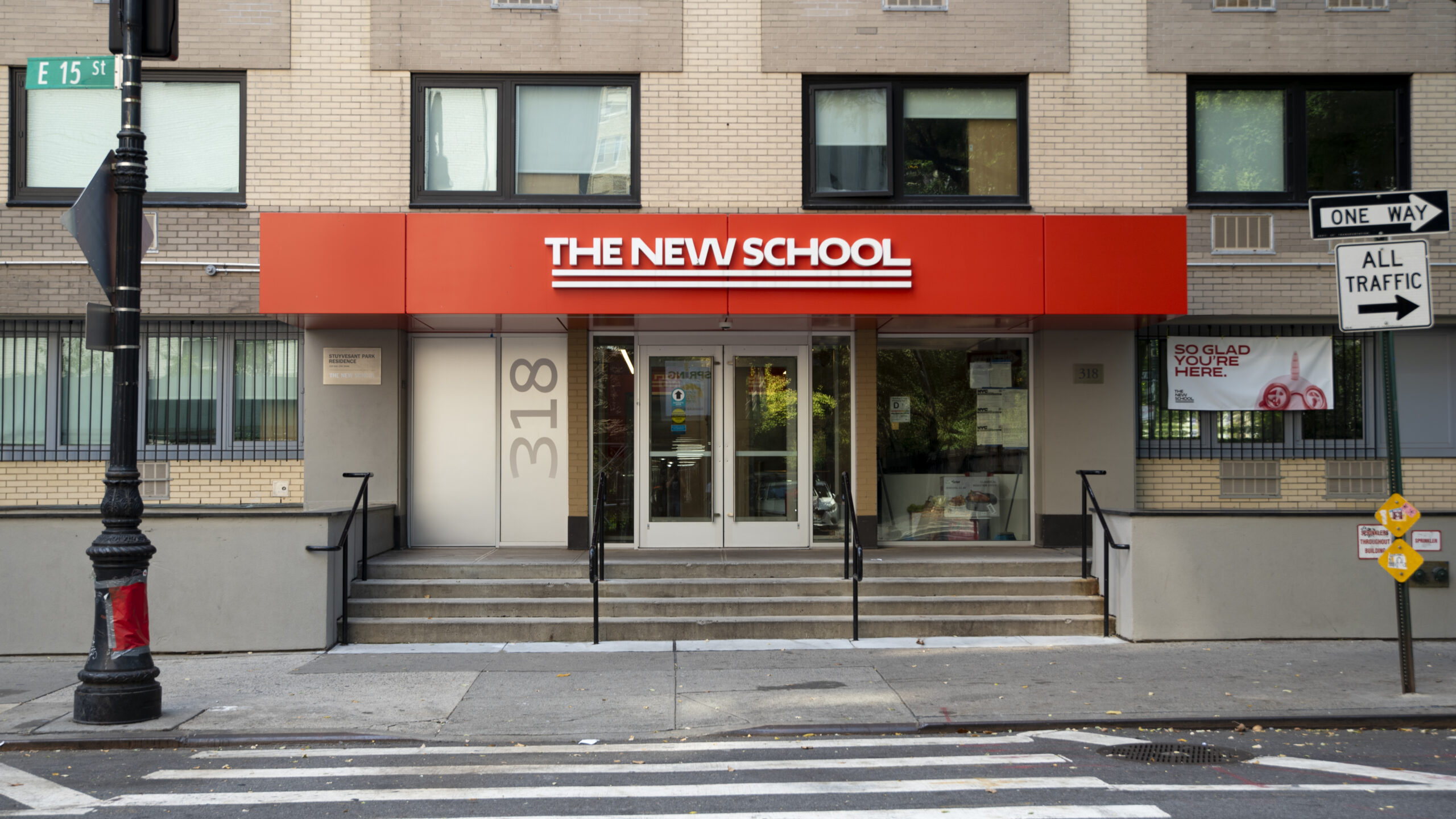
The New School agreed to let resident assistants (RAs) vote on unionization, but the proposal delivered in May excludes other residential education workers who perform similar duties, while maintaining all other student workers remain nonunionized.
This decision comes after a two-year effort to secure wall-to-wall union representation for all student workers. The New Student Workers Union (NewSWU) first began organizing for union representation for all campus student workers in May 2023.
“The university offered us a unit that includes only resident assistants, which makes up a fraction of the unit that we asked for,” Isabelle Fessler said, a graduate resident advisor (GRA) who serves on the NewSWU organizing committee.
Currently, only academic student workers are unionized under Student Employees at The New School (SENS-UAW). Students who work front-facing roles in administration offices, libraries, as technicians at university shops, and other non-academic jobs across campus have been organizing under NewSWU but do not yet have collective bargaining rights because the university has not recognized their union.
In August 2023, NewSWU filed a petition with the National Labor Relations Board (NLRB) to have non-academic student workers join the union representing academic workers, SENS-UAW.
NewSWU withdrew the petition in March based on advice from legal counsel to avoid potential rejection by Trump’s NLRB. NewSWU is pursuing voluntary recognition from the university as an alternative pathway to unionization, but the school only extended recognition to RAs.
“Given that you change job titles so frequently, that doesn’t actually give our RAs any protection, because if you give us a unit that includes only resident assistants, and then you go back to calling them resident advisors, where does that leave us?” Fessler said, commenting on the school changing student job titles.
NewSWU found the university’s limited RA-only proposal unsatisfactory. Kerrey Hall RA and sociology master’s student Drew Spiller argued that, at a minimum, all workers under Student Success, which includes the entire residential education department, should be included in the bargaining unit.
The university has not provided a counter-proposal to NewSWU’s initial response.
The New School’s offer came after RAs participated in a work stoppage on April 27, Admitted Students Day, last spring. They refused to perform duties without appropriate compensation and union representation.
According to an Instagram post shared by NewSWU, a supermajority of resident and community assistants signed the strike pledge leading up to the work stoppage.
Spiller said the union offer arrived on May 29, about a month after the work stoppage.
In a statement to the New School Free Press, Amy Malsin, vice president of university communications, said the university “fully support[s] the opportunity for resident assistants to decide for themselves whether they want to unionize through a private election agreement,” also adding that “joining a union is a serious matter of personal choice for eligible individuals.”
Organizers say unionization would address long-standing concerns about pay, working conditions, and safety protocols. Residential education workers are classified as first responders but receive limited crisis training and face restrictions that complicate emergency response.
The union negotiations came about alongside unusual delays in worker contracts this fall. Both RAs and GRAs typically receive agreements in April or May, but this year’s contracts did not arrive until Sept. 26, nearly two months into the fall semester after classes began.
According to Spiller, RAs learned at orientation in May that contracts were delayed. “[We] learned that the contracts were not ready yet, that they needed some more time, that legal was looking things over,” he said.
But when the contracts finally arrived, GRAs received a contract with a line not included in the one for RAs. Graduate resident advisor agreements included a clause stating workers “understand that this agreement does not create an employment relationship,” while RA contracts contained no such language.
Spiller noted the clause appeared deliberately placed to obscure it. “It’s hidden in a very sly spot, because it looks exactly like the same place in the RA contract, except that one sentence is added,” he said.
According to Spiller, residential education leadership opposed the clause. “The people of res ed, like the higher ups, were very adamant that that should not be in the contract,” he said, pointing out that the clause in the contracts feels like a union busting technique because it could be argued that, without a formal employment relationship, GRAs would not be able to unionize.
Despite not being unionized, residential workers received some wins from organizing. RAs saw a $1,000 increase in their stipend this year.
At RA orientation in May, a staff member acknowledged the raise was partly in response to organizing efforts, according to Spiller.
“There were some already-proposed changes for this, but they made particular attention to the kind of union development and struggle the RAs had been … undertaking for the past couple years,” Spiller said.
But recognition is still far away for organizers. Throughout the negotiation process, workers described the administration’s approach as evasive. According to an Instagram post shared by NewSWU, university leadership walked out of a meeting and “put in no effort in ending the meeting on good terms.”
On Sept. 25, union organizers met with administration to discuss expanding the bargaining unit beyond RAs. Spiller said the university requested additional documentation to justify including other positions, despite administration already putting the jobs under Student Success.
“They wanted job titles, descriptions, how this all connects with each other, despite admin already putting all these jobs under Student Success in the first place,” he said.
The negotiations continue as residential education workers push for comprehensive union representation. With RAs now eligible to vote on unionization while their colleagues remain excluded, the outcome will determine whether The New School expands collective bargaining rights across its student workforce.
“They didn’t give us a counter,” Fessler said. “They just said, ‘No, we only want to include RAs,’ and that’s where we’re at.”










Leave a Reply